The Castle can be visited
CastleMachern - Püchau
Püchau Castle
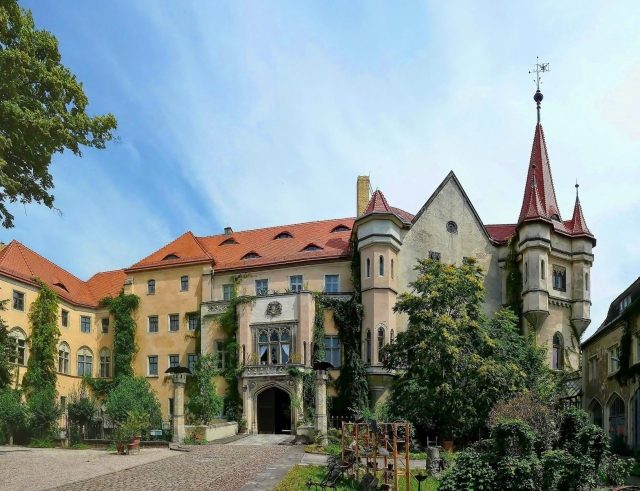
Püchau Castle, located between Wurzen and Eilenburg, is unlike many other castles in Saxony. Towers and balustrades characterize its unique appearance.
In Püchau, on a steep-sided promontory at the edge of the Mulde floodplains, stands one of the most significant historic castle buildings in the Leipzig area. The mountain spur has attracted fortifications since ancient times. As early as 924, there was a burgward here, where King Henry I found refuge from Hungarian horsemen. This makes "Bichni" older than Meißen.
In 1040, Emperor Henry III confirmed the ownership of Püchau Castle to the Diocese of Meißen. In the course of establishing the episcopal-Meißen territorial rule, the castle remained a military stronghold for the bishops, alongside Wurzen Castle, until the Reformation. With its integration into Saxon territory, however, it lost its military significance and was converted into a palace.
The castle stands out due to its size and the Windsor architecture, which is unusual in Saxony. The oldest parts of the castle are located in the two lower areas of the east and south wings and date back to the Renaissance period. On the ground floor, there are still rooms with beamed ceilings from the 16th and 17th centuries.
After Püchau came into the possession of the Counts of Bünau through marriage in 1667, the castle remained in the hands of one family through inheritance. The transfer of the castle to the von Hohenthal family occurred solely due to the lack of a male heir. The von Hohenthal family descends from the Leipzig merchant Peter Hohmann, whom the Emperor ennobled in Vienna in 1717. His descendants also received the title of Count in 1790. Püchau belonged to the Counts of Hohenthal, who, with 14 knightly estates, were among the largest landowners in Saxony, until their expropriation and expulsion by the communists in 1945.
The castle underwent a comprehensive redesign at the beginning of the 19th century, which gave it a distinct castle-like character once again. From 1875-88, Constantin Lipsius altered the castle again in the Neo-Gothic style.
Unfortunately, Püchau Castle is in great need of renovation. Nevertheless, it is worth visiting the castle with its magnificent facade and numerous towers. Inside, the Picture Hall, Marble Hall, and Heraldic Hall invite visitors for a tour. Various rooms can be rented for celebrations.
Furthermore, the castle park, located at the foot of the castle and picturesquely embedded in the Mulde floodplains, offers extensive opportunities for recreation. Originally, in addition to the ornamental gardens on the castle terrace, there was a baroque pleasure garden. Between 1833 and 1835, the grounds were considerably expanded to the northwest and laid out as an English park. The grounds in Muskau, Wörlitz, and Weimar served as models at that time. After correspondence between Count Carl Friedrich Anton von Hohenthal and the Muskau garden inspector Rehder, the lord of the castle engaged a gardener from the Muskau school to design the landscape park. During the time of gardener Döring, many design changes, such as the draining of swamps, were carried out.
Redesigns and extensive planting work took place between 1867 and 1869 under the direction of the castle gardener Hetzinger. The park largely acquired its present form during this period. The existing stock of exotic woody plants, such as cucumber magnolia, trumpet tree, tulip tree, and numerous rhododendrons, also dates from this time.
Take Mobile History with you
You are reading this text for free. Premium adds what matters on the road: descriptions read aloud, sites found through your camera, whole regions taken offline.
- Every description, including the ~17,700 Premium sites
- Audio guide: have descriptions read to you on location
- AR finder: see sites through your camera, with distance and bearing
- Unlimited saved sites
14 days free, then from €2.99 a month. Cancel anytime.
Source: Wikipedia · Licence: CC BY-SA 4.0 · Image: Thomas Eichler
This description draws on the facts documented in the linked Wikipedia article; Wikipedia content is licensed under CC BY-SA 4.0. Wording and editing: Mobile History.
Location: 51.4001, 12.6524