To be privately owned
CastleBruck an der Leitha
Prugg Castle
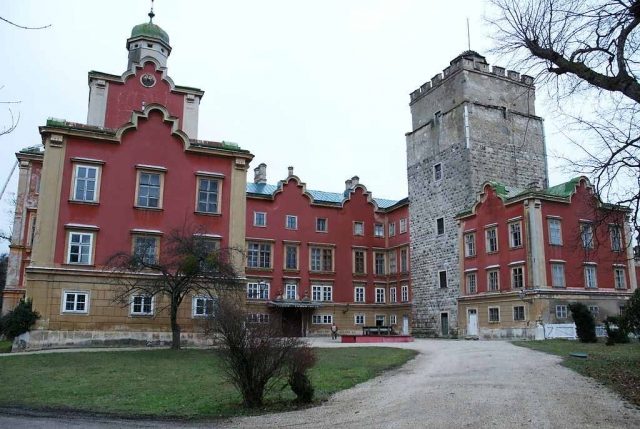
Prugg Castle is a city castle in Bruck an der Leitha in Lower Austria. The castle, privately owned by the Harrach family, along with its park and outbuildings, forms its own cadastral community of Bruck. The castle is not freely accessible, while the park is public.
The castle was originally built as a fortress for protection against recurring Hungarian invasions. The area belonged to a donation from 1074 by King Henry IV to the Bishop of Freising. The name Ascherichsbrugge came from Bishop Ascherich, who headed the Archdiocese of Gran around the year 1000.
After several changes of ownership, the town and the lordship fell to the Babenbergs in 1236. The former moated castle was first mentioned in a document in 1242. In the immediate vicinity is a bridge over the Leitha, which was important even under the Romans and formed the imperial border. Therefore, the border castle had great military significance and was never enfeoffed in the Middle Ages. Only in urgent need of money was it briefly pledged. These included, for example, the Kuenringer.
The castle always withstood attacks. Only in 1484 did it have to be abandoned due to lack of provisions after a six-week siege by the Hungarians. But by 1490 it was again in the possession of Maximilian I. During the First Turkish Siege against Sultan Süleyman, it had to be abandoned again.
In 1560, the town and castle were pledged to Baron Leonhard IV von Harrach, who was also already the owner of the neighboring Rohrau. In the course of the Thirty Years' War, it passed completely into the ownership of Imperial Count Carl von Harrach. Thanks to a letter of protection from Kara Mustafa Pasha, the castle was spared during the Second Turkish Siege in 1683.
After the Turkish Wars, the castle was completely rebuilt into a palace. From 1707-1711, Aloys Thomas Raimund Graf Harrach, Land Marshal in Lower Austria, had the older castle in Bruck an der Leitha completely rebuilt by the architect Johann Lucas von Hildebrandt. The artists who worked with Hildebrandt were the sculptors Johann Bendl, Giovanni Battista Passerini from the imperial quarry, Giovanni Stanetti and Joseph Kracker, the stucco artists Alberto Camesina and Santino Bussi, the fresco painter Bartolomeo Altomonte. Large commissions for the stonemason brotherhood in Kaisersteinbruch are documented.
Correspondence of the Count with his valet Koch Friedrich
Your Most Serene Excellency, High-born Imperial Count .... I report that on the 30th of last month, according to Your Excellency's command, I departed for Bruck, and immediately thereafter began to brick up the foundations for the New Stock, with which I hope to be finished this week. For this purpose, I will also hastily pick up Jean Luca (Hildebrandt) this week for further continuation, .... I also wanted to keep 12 masons at the New Building, but this is not possible, as I calculate up to 500 bricks to be processed per person, and the deliveries to supply them to me are sufficient. The imperial stonemasons are greatly delaying me with the roofing of the front gate, so that the sculptor cannot place his statues, to whom I send almost daily.
High-born Imperial Count, Your Excellency's gracious letter, dated May 30th, I have most obediently received and most obediently report that I was in Bruck yesterday with Jean Luca, who had the finished stones from Passerini placed on the gate, ... the lower floor should be raised within 12 days ...
Most obediently I report to Your Excellency how the New Building is being promoted quite well .... everything is ready, each window in its place, until placement, Passerini's stones are also finished, after the holidays, as soon as I or Jean Luca can come, they will be placed.
I, the undersigned, acknowledge that the remainder of 158 fl for my delivered stonemasonry work has been correctly paid to me by Mr. Johann Andreas Bertram. Battista Passerini
In the directory of stonemasonry work by Paul Kögl, here in Bruck an der Leitha, there is a reference to the Kaisersteinbruch spiral staircase in the castle building.
What was made and delivered by me, the undersigned, from hard Kaisersteinbruch stone for His Most Serene Excellency /:titl:/ Lord Count Alois Thomas Raimund von Harrach in His Castle in Bruck an der Leitha, as follows: Firstly, 4 large coping stones for the corners, each 15 fl - 60 fl, 325 feet 3 inches thick paving slabs in the horse stable, each foot 13 kr 70 fl 28 kr Sum - 130 fl 28 kr. Hans Georg Haresleben.
The interior was only completed in the 1730s. In 1789, the Baroque garden was transformed into an English park.
The castle was further expanded under Imperial Count Johann von Harrach in 1792. In the mid-19th century, the romantic gate and the neo-Gothic house of the park warden were built. From 1854 to 1858, the castle received its English Tudor style by the English architect Charles Buckton Lamb.
The park was maintained and cared for by up to 50 gardeners until the First World War. According to records, there were up to 6,000 different tree and plant species.
In 1945, the castle was heavily plundered. However, part of the furnishings could be recovered.
Prugg Castle is still in the family possession of the Harrach family.
Take Mobile History with you
You are reading this text for free. Premium adds what matters on the road: descriptions read aloud, sites found through your camera, whole regions taken offline.
- Every description, including the ~17,700 Premium sites
- Audio guide: have descriptions read to you on location
- AR finder: see sites through your camera, with distance and bearing
- Unlimited saved sites
14 days free, then from €2.99 a month. Cancel anytime.
Source: Wikipedia · Licence: CC BY-SA 4.0 · Image: http://commons.wikimedia.org/wiki/File:Schloss_prugg_bruck_an_der_leitha_frontside.jpg
This description draws on the facts documented in the linked Wikipedia article; Wikipedia content is licensed under CC BY-SA 4.0. Wording and editing: Mobile History.
Location: 48.0258, 16.7827