Museum
Educational Institution
CastleMauthausen
Pragstein Castle
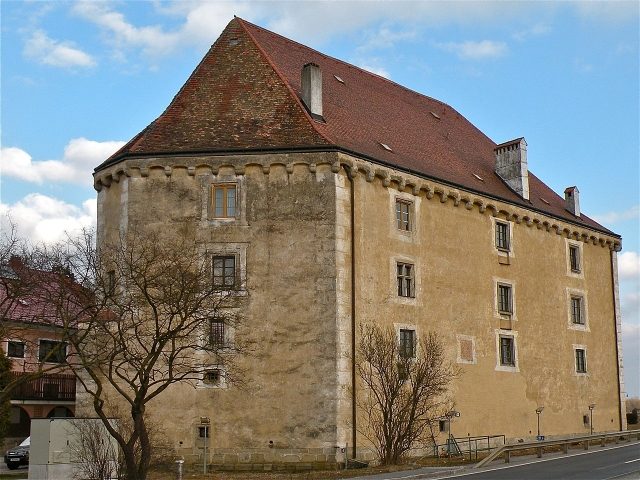
Pragstein Castle is a small castle in Mauthausen in Upper Austria and forms the motif of the Mauthausen market coat of arms.
The castle, extensively renovated at the end of the 20th century, houses the Mauthausen Local History Museum, a Pharmacy Museum (predominantly from the collection of Mauthausen pharmacist Norbert Aichberger), the Hans Gerstmayr Museum (steel engraving), and a hunting trophy collection, in addition to the Provincial Music School, the registry office, and several event rooms.
The castle was built on a rocky island in the Danube, upstream from the left bank. Access to the moated castle, surrounded by the Danube, was only possible via a suspension bridge. In the middle of the 19th century, the arm of the Danube that separated the castle from the mainland was filled in, and since the 1960s, the Danube Road B3 has run between the castle and the Danube.
The building is pointed on the west side. This broke the pressure on the castle during floods, and water and ice glided past it sideways. Pragstein Castle is a four-story, five-sided building, occupying a footprint of 19 by 35 meters. The exterior has changed several times; in earlier years, for example, turrets were attached to the corners. The central corridor contains the staircase. The castle has north and south gates. Flood level marks can be seen on the north gate of the castle, and the coat of arms of Laßla von Prag from 1507 is on the south side.
Owners+
The castle was built with the permission of Emperor Frederick III between 1491 and 1506 by Ladislaus Prager, the pledge holder of the Mauthausen dominion. After the death of Emperor Frederick, his successor, the Roman-German King Maximilian I, redeemed the pledge, but members of the Prager family were allowed to live there for many years afterward. In 1530, the complex was considered desolate but was renovated and occupied by mercenaries due to the Turkish threat. Afterward, the building was pledged several times and was again vacant in 1599. Georg Erasmus von Tschernembl modernized the building in 1603, and Emperor Ferdinand II handed it over to the imperial salt official Veit Spindler in 1612 and sold it to Leonhard Helfried von Meggau in 1633. In 1644, the property was inherited by the Cavriani family, who renewed numerous windows, doors, and floors. In 1770, Josef Gundaker Graf Thürheim bought the dominion. In 1894, the mayor of Mauthausen, Leopold Heindl, acquired the castle and sold it to the market town of Mauthausen in 1901. The local history museum has been housed there since 1910. In 1984, the Provincial Music School was opened there, and in 2007, the Pharmacy Museum was established.
Take Mobile History with you
You are reading this text for free. Premium adds what matters on the road: descriptions read aloud, sites found through your camera, whole regions taken offline.
- Every description, including the ~17,700 Premium sites
- Audio guide: have descriptions read to you on location
- AR finder: see sites through your camera, with distance and bearing
- Unlimited saved sites
14 days free, then from €2.99 a month. Cancel anytime.
Source: Wikipedia · Licence: CC BY-SA 4.0 · Image: http://commons.wikimedia.org/wiki/File:Mauthausen_Pragstein_SW.JPG?uselang=de
This description draws on the facts documented in the linked Wikipedia article; Wikipedia content is licensed under CC BY-SA 4.0. Wording and editing: Mobile History.
Location: 48.2405, 14.5155