Museum
CastlePöggstall
Pöggstall Castle
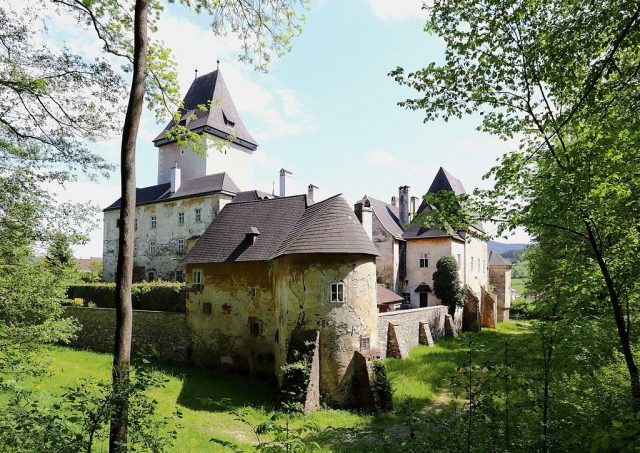
In 1218, a Heinricus de Pechstal is mentioned. He likely resided in a residential tower that was later demolished. In the foundation book of St. Bernhard, Otto II von Maissau appears as the owner of the lordship around 1240. Around this time, the first buildings of the current castle are believed to have been erected.
In 1291, the moated castle is said to have been destroyed during the noble uprising against Duke Albrecht I. In 1299, Ulrich von Maissau is verifiably documented. Even then, the regional court was connected to the sovereign's fief. Otto IV, the last Maissauer, transferred his Pöggstall property in 1433, with the approval of Duke Albrecht VI, to Georg and Christoph von Liechtenstein. The Liechtenstein family was followed by the Ebersdorf and in 1450 by the Viennese patrician family Holzer.
In 1457, King Ladislaus had Pöggstall Castle besieged by his captain Wilhelm Pebringer. The lordship was subsequently confiscated. In 1460, Emperor Friedrich III enfeoffed the son of the already deceased Konrad Holzer with Pöggstall again. In 1478, Kaspar I von Rogendorf acquired the lordship. Two years later, he had the St. Gilgen Chapel built right next to the castle as a castle church and burial site. After the construction of the rondel, the church was also included in the outer fortification ring. Pöggstall remained in the possession of his descendants until 1601. Under them, the castle acquired its present form. The castle became their free property and received the name Rogendorf. Furthermore, the regional court was also transferred to them.
Kaspar and Wilhelm were the last Rogendorfers in Pöggstall. In 1601, they sold the lordship to the Counts of Öttingen. They were followed in 1607 by the Wolzogen, who sold it in 1610 to the Lords of Sinzendorf. When the Sinzendorf family had to declare bankruptcy in 1747 due to their economic decline, the estate came into the possession of the Barons von Seldern in 1756. They were followed in 1772 by Josef Edler von Fürnberg. In 1795, Baron von Braun acquired the castle and sold it in the same year to the family fund of Emperor Franz I. In 1882, extensive renovations took place. In 1886, an imperial and royal district court was established in the castle. Until 1919, the lordship was in the possession of the Habsburgs. Afterwards, it was incorporated into the state war invalid fund. In 1975, the roof truss of the keep burned down and was renewed in the following years.
In 1986, the market town of Pöggstall acquired the castle from the Austrian Federal Forests. In 1999, the Renaissance paintings in the arcaded courtyard were protected by a glass roof. The rondel houses a legal history museum and a restaurant. In the main castle, a local history museum, a beekeeping museum, and a fairy tale museum display their exhibits.
Take Mobile History with you
You are reading this text for free. Premium adds what matters on the road: descriptions read aloud, sites found through your camera, whole regions taken offline.
- Every description, including the ~17,700 Premium sites
- Audio guide: have descriptions read to you on location
- AR finder: see sites through your camera, with distance and bearing
- Unlimited saved sites
14 days free, then from €2.99 a month. Cancel anytime.
Source: Wikipedia · Licence: CC BY-SA 4.0 · Image: https://commons.wikimedia.org/wiki/File:P%C3%B6ggstall_-_Schloss.JPG
This description draws on the facts documented in the linked Wikipedia article; Wikipedia content is licensed under CC BY-SA 4.0. Wording and editing: Mobile History.
Location: 48.3181, 15.1985