Uninhabited
CastlePlötzkau
Plötzkau Castle
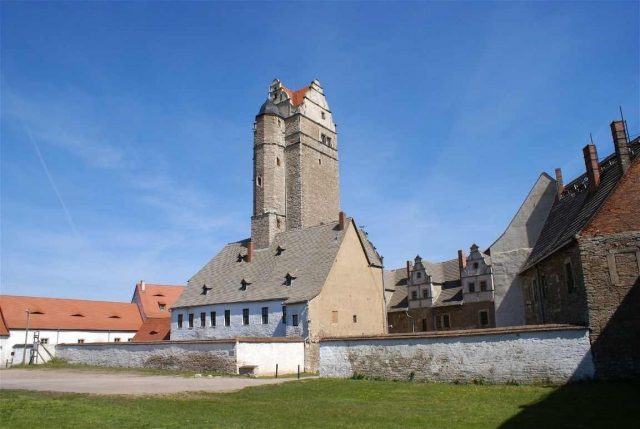
Plötzkau Castle in the town of Plötzkau (Saale-Wipper administrative district, Saxony-Anhalt) is a Renaissance castle on the site of a medieval count's castle. It became known primarily as the residence of Prince August of Anhalt, who made it the smallest sovereign state in the world (1611-1665).
The medieval circular castle was first mentioned in a document in 1049. Bernhard von Hecklingen is probably the first Count of Plötzkau. He founded a Benedictine monastery in nearby Kakelingen. It is assumed that the establishment of the county was related to the castle policy of Henry IV. His son Dietrich was documented as Count of Plötzkau. Helperich, Dietrich's son, received the Nordmark as a fief from Emperor Henry V in 1112. However, in the course of the uprisings of the Saxon nobility against Henry V, which ended in 1115 with the defeat of the emperor at the Battle of Welfesholz, he could not assert his claims. The family apparently remained closely connected to the imperial house, because Helperich's son, Konrad, was again enfeoffed with the Nordmark in 1130. Konrad could not enjoy his possessions for long, however, as he fell in 1133 during King Lothar I's Italian campaign. Konrad's brother Bernhard, the last Count of Plötzkau, died in the Second Crusade in 1147.
A bitter dispute over the inheritance of the Counts of Plötzkau erupted between Margrave Albrecht the Bear and the Saxon Duke Henry the Lion. In the struggle between the Ascanians and the Welfs, Archbishop Konrad of Magdeburg destroyed the castle in 1139. Ultimately, Albrecht prevailed. Later, Plötzkau came under the feudal lordship of the Gernrode Abbey. The Gernrode appointed the ministeriales from the families of Hoym and Freckleben as vassals. The ministerial family of Plötzkau possibly originated from one of these families.
In 1436, Prince Bernhard IV of Anhalt-Bernburg, after a settlement, took possession of Plötzkau as an expired fief. In the division of the country in 1554, the poor condition of the castle was mentioned, which necessitated a new building. To finance this, Prince Joachim waived the compensation payment of 74 guilders that Bernhard, Joachim Ernst, and Karl would have had to pay for the added value of Plötzkau. He even paid 1000 guilders for the construction in 1555/56.
From 1566 to 1573, Bernhard erected the Renaissance castle, which is still largely preserved today. Starting with the south wing, the east and north sides followed in the construction process, as well as the west front. Using the medieval keep, the tower was raised to seven stories. It received its hood with the four gables. The "Old House" by the tower remained and was only demolished in 1600. The following master builders are recorded: 1566 Bastian (from Dessau?), stonemason, Nickel from Alsleben stonemason, Wulf stonemason, 1567/68 Georg Schröter sculptor, 70s Christoph sculptor.
Of art-historical interest is the fireplace in the Prince's Hall, built by Georg Schröter. Its formal language shows close connections to Bernburg Castle.
In 1611, Prince August of Anhalt received the lordship of Plötzkau from the Principality of Anhalt-Bernburg as an amendment to the Anhalt inheritance division of 1606, and established his own princely line here (Principality of Anhalt-Plötzkau). In the following period, the castle buildings were altered in the Baroque style of the time. In 1665, the castle passed to the Bernburg-Harzgerode line and later, through inheritance, back to the Anhalt-Bernburg line. In 1720, Prince Karl Friedrich took over the government in Bernburg. His son Victor Friedrich resided at Plötzkau Castle. Further Baroque alterations were carried out. The interiors were luxuriously furnished. The moat was given a new function as a dog and deer moat. The economic use of the lordship was achieved by establishing a domain.
However, its use as a representative princely residence soon ended. As early as 1741, the establishment of a "Japanese factory" in the castle rooms was reported. From 1840 to 1874, the castle buildings were used as a penal and reformatory institution.
In the 19th century, the characteristic 21 gable dormers became increasingly damaged, one of which collapsed in 1833. Therefore, from 1865 to 1870, all gable dormers were thoroughly renovated and renewed for 4000 thalers.
After the dissolution of the penal institution, the castle was used by the domain administration. After 1945, refugees temporarily lived in the residential rooms. Later, the State Museum for Prehistory and Early History stored its depot here. This use lasted until 1992. Today, the castle is under the administration of the Foundation of Cathedrals and Castles in Saxony-Anhalt.
Take Mobile History with you
You are reading this text for free. Premium adds what matters on the road: descriptions read aloud, sites found through your camera, whole regions taken offline.
- Every description, including the ~17,700 Premium sites
- Audio guide: have descriptions read to you on location
- AR finder: see sites through your camera, with distance and bearing
- Unlimited saved sites
14 days free, then from €2.99 a month. Cancel anytime.
Source: Wikipedia · Licence: CC BY-SA 4.0 · Image: Roland Neubert, Halle (Saale)
This description draws on the facts documented in the linked Wikipedia article; Wikipedia content is licensed under CC BY-SA 4.0. Wording and editing: Mobile History.
Location: 51.7441, 11.6886