Uninhabited
CastlePlaue
Plaue Castle
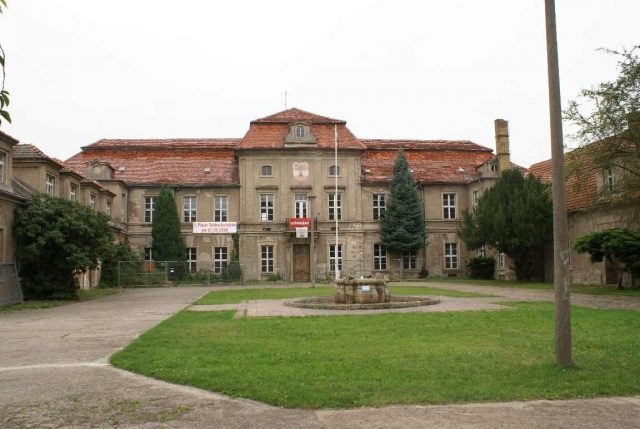
A fortified house in Plaue was first mentioned in a document from 1216. What the house looked like back then is completely unknown. The castle of Knight Johann (Hans) von Quitzow, formerly built on the same site, was captured in 1414 by Margrave Friedrich I and Archbishop Günther von Magdeburg during combat operations after a siege.
The so-called Quitzowburg was probably a structure flanked by two round towers and surrounded by a moat. During the conquest, the fortifications were partially destroyed, although they were considered impregnable with their brick ring wall fourteen feet wide (4.5 meters). According to the Magdeburg Schöppenchronik, the castle walls were so thick that one could drive a wagon on them.
A very large cannon, called the "Faule Grete" (Lazy Grete), is said to have proven wall-breaking. However, its existence has not yet been conclusively proven. After Georg von Waldenfels took over the castle in 1459, he refortified the partially dilapidated castle and enlarged the complex, incorporating the remaining ruins. This immediate predecessor of today's Baroque palace, surrounded by a moat and featuring its fortifications, presented the overall image of a typical 16th-century castle complex.
From 1711 to 1716, under Friedrich von Görne, the new three-wing complex was built using old foundations and parts of the rising masonry of the older complex. It differs from contemporary simpler manor houses and country estates in the Mark Brandenburg by its generous dimensions, which follow French models. The main building was two-story with two lower side wings. The high demands of the builder are also evidenced by the castle's own chapel, the spacious altan on the central risalit, and the "Chinese Room". Evidently, artistic inspirations from the most modern electoral building production, such as the Chinese fashion prevalent in Berlin, found their appeal in this aristocratic building project. The old castle tower was demolished in 1719.
During a visit, the Soldier King Friedrich Wilhelm I is said to have knighted his son Friedrich II here. The Russian Tsar Peter I also stayed here on one of his European journeys.
Under Leopold von Görne, in 1749, the pleasure garden was surrounded by a high wall, new hedges were planted, and a new orangery and greenhouse were erected, and the castle itself was "magnificently furnished."
Under the destructive spirit of Wilhelm von Anhalt (from 1765), the castle moat was filled in, the linden avenue leading to the castle was cut down, and the northern wing of the castle was demolished (only rebuilt in 1840). In addition, von Anhalt tried to erase all traces of his predecessor Görne. To this end, he sacrificed the remaining stocks of "Plauer Porcellan" at Plaue Castle, a ceramic that for a few years could compete with the famous Meissen porcelain and was produced in a Plaue manufactory.
In 1839, Hans Valentin Ferdinand Graf von Königsmarck acquired Plaue Castle and estate from Baron von Lauer-Münchhofen. The property remained in the hands of the Counts von Königsmarck, an old Marchian family first mentioned in a document in 1225, until 1945. In 1861, the castle was redesigned.
Plaue Castle was severely damaged in World War II. In 1945, Hans Guido Graf von Königsmarck (1902–1979) was dispossessed and expelled by the communists. Before the state of Brandenburg established an administrative school in the castle in April 1946, it was subjected to several looting incidents. In 1966, during the renovation of the building for the purpose of housing an institute for intensive language training, the exterior was greatly simplified. Decorative elements such as rusticated plasterwork, capitals, and coats of arms were removed, and the facades were covered with rough plaster. The interior was built over, and the furnishings, with the exception of a few stucco remnants, wood paneling, and old doors, were completely lost. Since the institute closed in 1993, the castle has stood unused and empty, despite a change of ownership in 2006.
Take Mobile History with you
You are reading this text for free. Premium adds what matters on the road: descriptions read aloud, sites found through your camera, whole regions taken offline.
- Every description, including the ~17,700 Premium sites
- Audio guide: have descriptions read to you on location
- AR finder: see sites through your camera, with distance and bearing
- Unlimited saved sites
14 days free, then from €2.99 a month. Cancel anytime.
Source: Wikipedia · Licence: CC BY-SA 4.0 · Image: Roland Neubert, Halle (Saale)
This description draws on the facts documented in the linked Wikipedia article; Wikipedia content is licensed under CC BY-SA 4.0. Wording and editing: Mobile History.
Location: 52.4078, 12.4214