Gallery
CastlePilsach
Pilsach Castle
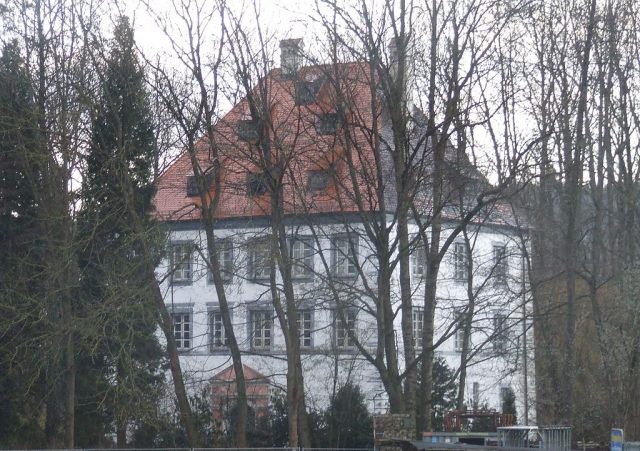
Pilsach Castle is a small moated castle in the municipality of Pilsach, north of Neumarkt in the Upper Palatinate. It is located on a small island in a pond fed by the Pilsach, a small stream that gave the castle and the town their name.
The castle was probably originally a medieval pond house, which was later expanded from a residential tower into a box-shaped building with a hip roof.
As early as the beginning of the 12th century, there was a manor in Pilsach, which was under the rule of the Freie von Wolfenstein. This castle stood on the summit of the Ottenberg, which rises immediately west of Pilsach. Only square rampart remains are preserved from this complex, which is now only preserved as a castle site.
The owners of the so-called "Lower Castle" from the 14th century to the 17th century were the Senfft von Pilsach. In 1632, the castle was burned down by Gustavus Adolphus's troops but was immediately rebuilt. In 1808, Margarete du Prel inherited the moated castle and brought it into her marriage with Baron Carl Ernst von Grießenbeck, an officer in royal Bavarian service. It remained in the family's possession until 1863, after which the castle constantly changed owners.
In 1919, the Höffner couple bought the moated castle and established a foal breeding farm. Klara Höffner was a writer and called herself Klara Hofer. During renovation work in 1924, a room was discovered on a mezzanine floor, which she interpreted as a secret dungeon. Hofer published her discovery in a newspaper and linked it to the assumption that Kaspar Hauser might have spent his traditional childhood without human contact in this room. She addressed the Kaspar Hauser myth in 1924 with the book "The Fate of a Soul. The Story of Kaspar Hauser with regard to the latest findings". Fritz Klee, an amateur researcher from Nuremberg, then visited the "dungeon", described it, and compared it with Kaspar Hauser's statements about his prison. However, there is no historical proof that Kaspar Hauser was held in Pilsach. After a staircase renovation in 1982, the current owners of the castle presented a small wooden, white hobbyhorse, which, according to an alleged dendrochronological examination, is said to date from around 1820. In contrast, the historian and archive director Reinhard Heydenreuter, who also publishes in scientific Hauser research, emphasizes in the article by journalist Ulrich Rach ("Kaspar Hauser was probably never imprisoned in Pilsach. Legend is over. Old documents in the state archive contradict common theses") in the Nürnberger Nachrichten of December 7, 1996, that a wooden horse associated with Kaspar Hauser does exist, "but the owners keep it under lock and key and do not allow it to be examined for its age."
Today, the castle houses a gallery with a focus on glass art.
Take Mobile History with you
You are reading this text for free. Premium adds what matters on the road: descriptions read aloud, sites found through your camera, whole regions taken offline.
- Every description, including the ~17,700 Premium sites
- Audio guide: have descriptions read to you on location
- AR finder: see sites through your camera, with distance and bearing
- Unlimited saved sites
14 days free, then from €2.99 a month. Cancel anytime.
Source: Wikipedia · Licence: CC BY-SA 4.0
This description draws on the facts documented in the linked Wikipedia article; Wikipedia content is licensed under CC BY-SA 4.0. Wording and editing: Mobile History.
Location: 49.3225, 11.5053