The Castle can be visited
Apartments
CastleLoreley-Braubach
Philippsburg Castle
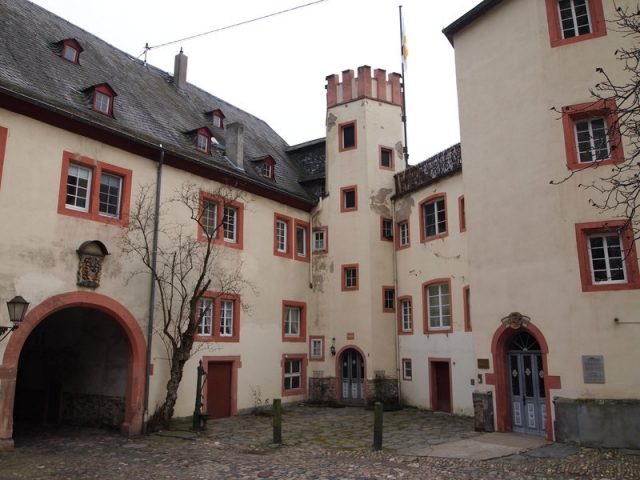
Philippsburg Castle is a castle complex on the southern outskirts of Braubach in Rhineland-Palatinate, which has housed the European Castle Institute since 1999. Due to numerous alterations, little of the original building fabric remains today. Only a stair tower on the western residential building and two gatehouses with half-timbered gables have been preserved. Nevertheless, this complex, in conjunction with the neighboring Marksburg, clearly illustrates the historical transformation of noble residences from medieval hilltop castles to early modern castles in valley locations.
Philippsburg Castle received its name from Landgrave Philipp II of Hesse-Rheinfels, who commissioned the complex as a new residence, as Marksburg no longer met the elevated noble living standards at that time and was therefore not suitable as a future widow's seat for his wife Anna Elisabeth of Palatinate-Simmern. The Hessian master builder Anton Dauer was responsible for the construction work between 1568 and 1571, thus erecting the first Renaissance castle on the Middle Rhine.
Incorporating Braubach's medieval city fortifications, a three-story main house with a show facade facing the Rhine was built, protected by an outer fortification consisting of two round towers and a curtain wall with loopholes. A further wing adjoined it to the southeast, while utility buildings stood to the northeast of the main house.
After her husband's death, Landgravine Anna Elisabeth inhabited the complex from 1583 to 1602. She was followed by Landgrave Johann the Belligerent, who used Philippsburg Castle as his residence from 1643 to 1651.
After his death in 1651, it remained largely uninhabited and fell into disrepair due to the loss of its residential function. From 1802, the castle was owned by the Duchy of Nassau, whose rulers had the dilapidated complex renovated in 1804/05. During this process, the steep roof with its dormers and their decorative gables, as well as the third floor of the residential building, had to be removed.
In the subsequent period, the castle was partly used as a district court.
The entrepreneur Johann Christian Heberlein bought the complex in 1822 and converted it into a hotel. During the construction work carried out for this purpose, the main building definitively lost its representative appearance and acquired its current rather modest exterior.
During the construction of the railway line on the right bank of the Rhine in 1861, additional parts of the southern outer bailey, including the so-called Muckenturm, as well as the fortification on the Rhine front, had to be demolished.
Since 1997, Philippsburg has belonged to the German Castle Association, which established the European Castle Institute with a castle research library there at the end of 1999, after further alterations in the so-called Hanika House. Apartments are now located in the former utility building. The castle's inner courtyard is freely accessible to visitors.
Take Mobile History with you
You are reading this text for free. Premium adds what matters on the road: descriptions read aloud, sites found through your camera, whole regions taken offline.
- Every description, including the ~17,700 Premium sites
- Audio guide: have descriptions read to you on location
- AR finder: see sites through your camera, with distance and bearing
- Unlimited saved sites
14 days free, then from €2.99 a month. Cancel anytime.
Source: Wikipedia · Licence: CC BY-SA 4.0 · Image: http://www.wehrbauten.de/thread.php?threadid=932
This description draws on the facts documented in the linked Wikipedia article; Wikipedia content is licensed under CC BY-SA 4.0. Wording and editing: Mobile History.
Location: 50.2701, 7.6481