To be privately owned
CastleMouret
Petite Riedera Castle (Mouret)
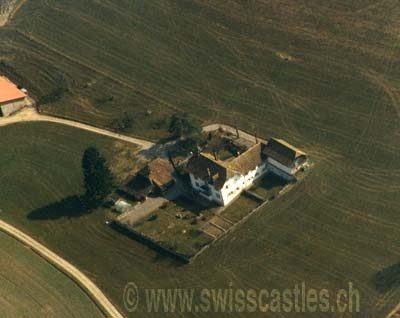
The area of Petite-Riedera is mentioned for the first time in a 14th-century document, in the archives of the Gottrau family at Léchelles Castle. This family - which had several branches - owned various lordships and numerous territories. The manor house was built in the 1580s for Marti Gottrau. The Gottrau von Billen branch inhabited Petite-Riedera until 1804. At that time, Tobie von Gottrau, the old bailiff, sold the property to Dom Augustine von Lestrange, the general abbot of La Trappe, a French refugee, prior of Valsainte. He had the old manor house converted into a convent for women.
In particular, he had a large outbuilding erected, visible in the watercolor (Inventory of Cultural Heritage of Buildings in the Canton of Fribourg, Aloys Lauper). The Trappistine sisters lived there from 1805 to 1815. These, forbidden in France at the time of the Revolution, lived in various places until they arrived in Switzerland. First in Villarvolard from 1802 to 1804. The Trappistines were then accepted by the Fribourg authorities in Riedera, on the condition of opening a school there. During the renovations and enlargement of Petite-Riedera, the sisters lived in Grande-Riedera. The work of Mother Marie of Trinidad Kervingant, The Nun in the Face of the French Revolution, provides some information about the time when Petite-Riedera was a convent. Madame de Staël found a "rather cold" reception there during her exile, and she thought the house was strict. A euphemism! About fifty people lived in the Riedera convent for ten years under very difficult conditions with an overly demanding leadership in discomfort and deprivation. Further details about the proselytizing zeal of Abbot von Lestrange - who worked for the establishment of the Trappistines in Riedera, even resorting to intrigue, and promoted schools in the Canton of Fribourg run by the Third Order of Trappistines - can be found in "The French Emigration in the Canton of Fribourg" by Tobie von Raemy (cf. Bibliography).
Petite-Riedera then became the property of Claude-Geist von Rigot, Marquis of Montjoux, and his wife Françoise-Catherine-Sabine von Agoult. They were French Royalists who had fled to Switzerland during the Revolution. This couple had also acquired the lower castle of Onnens in 1811. On May 25, 1838, the nephews and heirs of the Marquis of Montjoux, both residing in Rathières near Monestier de Clermont (Isère), sold Petite-Riedera to a Lyonnaise, Marie-Adelaide, the Countess of Poype. Her sister, who belonged to the Trappistines in Riedera, was buried there. Madame de Poype immediately gave the recently acquired property to the bishop of the diocese, reserving a right of use. She was also the founder of the Providence orphanage in Fribourg in 1841. Madame de Poype died on her property of St-Didier (Ain) in 1859 at the age of 84.
The area and Petite-Riedera have belonged to the Peiry family since 1859. Part of the large residence where this family lived served as a country house for the bishops of Lausanne, Geneva, and Fribourg since 1841. Mgr Besson turned the chapel, located inside the house, into a real museum. The statues were taken by the bishops. One can still admire in this chapel, under a ceiling, the precious but profane decoration, an altarpiece from 1586.
Take Mobile History with you
You are reading this text for free. Premium adds what matters on the road: descriptions read aloud, sites found through your camera, whole regions taken offline.
- Every description, including the ~17,700 Premium sites
- Audio guide: have descriptions read to you on location
- AR finder: see sites through your camera, with distance and bearing
- Unlimited saved sites
14 days free, then from €2.99 a month. Cancel anytime.
Source: Wikipedia · Licence: CC BY-SA 4.0
This description draws on the facts documented in the linked Wikipedia article; Wikipedia content is licensed under CC BY-SA 4.0. Wording and editing: Mobile History.
Location: 46.7319, 7.1718