To be privately owned
CastleBarberèche
Petit Vivy Castle (Barberêche)
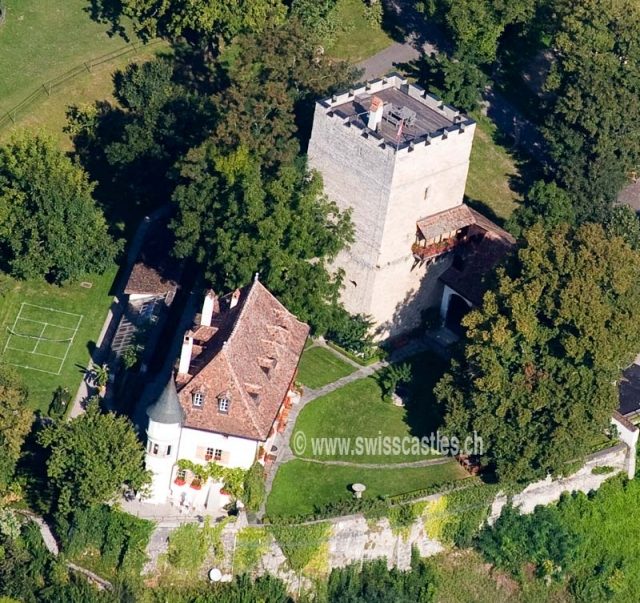
Through the agreement of 1293, the three Pont brothers received Petit-Vivy in undivided ownership and shared the rights of the lordship. The manor house was referred to there as "castrum de viver et turris", unlike the "Podest von Veteri Viver", the current Grand-Vivy castle. However, a division took place before 1363; at that time, the Vivy fortress became a fief of the Counts of Tierstein, and was entrusted to Wilhelm von Treyvaux. In 1378, Wilhelm sold the castle and its dependencies to Nicolas von Vuippens of Fribourg. He received financial support from Fribourg, on the condition that the castle and fortifications would always be open to the city of Fribourg and could only be resold to a Fribourger. It seems that during the Sempach War in 1386/88, Petit Vivy was occupied by the Bernese. In 1410, from May to September, a Fribourg company was stationed there. In 1423, Petrus Rich of Fribourg, brother-in-law of the Lords of Vuippens and their heir, became the Lord of Petit-Vivy. When he died in 1430, both Heinrich von Ringoltingen, son of the Bernese bailiff Rudolph, and Hentzmann Velga of Fribourg sought the hand of his daughter Loyse, known for her beauty. Without a doubt, they were also interested in the immense estates – the Fribourg and Bernese ones.
The sought-after girl retreated to the Dominican convent in Basel and handed over all her possessions to her mother. Heinrich von Ringoltingen's father, Rudolph, then proposed to her mother and succeeded. Loyse resisted and wanted to reclaim her possessions. The struggle escalated and was one of the causes of the war waged by the Fribourgers against Bern and Savoy, which ended on July 16, 1448, with a peace treaty in Murten. The Fribourgers not only received nothing but were also forced to pay heavy war reparations. But in 1466, another son of Rudolph, also bailiff of Bern – he was the translator of "Beautiful Mélusine" – sold the fortress and its dependencies to bailiff Jean von Praroman, the then owner of Grand-Vivy. The latter's successor sold the castle of Petit-Vivy in 1588, including the watchtower and the territory, to Pierre von Amman, the bailiff of Fribourg. In 1623, the whole passed to Nicolas von Gléresse, whose descendants remained the owners until 1799. After this time, the owners changed at a sometimes very rapid pace; the territory was fragmented, sold, and thus its role as an economic seat disappeared.
In 1293, the property included both Petit-Vivy, with the fortified castle, and Grand-Vivy or Vieux-Vivy, the site of the old fortress. Thus, before this date and on the initiative of the von Vivier family, the relocation of the seat of the lordship took place after the abandonment of Grand-Vivy and the construction of the new fortress of Petit-Vivy. In 1379, the Council of Fribourg deemed it opportune to provide the then owner, Nicolas von Vuippens, with the sum of 26 florins of good gold to build the castle.
Later, only a few dates bear witness to the alterations of the manor house: in 1641, as carved into the ground floor of the guardhouse; 1689, when the bishops approved the erection of a chapel; 1698, the date contained on a brick of the dwelling body and 1704 on the cornice of the same building; in 1884, the high mansard roof that covered the watchtower since the second half of the 18th century was demolished in favor of an eclectic style crenellated crowning; and finally in 1886, the northern half of the western enclosure wall was demolished, the roof with shingles and the chapel bell replaced. After the tower received an asphalted platform that ensured its isolation, it was placed under federal protection in 1905. The plans drawn up in 1912/13 by the architect Otto Striebel of Fribourg – for the restoration of the dwelling body, the stables, the staircase, the tower, and for the construction of a bridge over the moat – were not executed. On the other hand, the project for the restoration of the dwelling body, drawn up in 1950 by Alfred Schatzle, was largely taken up by the later owners.
The watchtower dates from the 13th century, a little before 1293, and the enclosure wall, mentioned in 1379, probably originated at the same time or a little later. The guardhouse and the gallery crowning the northern enclosure wall probably date from the 17th century, with the dwelling body on the western wall probably originating from the building alterations of the 17th century, before 1704. The main part of the work probably dates from 1683, because on October 28 of that year, Antoine Besancon, master mason and citizen of Fribourg, stated that he was satisfied with the work carried out for Francois von Gléresse, the owner of the castle. The chapel, mentioned in 1689, dates in its present form from the first quarter of the 19th century.
The almost triangular fortress of Petit-Vivy forms a platform at the edge of a rock. It was surrounded on the rural side (to the north and west) by a moat 20 to 25 m wide, dug at the foot of the enclosure wall. It was impregnable on the side facing the Sarine, where a retaining wall built on the rock allowed the establishment of a courtyard. The moat has been partially filled in, but is still recognizable. The enclosure wall to the north is more or less intact, while that to the west, apart from the foundation wall and where it served as a facade for the dwelling body, has been destroyed. Initially isolated, the watchtower with an entrance on the third floor stood in the northwest of the courtyard, while in the extreme west, the chapel was built on the earth fill of the pit against the outer flank of the now demolished rampart. Finally, a well was dug in the center of the courtyard, which has been completely exposed.
Take Mobile History with you
You are reading this text for free. Premium adds what matters on the road: descriptions read aloud, sites found through your camera, whole regions taken offline.
- Every description, including the ~17,700 Premium sites
- Audio guide: have descriptions read to you on location
- AR finder: see sites through your camera, with distance and bearing
- Unlimited saved sites
14 days free, then from €2.99 a month. Cancel anytime.
Source: Wikipedia · Licence: CC BY-SA 4.0
This description draws on the facts documented in the linked Wikipedia article; Wikipedia content is licensed under CC BY-SA 4.0. Wording and editing: Mobile History.
Location: 46.8657, 7.1722