To be privately owned
CastlePersenbeug-Gottsdorf
Persenbeug Castle
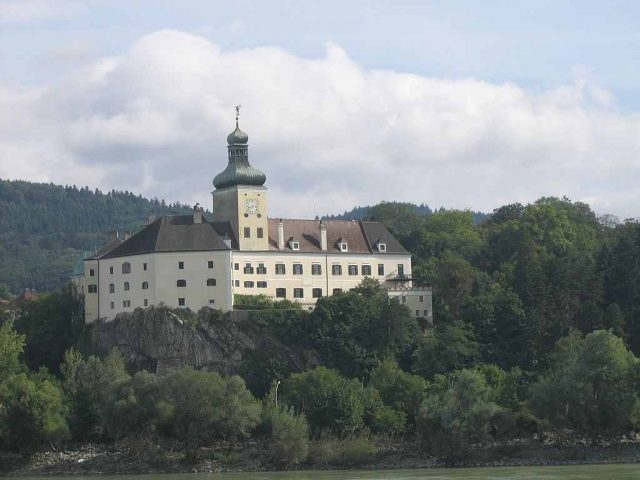
As a precursor to the present-day castle, a presumably wooden castle already stood here in the 10th century. It was probably built or at least refortified around 950 by Count Sieghart von Sempt und Ebersberg as a stronghold against the Hungarians. His vassal Otker de Persinpiugin is mentioned as burgrave around 970.
The County belonged to the Counts of Sempt-Ebersberg until their extinction in 1045. In the same year, the nephew of Countess Richlinde, the widow of Adalbero III of Semt-Ebersberg, Welf III, was enfeoffed with the castle and lordship. After his death in 1055, both were confiscated by the Emperor and subsequently usually granted as a fief together with the toll in Ybbs.
Until the 14th century, the abbots of Ebersberg owned it but passed it on as a sub-fief. Among their vassals were also the Babenbergs, who again entrusted burgraves with the administration. From 1301 to 1364, Agnes, the daughter of King Albrecht I, held the lordship. At that time, the castle was already princely and there was no longer any talk of a fief from Ebersberg. In 1430, the Hussites caused severe damage. In 1432, Elisabeth, the wife of Albrecht V, received the lordship as a morning gift. Georg von Säusenegg received it in 1450 as a pledge. Later, mainly administrators were appointed. In 1538, Persenbeug was pledged to Wilhelm von Rogendorf, who had major construction work carried out on the castle. Emperor Rudolf II sold the castle and lordship in 1593 to Baron Ferdinand Albrecht von Hoyos as a free property.
During the Peasants' War of 1597, rebels led by the shoemaker of Emmersberg occupied the castle for five weeks. Ferdinand Albrecht began the major reconstruction of the castle, which largely amounted to a new building, with the construction of the castle chapel in 1609. His widow Regina continued the work in 1617, and Adam Eusebius Count Hoyos completed it in 1621. At that time, Persenbeug received its present appearance. In 1619, the Protestant Upper Austrian estates had the castle temporarily occupied. The Hoyos family owned the lordship until 1800. After Count Leopold died in 1796, his daughters sold the property to Emperor Franz II. After his death, it passed into the possession of his wife, Empress Caroline Auguste, who bequeathed it to her grandson, Archduke Carl Ludwig. He gave Persenbeug to his son Archduke Otto. He sold Persenbeug to Emperor Franz Joseph in 1896.
After the end of the monarchy, it remained in the possession of his daughter Marie Valerie. The castle and estate are still owned by her descendants, the families Habsburg-Lothringen and Waldburg-Zeil. The castle is inhabited and is the seat of the estate administration.
Take Mobile History with you
You are reading this text for free. Premium adds what matters on the road: descriptions read aloud, sites found through your camera, whole regions taken offline.
- Every description, including the ~17,700 Premium sites
- Audio guide: have descriptions read to you on location
- AR finder: see sites through your camera, with distance and bearing
- Unlimited saved sites
14 days free, then from €2.99 a month. Cancel anytime.
Source: Wikipedia · Licence: CC BY-SA 4.0 · Image: https://commons.wikimedia.org/wiki/File:SchlossPersenbeug.jpg
This description draws on the facts documented in the linked Wikipedia article; Wikipedia content is licensed under CC BY-SA 4.0. Wording and editing: Mobile History.
Location: 48.1900, 15.0751