To be privately owned
CastleLütjenburg-Panker
Panker Castle
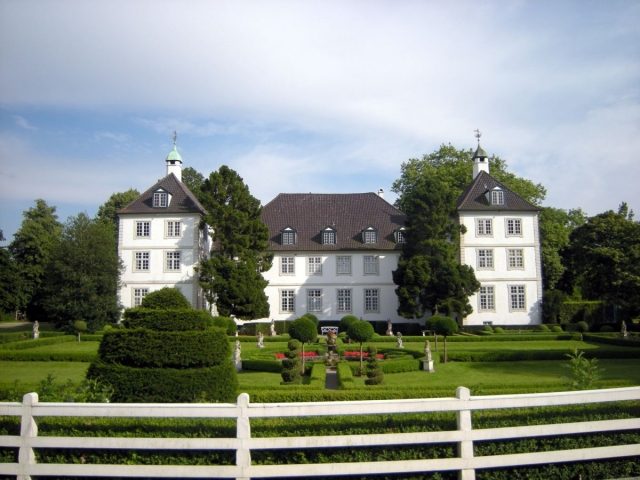
The over five-hundred-year-old Panker Estate is located in Panker in the Plön district near Lütjenburg in Schleswig-Holstein. The estate had been in the possession of the Rantzau family since the late Middle Ages, was purchased in 1739 by the Swedish King Frederick from the House of Hesse to provide for his illegitimate sons, who founded the Lordship of Hessenstein there, and passed to the Electors of Hesse-Kassel in 1808. The estate with its lands and buildings today belongs to the Hessian House Foundation.
The manor house, often also referred to as a castle, is privately owned, but the surrounding estate village is developed for tourism and, with several restaurants, galleries, and resident artisans, is one of the most famous excursion destinations in the Holstein Switzerland region.
Rantzau Estate
A manorial seat already existed in Panker during the time of the Wends, but little is known about this period. In the late Middle Ages, the lands came into the possession of the Rantzau family, who were among the most important noble families of their time in Schleswig and Holstein and owned a multitude of estates and noble residences in the country. The Rantzau family is documented in Panker since the end of the 14th century. They managed the estate with various family branches and built the core of the present manor house around 1650. Although Panker was a large noble estate at this time, it had no greater significance in regional history. The last member of the family at Panker was Hans Rantzau, who offered the property for sale shortly before his death in 1740.
Lordship of Hessenstein (House of Hesse)
In 1739, King Frederick I of Sweden, from the Hesse-Kassel line of the House of Hesse, acquired the Panker estate and the neighboring Klamp for 88,000 Reichstalers; in 1741, he also bought the neighboring estates of Schmoel and Hohenfelde for 138,000 Reichstalers. Frederick I acquired the properties at the instigation of his mistress Hedvig Ulrika Taube, to provide for the sons born from this morganatic marriage. Frederick, who had been a Prince of the Holy Roman Empire as Landgrave of Hesse-Kassel since 1730, also obtained from the German Emperor the elevation of his beloved and their offspring to Counts of Hessenstein. Panker became the residence of the elder son Friedrich Wilhelm, who, after the death of his younger brother Karl Eduard (Carl Edvard, 1737-1769), could dispose of all four estates. His Lordship of Hessenstein developed into a small social center for the Schleswig-Holstein nobility in the duchies. In 1772, he was elevated to the status of Imperial Prince as a so-called Personalist.
In his will, Friedrich Wilhelm stipulated that Panker and the Lordship of Hessenstein should in the future pass as a Fideicommiss into the hands of the main line of the House of Hesse-Kassel - excluding the respective reigning prince. The first heir was Karl von Hessen-Kassel, who was appointed governor of Schleswig-Holstein and resided primarily at Gottorf Castle. Although the estate was continuously managed during this period, the manor house was not constantly inhabited. The family used the property with varying intensity until the 20th century. Thus, the house sometimes stood empty for longer periods, then again became a regular residence for various family members. Friedrich Karl von Hessen was born here, and through a marriage, the Hessensteins were related to the Danish royal family.
20th Century and Present
After the First World War, social changes occurred on the estate; some of the surrounding farmsteads were sold to farmers. As the Weimar Constitution demanded the dissolution of all princely private property, the Hessian House Foundation was founded in 1928 to manage the family's possessions and assets. After the Second World War, a significant Trakehner breeding program was established on the estate, and the manor house was renovated from 1954 onwards. In 1957, the large barns and stables of the farmyard between the manor house and the gatehouse were destroyed by arson.
In 1967, the manor house served as a backdrop in the film adaptation of Kurt Tucholsky's novella Rheinsberg. In this film, starring Cornelia Froboess and Christian Wolff, it depicted Rheinsberg Castle in Brandenburg.
Towards the end of the 1980s, the estate village, which had previously been agriculturally oriented, was expanded with tourism concepts. Gut Panker and its lands are currently (2013) managed by Heinrich Donatus Prince of Hesse.
Buildings+
The Manor House and the Garden
The manor house is often also called Panker Castle. According to an old regional definition - which, however, was applied quite inaccurately - only the houses of a sovereign ruler actually had the right to be called a castle. However, since the property was acquired by the Swedish king and his son Friedrich Wilhelm was finally appointed Imperial Prince in 1792, the interpretation of the designation is quite possible. The house has developed to its present form over several centuries, as an 18th-century inscription above the portal also indicates:
- "Old house repaired / worthy of no reproach"
The building's floor plan reveals a central main structure, to which four extensions are attached: two wings on the courtyard side and the two garden-side tower pavilions. The main structure conceals the original building of the manor house, whose oldest parts date from around 1650. The old house, still relatively modest in size, was extended at the beginning of the 18th century with the courtyard-side tracts to form a baroque three-wing complex enclosing a small courtyard of honor. At the beginning of the 19th century, the manor house was further enlarged by the construction of the rear, three-story residential towers, thus acquiring its present form. The facades are kept in white and largely dispense with decorative ornamentation, which refers to the last alterations during the period of Classicism. The house is two-story, only the towers and the courtyard-side risalit have a third story.
Inside the house, the original furnishings have only partially been preserved; among other things, baroque ceiling paintings from Hessian castles and some old beamed ceilings from the original building can be found. The building was extensively renovated in 1954 and partly redecorated in the taste of the time. The manor house remains privately owned and inhabited to this day, and is therefore not accessible to the public.
The manor house was once surrounded by a spacious baroque garden, whose basic structure, formed by avenues, is still partly recognizable today. The former garden parterre in front of the north side of the castle is now occupied by a large meadow. The garden was, in keeping with the spirit of the era, transformed into an English landscape garden in the 19th century and designed with watercourses, bridges, ponds, and groups of trees. As is customary for such parklands, the garden is provided with various follies, including a temple from the first half of the 19th century in the form of a prostyle. Alongside the park at Eutin Castle, the garden of Panker is considered one of the most important landscape gardens in Schleswig-Holstein. As a large part of the garden area is on the private grounds of the estate, it is not accessible to visitors.
In front of the northern facade of the manor house, a small garden parterre in the style of Italian Renaissance gardens was laid out starting in 1962. The layout is structured by boxwood beds and lawns and decorated with hedges and bushes in Ars Topiari. The sculptures on display come from Italy, were made in the 18th century, and represent allegories of the seasons and the elements.
The Gatehouse, the Farmyard, and the Chapel
East of the manor house is the large gatehouse, which once limited access to the farmyard. The building was erected around 1790 and served as both a gatehouse and a cavalier's house. The seventeen-axis building now houses the workshops of various artisans, as well as privately used and holiday apartments. The actual farmyard consisted of large, typical regional barns and stables, which occupied the entire area of today's meadow. The buildings of this courtyard between the gatehouse and the manor house were destroyed by a large fire in 1957 and subsequently not rebuilt; instead, new farm buildings were erected north of the estate grounds.
Northwest, within sight of the manor house, is the estate chapel. The single-nave building with a slender bell tower was erected in 1890 and designed in the historicizing style of the Nordic Renaissance. Regular services no longer take place in the chapel, but it is rented out for weddings and similar events.
The Estate Village and the Hessenstein
The manor house forms the center of the estate village, which is part of the municipality of Panker and where about 80 people live. The building stock of the village has remained largely unchanged since the 19th century, apart from the demolished and rebuilt buildings of the farmyard elsewhere. Among the preserved buildings are the feudal houses of the former estate workers, a widow's home, the coach house, and the former stud farm, which houses one of the most important Trakehner stud farms in the country. It was founded in 1947 with horses rescued from East Prussia. Also widely known is an inn called "Ole Liese," where Prince Friedrich Wilhelm von Hessenstein's favorite horse of the same name received its retirement at the beginning of the 19th century. In return for caring for the animal, the farmhand living here received a liquor license, from which today's restaurant emerged.
About one and a half kilometers from the manor house, on the 128-meter-high Pilsberg, a push moraine, stands a 19th-century observation tower, the so-called Hessenstein. The polygonal tower in the Neo-Gothic style was built from 1839 to 1841 and is seventeen meters high. A cast-iron spiral staircase leads to the observation platform, surrounded by battlements, which offers a view of the Baltic Sea as far as Fehmarn and, in good weather, to the Danish islands. The tower adorns the coat of arms of Panker and was the first of a series of similar observation towers in Schleswig-Holstein, such as the Elisabethturm on the Bungsberg or the Parnass Tower near Plön.
The estate district still consists of several thousand hectares of arable land and forest areas and is still managed.
Take Mobile History with you
You are reading this text for free. Premium adds what matters on the road: descriptions read aloud, sites found through your camera, whole regions taken offline.
- Every description, including the ~17,700 Premium sites
- Audio guide: have descriptions read to you on location
- AR finder: see sites through your camera, with distance and bearing
- Unlimited saved sites
14 days free, then from €2.99 a month. Cancel anytime.
Source: Wikipedia · Licence: CC BY-SA 4.0 · Image: http://schloesserrundschau.de/schleswig/schloesser/ploen04.html
This description draws on the facts documented in the linked Wikipedia article; Wikipedia content is licensed under CC BY-SA 4.0. Wording and editing: Mobile History.
Location: 54.3288, 10.5718