To be privately owned
CastlePähl
Pähl Castle
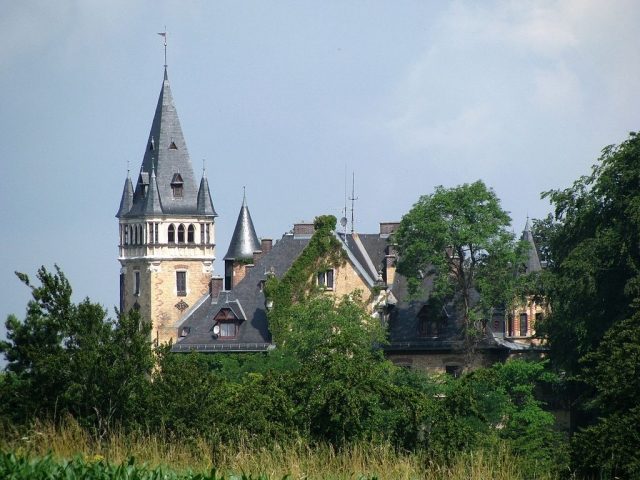
Hochschloss Pähl is an old Bavarian noble seat near Pähl in the district of Weilheim-Schongau, about 100 meters above the Ammer valley floor and Lake Ammersee. The current Hochschloss, a villa in a romanticized castle style, was built from 1883 to 1885 according to the plans of architect Albert Schmidt on the site of older predecessor buildings. The castle is privately owned and not publicly accessible.
Romans and Germanic Tribes
There are several indications that the area around Pähl was already settled in Roman times. Among other things, a Roman fibula found in nearby Kerschlach testifies to a larger Roman settlement in the area. The Romans built burgi at strategically favorable locations, from which the foreland could be well observed. It is not excluded that such a burgus could have stood on the site of the Hochschloss in the 3rd century.
In the middle of the 5th century, the Romans were displaced by the invasion of Germanic peoples, and the Roman fortifications fell into disrepair. In the Weilheim area, the Huosi settled, to whom the area is still attributed around 1100. According to the account of the Bavarian chronicler Ulrich Füetrer from the 15th century, Charlemagne, who according to legend was born in the Reismühle or Karlsberg Castle near Gauting, is said to have spent his youth at Pähl Castle. Efforts to verify this tradition have, however, failed so far due to a lack of historical findings.
Counts of Andechs
In the 12th and 13th centuries, Pähl Castle belonged to the possessions of the Counts of Andechs. When and by whom this castle was built remains unknown. The local nobility in Pähl, probably Andechs ministerials, are frequently mentioned in documentary traditions. From these documents, it can be concluded that the Counts of Andechs-Wolfratshausen were in possession of the castle, individual estates, and the rights over the church and the tithe. After the death of Duke Otto VIII of Andechs in 1248, no more Andechs can be proven.
Wittelsbachs
The Wittelsbachs already owned a manor in Pähl in 1230. After the Andechs died out, they took over their possessions. Wolfratshausen Castle fell to them in 1243, Starnberg Castle in 1246. Pähl Castle went to the Wittelsbachs as an administrative seat after the death of Otto VIII. They established an urbarium office at the castle. Duke Otto II appointed his own ministerials as officials when taking over this area. An exception was the Andechs judge Ulricus Rufus, who could provide valuable services to the Wittelsbachs, among other things, in property law matters. They appointed him as a regional judge and entrusted him with the administration of the regional judicial district.
The Hochschloss was the center of the court, the seat of the regional judge, administrator, and castellan. A castellan is first mentioned in Pähl in 1270. From the Hochschloss, the function of a Vogt was exercised, the neighboring monasteries were protected, and the estates were administered. As regional judges of Pähl, mostly members of the nobility residing in Upper Bavaria appeared. Hans Heseloher, who served as regional and city judge in Weilheim from 1466 to 1483, gained greater fame beyond his time. Heseloher, also known as a "late minnesinger," dedicated himself to art alongside his office and created impressive songs and poems.
After two centuries, the regional court of Pähl was the ancestral family property of the Wittelsbachs and the Bavarian duchy. In the years 1466 until his death in 1493, Duke Christoph of Bavaria, about whose knightly life many anecdotes have been preserved, received Pähl Castle as an appanage.
In 1505, Duke Albrecht IV mortgaged the Hochschloss and the lordship of Pähl to the Augsburg patrician Hans Paumgartner. After they had been redeemed again, the seat of the administrator, the castellan, and the judge was moved to Weilheim by 1520. Hochschloss Pähl lost its importance; it was only temporarily the official residence of the castle administrator. On January 2, 1578, Duke Albrecht V granted his master of the horse Caspar Eglof and one of his descendants the administration of Pähl for life. In 1618, the ownership rights of the Wittelsbach territorial lords ended after Duke Maximilian I, for financial reasons, no longer had any interest in Pähl Castle. He left it to Carl Eglof, it was allodified and equipped as a noble seat with lower jurisdiction.
The high jurisdiction thus ended for Pähl. A dungeon, presumably located in the keep, is said to have been used until then, especially for noble persons.
Noble Seat of the Nobility and Andechs Monastery
Even before the actual transfer of ownership, Carl Eglof, son of Caspar Eglof and regional judge in Landsberg, began renovating the dilapidated castle complex, as he was obviously entitled to expect. However, farmers refused to supply him with building materials when they learned that the castle had been sold. After the death of the regional judge after 1632, the castle fell to his eldest son Johann Wilhelm Eglof, canon at the collegiate church of St. Martini and Kastuli in Landshut. This coincided with the invasion of the Swedes into Bavaria during the Thirty Years' War. In the course of this, the Hochschloss was severely damaged, plundered several times, and devastated by fire.
In January 1660, Canon Eglof left it to his sister and his brother-in-law Hans Ferdinand von Perfall zu Greifenberg. In 1663, the Lords of Berndorf, who already owned the other two castles and a Hofmark in Pähl, came into possession of the Hochschloss. After that, it changed owners several more times. These were attracted by the impressive location but did not want to invest in urgently needed repair work, for which considerable sums would have been necessary.
In 1690, Andechs Monastery, with Abbot Quirin Wessenauer, took over the property. However, the monastery was not interested in the castle, but only in the land. It left the castle almost empty, only the dairy farm was in operation. After the castle wall had already fallen into disrepair in the 17th century, the western part of the castle collapsed at the beginning of the 18th century. The so-called Fällturm stood amidst ruins. The monastery had the opening closed. From the stones of the collapsed main building, a country house for the administrator was built, which is later referred to as "Schlösschen" or "Schloss."
Secularization and New Construction
In the course of secularization, Andechs Monastery was dissolved in 1803 and its property auctioned off. The Hochschloss Pähl complex came into the ownership of the regional judge and administrator of Murnau, Aloys Bayerhammer, for 4,375 guilders, after Count Vieregg, who had previously bought it for 5,000 guilders, withdrew. Bayerhammer had the main building made habitable and other parts of the building, including the castle chapel, demolished. Around 1833, the complex is again described as a ruin.
Bayerhammer's son sold the castle estate in March 1844 for 21,000 guilders to the lithographer and later court photographer Franz Hanfstaengl. In the spirit of the medieval romanticism prevalent at the time, he wanted to have the castle expanded into a medieval-romantic castle, similar to what Ludwig Schwanthaler had already realized with Schwaneck Castle. He had Gottfried Semper draw up corresponding designs, which, however, could only be partially realized due to the costs. Under Franz Hanfstaengl, the Hochschloss developed into a meeting place for artists and other well-known personalities. This period also saw the romance of his son Edgar Hanfstaengl with Duchess Sophie in Bavaria, the temporary fiancée of King Ludwig II, who often met at Hohenpähl. Since the Hanfstaengls kept a guest book, it is well documented who among their contemporaries stayed there.
Edgar Hanfstaengl took over the property from his father in November 1869 and held it for nine years. Via Friedrich Martin Schubart, Hohenpähl passed in October 1882 to his brother-in-law Ernst Oswald Czermak, a private citizen from Pähl and son of the Leipzig physiologist Johann Nepomuk Czermak. Czermak had the ruins of the old castle as well as the still habitable farm buildings demolished and commissioned the Munich architect Albert Schmidt with a new building, which was then completed by 1885. At the same time, the farm buildings, which had previously been located on the castle grounds themselves, were newly erected northeast of it.
In May 1904, the new Hochschloss was sold to Count Karl Otto von Holnstein. However, since it did not appeal to his newly wed wife, Countess Eckbrecht von Dürckheim-Montmartin, née Haniel, the Count sold it in August 1904 to Count Bernhard von Spreti and his wife. In November 1930, their son Rudolf Graf von Spreti became the sole owner of Hochschloss Pähl. Today it is owned by the von Stauffenberg family.
In recent times, the Hochschloss has been used as a setting for various TV crime series. For example, Graf Yoster, Derrick, and Der Alte have already investigated here.
Description+
Hochschloss Pähl is located on a west-facing spur of land, just before the ridge between Lake Starnberg and Lake Ammersee steeply drops into the Ammer Valley. To the east and south of the castle complex is the Pähl Gorge. To the south, there is an extraordinary view of the Weilheim region, the Ammer Valley, and the Alpine foothills between the Werdenfelser Land and Ostallgäu.
Middle Ages
No written records are known about the construction and layout of the old ducal castle. However, a view from around 1440 has been preserved, which the Master of the Polling Panels captured in his painting "Birth of Christ," which belongs to the treasures of the Bavarian State Painting Collections. It shows a rather simple medieval building with a freestanding keep and a curtain wall, into which a square tower and a round tower are integrated.
Pähl Altar
As in every castle of this era, there was also a chapel at Hohenpähl. This was dedicated to Saint George. It dated from the Middle Ages and was demolished soon after secularization. A masterpiece from it, which was not initially recognized as such, is the art-historically significant Pähl Altar. Since the artist of this work is not known by name, he is provisionally referred to today as the Master of the Pähl Altar. The Pähl Altar is a three-part winged altar with late Gothic panel paintings. It is 103 centimeters high, the central wing is 68 and the side wings are each 28.5 centimeters wide. It is described, especially the crucifixion scene, as "the most delicate and spiritually most beautiful representation of this kind and as the purest expression of the new style of German painting around 1400."
Early Modern Period
Only a sketch from 1568 is available, which Philipp Apian or one of his assistants made for the Bavarian Landtafeln.
Present Day
Today's Neo-Gothic Hochschloss is a group of buildings with 40 rooms around an irregularly laid out inner courtyard. One enters it through a gate tower in the northeast. To the right of it is the guest building. Opposite on the south side is the main building with two towers of different heights, the taller of which measures almost 30 meters. An outbuilding in the west contains remnants of the old Hochschloss's building fabric. Arcades, loggias, dormers, and turrets are architectural elements of the buildings.
The interior rooms are characterized by high-quality materials and a generous layout. Overall, the castle, designed for long-distance effect, is described as a "coherent ensemble of late Historicism."
Take Mobile History with you
You are reading this text for free. Premium adds what matters on the road: descriptions read aloud, sites found through your camera, whole regions taken offline.
- Every description, including the ~17,700 Premium sites
- Audio guide: have descriptions read to you on location
- AR finder: see sites through your camera, with distance and bearing
- Unlimited saved sites
14 days free, then from €2.99 a month. Cancel anytime.
Source: Wikipedia · Licence: CC BY-SA 4.0
This description draws on the facts documented in the linked Wikipedia article; Wikipedia content is licensed under CC BY-SA 4.0. Wording and editing: Mobile History.
Location: 47.9106, 11.1835