To be privately owned
CastleOtterwisch
Otterwisch Castle
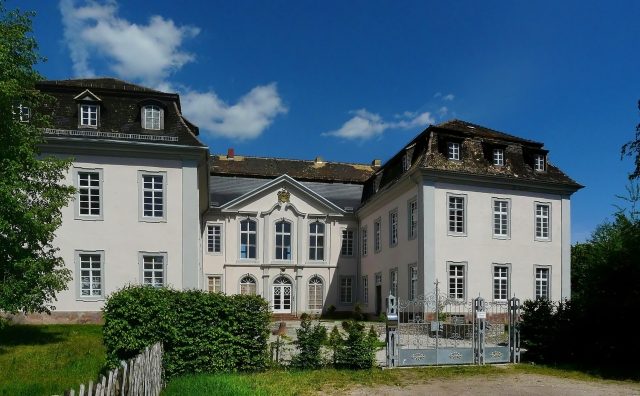
The area around Otterwisch - southwest of Grimma - was already settled in prehistoric times. The oldest evidence of human activity dates back to the Stone Age (about 10,000 years ago). But there are also finds from the Neolithic Age (about 3,000-6,000 years ago).
The Germanic tribes who later settled in this area retreated behind the Saale after the Migration Period (4th-6th century) and made way for the Slavic peoples. About 1,000 years ago, in early German times, German knights again occupied the area, and in their wake, German farmers also came to this region and founded the village of Otterwisch in the middle of the 12th century.
The first written mention of the place was in a document from Bishop Friedrich of Merseburg dated October 8, 1269. However, archaeological finds and still visible ramparts indicate that a fortified Slavic settlement ("Grötsch") must have existed on the right bank of the Gösel already in Slavic times, from which an outwork emerged in early German times.
From a purchase agreement from the year 1500, it can be seen that the Altzella Monastery sold "the wasteland of Otterwusch" to the Augustinian Monastery Grimma. After several changes of ownership, the von Metzsch family finally acquired the estate in 1660 and had a manor house built in Renaissance style at the end of the 17th century. However, this manor with 365 windows and a large hall did not last long, because only 30 years later its decay and conversion into a sheepfold and farmyard were reported.
The history of the present Baroque castle begins with the acquisition of the castle grounds by Rahel Charlotte Reichsgräfin Vitzthum von Eckstädt, widow of Friedrich Reichsgraf Vitzthum von Eckstädt, Royal Polish and Electoral Privy Councillor and Cabinet Minister. The Countess of Vitzthum had the castle built on its present site between 1727 and 1730.
The prosperity and the example of the Dresden court, as well as fashion and contemporary taste, were the reasons for the magnificent execution of the building. Noteworthy are the vestibule with four pairs of Tuscan columns, the staircase in the south wing, and the hall on the upper floor of the main wing.
No less interesting must have been the park adjoining the castle to the east, because at the end of the 18th century the castle received a high visit from Elector Friedrich August, who specifically wanted to see the artistically designed garden. The French style served as a model. Later, new installations in the English garden style were added. Unfortunately, nothing of this old artistic beauty remains.
Subsequent owners of the Baroque castle made various alterations to the building until Hanskarl von Arnim finally restored the building to its original beauty at the beginning of the 20th century. In 1945, the von Arnim family was dispossessed and expelled by the communists. Then the entire manor was divided up and the rooms of the castle were made usable for the village population. Thus, among other things, the nursery, the after-school care center, the library, and the sports hall found accommodation. Meanwhile, Otterwisch Castle is in private hands.
Take Mobile History with you
You are reading this text for free. Premium adds what matters on the road: descriptions read aloud, sites found through your camera, whole regions taken offline.
- Every description, including the ~17,700 Premium sites
- Audio guide: have descriptions read to you on location
- AR finder: see sites through your camera, with distance and bearing
- Unlimited saved sites
14 days free, then from €2.99 a month. Cancel anytime.
Source: Wikipedia · Licence: CC BY-SA 4.0 · Image: Thomas Eichler
This description draws on the facts documented in the linked Wikipedia article; Wikipedia content is licensed under CC BY-SA 4.0. Wording and editing: Mobile History.
Location: 51.2046, 12.6103