School
CastleOttersberg
Ottersberg Castle
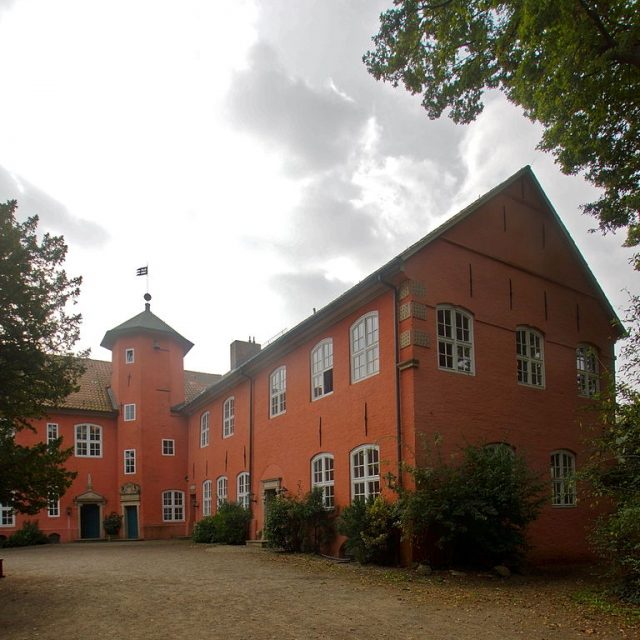
The name Ottersberg probably does not come from "Otter", but from "Ostara", the spring goddess. A early Saxon water sanctuary probably stood on the site of the later fortress.
A castle is first mentioned in the 8th-9th century. Otto the Great conquered the castle in the 10th century, fortified it against the Saxons and granted the place market rights. After the Diocese of Bremen became an archdiocese in 847, Ottersberg, which was located in the Prince-Archbishopric of Bremen-Hamburg, also came as a fief to the Archbishops of Bremen through Otto the Great.
According to an entry in the ecclesiastical register of Bremen, the castle is said to have been a "castricium ruinosum", a ruined castle, in the 11th century and the subsequent period.
In the 12th century, the castle fell to the noble family of Wölpe. One of the counts was a loyal follower of Henry the Lion of Brunswick.
From 1203-21, Bernhard von Wölpe defended the castle and land around Ottersberg for Bishop Iso of Verden against Archbishop Gerhard II of Bremen. Years of disputes over Ottersberg Castle followed, as it became of great importance for the defense of trade routes between Hamburg-Stade and the rest of the imperial territory.
Archbishop Gerhard II of Bremen expanded the fortress triangle of Ottersberg-Langwedel-Thedinghausen to defend his archdiocese.
Duke Otto the Child, a grandson of Henry the Lion, conquered the castle in 1236, but was forced by the Archbishop of Bremen to have it razed to its foundations and salt strewn on the ruins, as a sign that it should never be rebuilt.
In 1285, the castle finally came into the possession of the Archbishops of Bremen. Archbishop Giselbert von Brunkhorst had the castle rebuilt and fortified more strongly than before.
In the 14th century, the run-down castle was pledged by Archbishop Albert II of Bremen to Sir Johann Clüver. In his coat of arms, he bears a bear's claw on a golden background.
In the 16th century, the castle came into the possession of the Frese-Quiter family and was subsequently sold to the city of Bremen, which established it as the country seat of the city treasurer Vagedes. Ottersberg had become Protestant during the Reformation. The castle was used by city treasurer Hermann Vagedes as a training ground for conscripted citizens. According to an old conscription law of the Prince-Archbishopric of Bremen, the citizens of Ottersberg and Fischerhude had to perform guard duty at the castle. At that time, there were 400 able-bodied men who held a "bird and target shooting" event every year, from which today's shooting clubs are said to originate.
In 1562, the castle and grounds returned to the Archdiocese of Bremen. After Archbishop Georg had the ramparts strengthened, one of his successors, Johann Friedrich, Prince of Denmark, began to expand the castle more beautifully and splendidly in the Renaissance style from 1585 onwards. The stone ornaments on the portals and lintels are testimonies from this period.
The Thirty Years' War (1618-48) interrupted all peaceful reconstruction work. The armies of the Swedes and the Imperials alternately marched through Ottersberg and the surrounding area, bringing hardship and death to the long-suffering population. In 1626, the imperial general Tilly had all houses and the chapel of Ottersberg burned down.
The Swedes occupied the castle in 1640 and kept it in their possession for over thirty years. The Swedish general Axel de Lille (with three lilies in his coat of arms) received the castle and surrounding area as a gift from his king. During the time of Queen Christina of Sweden, Ottersberg even became the headquarters of General Königsmark in 1649.
In 1674, the Swedish occupation ended. 140 Swedish soldiers and officers fell in the battle for Ottersberg. Gravestones of these fallen Swedes can still be seen in the chapel of Ottersberg.
Under the Bishop of Münster, Bernhard von Galen, the victor over the Swedish armies, the land was terribly plundered in 1677. To create a field of fire for his cannons, the bishop even moved the town of Ottersberg, which was located between the Wümme arms near the castle, to where it lies today.
In the Peace of Nijmegen in 1679, the castle returned to the hands of the Swedes. It was rebuilt.
In 1712, Ottersberg became Danish property, but was sold by Frederick IV of Denmark to the House of Brunswick-Lüneburg.
In 1757, during the war with Prussia and Frederick II, the French occupied the completely demolished castle, but soon lost it to the Duke of Brunswick, who had the fortifications torn down.
After the Battle of Jena and Auerstedt in 1806, Ottersberg belonged to the Kingdom of Westphalia, which Napoleon gave to his brother Jerome. Ottersberg became French.
The "Amtshof" (administrative court) was taken over as an administrative seat by the Prussian state in 1859 and went into private ownership of the Clüver family in 1883. Over a longer period, peace and order returned, and little was changed in the buildings. A beautiful old tree population protected the old structure.
The National Socialist state took over the Amtshof in 1933 and set up a camp for the Reich Labor Service. The planted castle garden became a parade ground.
American and British troops took over the Amtshof and the grounds in 1945. During its defense, many damages to the building had been caused by bombs and grenades.
In 1946, the Freie Rudolf-Steiner-Schule leased the Amtshof grounds with all buildings. The leased grounds were bought in 1963 by the Clüver heirs and thus became the property of the Rudolf-Steiner School Association.
In 1967/68, the Amtshof was renovated and a new school and dormitory building was constructed.
Take Mobile History with you
You are reading this text for free. Premium adds what matters on the road: descriptions read aloud, sites found through your camera, whole regions taken offline.
- Every description, including the ~17,700 Premium sites
- Audio guide: have descriptions read to you on location
- AR finder: see sites through your camera, with distance and bearing
- Unlimited saved sites
14 days free, then from €2.99 a month. Cancel anytime.
Location: 53.1048, 9.1393