School
CastlePetersberg-Ostrau
Ostrau Castle
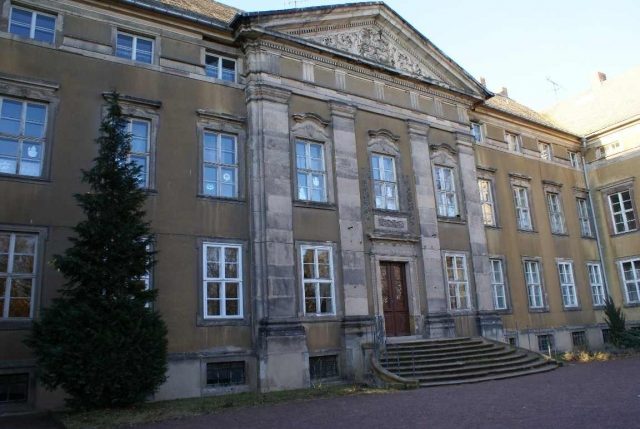
Ostrau Castle is a Baroque castle in the town of Ostrau (Saalekreis) near Halle (Saale). The Baroque castle dates from after 1713. The wide moat surrounding the castle belonged to a medieval fortress. Only minimal remains of this fortress are preserved.
The name of the town Ostrau is derived from the Slavic word "island". It is therefore assumed that the island formed by a wide moat already bore a ring fort during the period of Slavic settlement.
The town was first mentioned in a document when Margrave Konrad the Great donated the chapel and four hides of land to the Augustinian monastery on Petersberg in 1125. A medieval fortification can be assumed to have existed when Hogerus von Ostrau, a margravial ministerialis, was mentioned in 1156. This family resided in Ostrau until 1285. Otto II von Ostrau had a castle chapel built in 1237.
In 1288, Ostrau was included in the sale of the Lordship of Wettin to the Archdiocese of Magdeburg by the Counts of Brehna. In the years up to 1378, the Bishops of Merseburg gradually bought up the entire Lordship of Ostrau.
The bishops enfeoffed Ostrau to various vassals, among them the families von Witzleben, von Hoym, von Leipzig. In 1540, Bishop Sigismund von Lindenau enfeoffed the property to Duke Henry the Pious. Finally, in 1585, the von Veltheim family acquired the castle. It remained in family possession until 1945. The Veltheims had the castle converted into a four-winged Renaissance castle with a spacious farmyard.
During the Thirty Years' War, the castle was able to hold out against a Swedish corps under General von Königsmarck and against imperial troops under General Gallas.
From 1713, Otto Ludwig von Veltheim had the old buildings demolished and a castle in the style of French Baroque built by the French architect Louis Remy de la Fosse. It is one of the most valuable Baroque buildings in the state of Saxony-Anhalt.
Under Dr. Hans Hasso von Veltheim, Indologist, Anthroposophist and world traveler, the castle and the castle park were thoroughly renovated between 1929 and 1933. He completed the Baroque castle construction by extending the northeast wing. He had the patron's box of the castle church converted into an anthroposophically inspired tomb-altar chapel. The nobleman made the castle a meeting place for anthroposophists and intellectuals from all over the world.
In 1945, von Veltheim was dispossessed and expelled by the communists. The library and cultural assets were partly transferred to the Martin Luther University Halle-Wittenberg, confiscated by the Soviet occupiers or plundered. Marsden Hartley's painting Lighthouse from Veltheim's collection hung in Moritzburg (Halle) from 1954. Later, the castle was used as a boarding school. The tomb-altar chapel, as part of the church, largely survived this period intact. In 1990, Hans Hasso von Veltheim's urn was buried there.
Currently, the castle is used by a primary school, a youth club, and the Ostrau Cultural Association.
Of the medieval building fabric, apart from the foundation of the keep, only the moat remains.
Take Mobile History with you
You are reading this text for free. Premium adds what matters on the road: descriptions read aloud, sites found through your camera, whole regions taken offline.
- Every description, including the ~17,700 Premium sites
- Audio guide: have descriptions read to you on location
- AR finder: see sites through your camera, with distance and bearing
- Unlimited saved sites
14 days free, then from €2.99 a month. Cancel anytime.
Source: Wikipedia · Licence: CC BY-SA 4.0 · Image: Roland Neubert, Halle (Saale)
This description draws on the facts documented in the linked Wikipedia article; Wikipedia content is licensed under CC BY-SA 4.0. Wording and editing: Mobile History.
Location: 51.6183, 12.0115