To be privately owned
CastleTumegl/Tomils
Ortenstein Castle (Tumegl/Tomils)
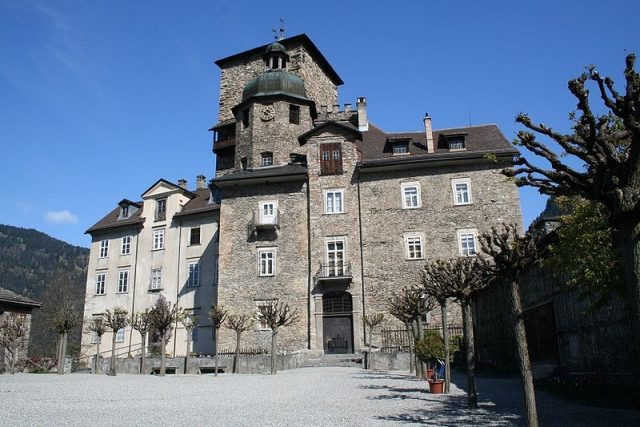
Ortenstein Castle is a castle complex in the area of the Tumegl/Tomils faction of the municipality of Tomils in Domleschg in the Swiss canton of Graubünden.
The name derives from the Old and Middle High German word "ort," which means outermost point, edge, tip. It thus characterizes the castle's location on the outermost edge of a plateau that drops vertically towards the plain of the Hinterrhein.
Even though modern renovations have altered the original character of the castle, the main elements of the medieval complex are still recognizable. The complex is dominated by its oldest part, the seven-story keep in the center with a footprint of approximately 11 x 11 meters and a wall thickness of 1.6 meters. The vaults in the lower floors are of more recent date; in the upper floors, arcades, latrine bays, and window niches have been preserved. The tower is topped by a battlements and a pyramidal roof. This originally consisted of a lighter construction so that it could be removed in case of danger. The actual roof, a lean-to roof sloping to the west made of strong beams, was hung inside the tower and placed below the battlements. Originally, the tower was surrounded by a trapezoidal curtain wall, which was gradually built over in the course of centuries.
There is no certainty about the age and sequence of the construction. Many renovations date from the years between 1720 and 1740. At that time, the west wing was extended to the curtain wall, the bell tower was raised and fitted with an onion dome. The east wing was also newly built, and all interiors were generously furnished. During the renovations from 1860, under the then owner, the historian Wolfgang von Juvalta, the roofs were renewed, some facades were redesigned, and the dilapidated buildings were repaired.
The surroundings of the castle have also changed significantly over time. Garden terraces were laid out on the steep slope to the east of the complex. On the southern forecourt, where originally a bailey with farm buildings probably stood, there is now a garden.
No documents exist regarding the time of construction. It is assumed that the tower was built on episcopal land in the second quarter of the 13th century. Whether the Bishop of Chur himself commissioned the construction or the Barons of Vaz erected it is uncertain. In any case, Ortenstein was located there, and the Vaz were the holders of the castle as episcopal feudal lords.
The earliest written mention of the castle dates from 1309 and 1312, when the last Vaz, Donat von Vaz, issued documents here. After his death around 1338, Ortenstein, along with the other estates in Domleschg, came to the Counts of Werdenberg-Sargans through the marriage of his daughter Ursula von Vaz. In 1338, Ursula received Ortenstein as a fief from the bishop, along with Meierhof and the church patronage of Tomils. She was often at the castle and issued numerous documents here. Until 1492, the episcopal fiefs to the Werdenbergers were often renewed.
A family named von Ortenstein appeared in the 14th century. They were a family of Vaz-Werdenberg ministerials who served as bailiffs at Ortenstein. Further bailiffs documented from 1411 include Oswald von Marmels, Half-Count Marquard von Werdenberg-Sargans, Conradin Jecklin the Elder, Peter Mängel von Splügen, Conrad Jecklin the Younger, and from 1518–1523 Victor Büchler.
During the Schams Feud in 1451, Ortenstein was destroyed along with other Werdenberg castles in Domleschg. An arbitration award of July 21, 1452, in contrast to other castles, permitted the reconstruction of Ortenstein, which "nu in disem krieg brochen ist" (now broken in this war), but it was no longer allowed to be used against the Upper and Gotteshausbund. The reconstruction significantly altered the complex.
In 1455, the Werdenbergers had to pledge the castle to Peter von Griffensee for economic reasons. In 1463, another pledge followed to the Counts of Montfort, and in 1471 to Glarus. After the death of Count Georg von Werdenberg-Sargans in 1505, Ortenstein became an episcopal fief of Count Andreas von Sonnenberg in 1509, then passed to Wilhelm Turchsess von Waldburg, and in 1523, through sale, to Ludwig Tschudi the Younger of Glarus, a brother of the historian. He sold the castle with its sovereign rights in 1527 to the municipality of Tomils, which in turn sold it in 1528 to Victor von Büchler, the former bailiff of Ortenstein.
His daughter Anna brought Ortenstein into her marriage with Jakob Travers, who belonged to one of the most influential patrician families of the Three Leagues. A branch of the Travers family remained in possession of Ortenstein until 1846. Under them, the major renovations of the 17th century were carried out.
Due to the economic decline of the Travers family, Ortenstein fell into the hands of their creditors, who sold the castle in 1856 to Father Theodosius Florentini. He wanted to establish an orphanage and a printing press in the castle, similar to Rhäzüns Castle, but could not realize the plans due to financial difficulties. In 1850, there were plans for an agricultural school, but it also did not materialize. In 1860, Ortenstein was sold for 103,000 francs to the historian Wolfgang von Juvalta. Through an inheritance, the complex came into the possession of the von Tscharner family in 1893, who still own Ortenstein today.
Take Mobile History with you
You are reading this text for free. Premium adds what matters on the road: descriptions read aloud, sites found through your camera, whole regions taken offline.
- Every description, including the ~17,700 Premium sites
- Audio guide: have descriptions read to you on location
- AR finder: see sites through your camera, with distance and bearing
- Unlimited saved sites
14 days free, then from €2.99 a month. Cancel anytime.
Source: Wikipedia · Licence: CC BY-SA 4.0
This description draws on the facts documented in the linked Wikipedia article; Wikipedia content is licensed under CC BY-SA 4.0. Wording and editing: Mobile History.
Location: 46.7596, 9.4352