Museum
CastleOranienburg
Oranienburg Castle
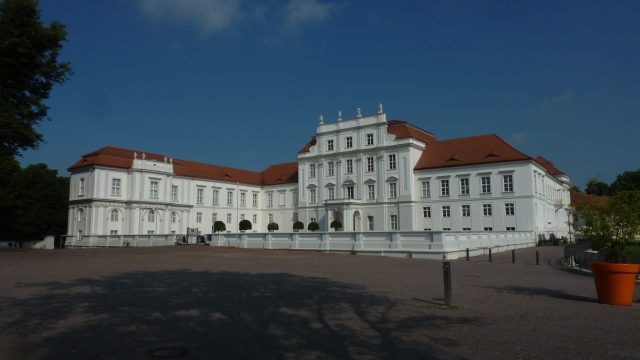
Oranienburg Palace is located in Oranienburg, the district town of the Oberhavel district in the state of Brandenburg. It is the oldest Baroque palace in the March of Brandenburg.
Origins
The Slavic settlement of Bothzowe became the town of Bötzow, where the Ascani Markgraves built a castle complex on an island in the Havel. This castle, first mentioned in 1288, secured the important Havel crossing. After the extinction of the Ascanians, the castle changed hands several times until it came into the possession of the Hohenzollerns in 1485 through Margrave Johann Cicero. Around 1550, Elector Joachim II replaced the castle with a new hunting lodge. The castle finally lost its importance after the Thirty Years' War and was abandoned. On this site, a palace in the Dutch style was built from 1651 to 1652. The structure of the hunting lodge became part of the central building of the new palace. Elector Friedrich Wilhelm had it built for his first wife, Luise Henriette von Oranien, to whom he had given the estate. The palace was named Oranienburg. The palace name was also transferred to the city in 1652. The architect was Johann Gregor Memhardt, who had been trained in the Netherlands.
Luise Henriette commissioned Johann Gregor Memhardt with the planning and execution of a pleasure garden west of the palace. A Dutch-style garden with a pleasure house in the center was created. However, the garden primarily served the cultivation of trees, ornamental shrubs, flowers, and vegetables. Thus, the Electress introduced, among other things, potatoes and cauliflower to the March of Brandenburg. At the instigation of Luise Henriette's son, Elector Friedrich III, his architect J.A. Nering designed the representative entrance portal in 1690. The entrance pillars with their projecting pairs of Tuscan columns are crowned by the allegorical figures of Autumn and Summer. Also noteworthy is the wrought-iron portal with the Elector's monogram and the electoral hat.
Oranienburg Palace is one of the four "mother houses" of the Dutch royal family. The name refers to William of Orange. In addition to Oranienburg in Brandenburg, Oranienbaum Palace near Dessau and Oranienstein Palace near Diez are among the ancestral castles of the Dutch royal family. The fourth house, Oranienhof near Bad Kreuznach, no longer exists.
Use by the Electors
From 1690, Oranienburg Palace was the preferred residence for Elector Friedrich III. Around 1700, the palace was expanded and lavishly decorated under the direction of the architects Eosander von Göthe and Arnold Nering. Connecting wings were built between the central building and previously separate pavilions, as well as the two northern wings. From 1709, the southern wings were built. The entire complex had the shape of an H. Thus, Friedrich I could also fulfill his representative duties as King in Prussia in a manner befitting his status. A special feature was the porcelain cabinet, famous among contemporaries, magnificently furnished and adorned with an allegorical ceiling painting by the court painter Augustin Terwesten. The vaulted Hare (Dining or Grotesque) Hall was painted by the court painter Samuel Theodor Gericke.
The garden grounds, the pleasure garden, were also elaborately designed. However, this was soon dismantled.
From 1743, Prince August Wilhelm of Prussia resided in Oranienburg. The architect Johann Gottfried Kemmeter, who had already supervised repair work on the palace from 1727-1729, undertook further alterations on behalf of the Prince. In 1755, the construction of the Orangery began according to plans by Georg Christoph Berger. After the Prince's death in 1758, the Orangery served as a powder and prisoner store. Only during the reign of his son Friedrich Wilhelm II was the Orangery completed and used.
The palace and gardens fell into disrepair. In 1794, Crown Princess Luise received the palace. However, the Crown Prince and Princess only lived at Oranienburg Palace for a short time.
Private Use
In 1802, under King Friedrich Wilhelm III, the palace was sold. The pharmacist Dr. Johann Gottfried Hempel acquired it with the obligation to establish a cotton weaving mill in the palace. The war against France brought cotton production to a halt in 1807. In 1814, a sulfuric acid factory was established in the palace, which was the first in Prussia to produce using the lead chamber process. In 1833, Friedlieb Ferdinand Runge discovered aniline and carbolic acid (phenol) in coal tar. In that year, the central building of the palace was largely destroyed by a fire. The Orange Hall and other magnificent rooms fell victim to the flames.
In 1835, the first stearin candles were produced in the factory, and in 1840, the first paraffin candles. In 1842, the southeast wing was destroyed by fire. Its remains were demolished and never rebuilt. In 1848, the production facility was moved from the palace to the Mühlenfeld. Since June 18, 1858, the 191st anniversary of her death, a monument to Luise Henriette von Oranien stands on Oranienburg Palace Square, created by the Berlin sculptor Wilhelm Wolff (born 1814 in Fehrbellin). On the occasion of the inauguration, King Friedrich Wilhelm IV announced his intention to rebuild the palace. Between 1858 and 1860, restoration and reconstruction took place. In 1861, an evangelical teacher training college was opened in this building, which existed until 1925.
The 20th Century
During the Nazi era until 1938, Oranienburg Palace was an SS barracks. The Orangery served as a horse stable during this time. In 1938, the palace was rebuilt, creating the main staircase that still exists today. A three-winged extension was built north of the palace. The entire complex then served as a colonial police school.
During World War II, the palace suffered considerable damage during the bombing raids on Oranienburg. The demolition of the palace bridge in April 1945 caused further destruction.
After the end of World War II, the Orangery served as an emergency church for the destroyed St. Nicolai Church. The palace itself was externally restored by 1954. From 1952, after temporary use by the Red Army, it was a barracks for the Barracked People's Police and later the Border Troops of the GDR until 1990.
In 1997, the palace was transferred to the city of Oranienburg. By 1999, the building was extensively renovated and restored. Historically significant rooms, including the Orange Hall, were able to be restored. In addition to the city administration, the renovated palace now houses a museum of the Prussian Palaces and Gardens Foundation Berlin-Brandenburg and the Regional Museum of the Oberhavel district.
In 2009, Oranienburg hosted the fourth Brandenburg State Garden Show under the title "Dream Landscapes of an Electress." It ran from April 25 to October 18 of that year. The central preparatory project was the transformation of the military wasteland behind the palace into a park and thus the restoration of the palace park. This included, among other things, the creation of a new palace harbor and a Havel promenade. Additionally, the route of the main road was changed, and the bridge alignment used until 1901 was restored with a newly built palace bridge. This restored the central importance of the palace square for the city. At the same time, the construction of Nehringstraße between the palace and the district administration office created a previously missing third axis, thus taking into account the Baroque city plan. Numerous ruined properties and estates were purchased by the city of Oranienburg to eliminate urban planning deficiencies. Through these measures, the historic center of Oranienburg was significantly reshaped and sustainably upgraded in terms of urban development.
Take Mobile History with you
You are reading this text for free. Premium adds what matters on the road: descriptions read aloud, sites found through your camera, whole regions taken offline.
- Every description, including the ~17,700 Premium sites
- Audio guide: have descriptions read to you on location
- AR finder: see sites through your camera, with distance and bearing
- Unlimited saved sites
14 days free, then from €2.99 a month. Cancel anytime.
Source: Wikipedia · Licence: CC BY-SA 4.0 · Image: Joachim Schneeleopard
This description draws on the facts documented in the linked Wikipedia article; Wikipedia content is licensed under CC BY-SA 4.0. Wording and editing: Mobile History.
Location: 52.7548, 13.2368