The Castle can be visited
CastleOranienbaum
Oranienbaum Castle
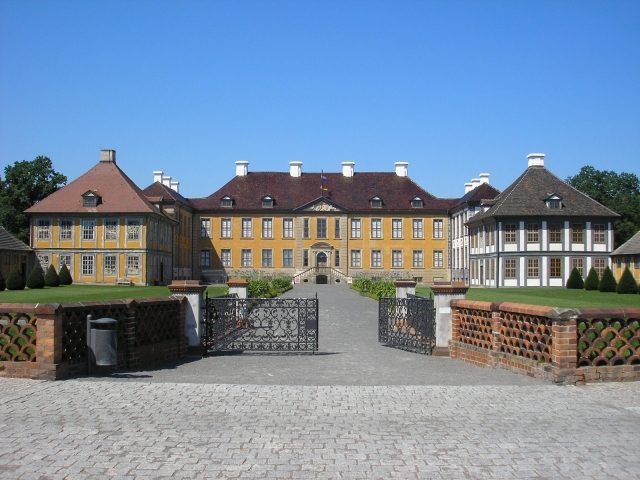
Oranienbaum Palace is located in the town of Oranienbaum-Wörlitz in Saxony-Anhalt.
Geography
The palace, located in the Oranienbaum district, lies east of Dessau-Roßlau, only a few kilometers from Wörlitz Park.
History
From 1683, the palace was initially built as a summer residence for Princess Henriette Catharina, wife of Prince Johann Georg II of Anhalt-Dessau and born Princess of Orange-Nassau. The Dutch master builder Cornelis Ryckwaert, who was in Brandenburg service, was commissioned with the construction. Initially, only a palace with cavalier pavilions was erected and a 28-hectare Baroque garden in the Dutch style was laid out. At the same time, Ryckwaert also had the town of Oranienbaum built on a geometric plan. After the death of the prince in 1693, Oranienbaum was converted into the current three-winged palace as a widow's residence for Princess Henriette Catharina. The rooms were equipped, among other things, with precious leather wallpaper. In the cellar, the still existing summer dining room, decorated with Dutch Delft tiles, was furnished.
After the death of Henriette Catharina in 1708, Oranienbaum Palace was only occasionally used by the Princes of Anhalt-Dessau for hunting. Only Prince Leopold Friedrich Franz of Anhalt-Dessau showed more interest in Oranienbaum Palace again. He had the palace and park redesigned after 1780. Numerous rooms received new furnishings in the Chinese style. The former Baroque island garden was transformed from 1793 to 1797, according to the ideas of the English gardener Sir William Chambers, into the only largely preserved English-Chinese garden in Germany, with a five-story pagoda, a garden house (teahouse) accessible by water, and several arched bridges.
Oranienbaum Palace is one of the four "mother houses" of the Dutch royal family. The name refers to William of Orange. In addition to Oranienbaum in Saxony-Anhalt, Oranienburg Palace in Brandenburg and Oranienstein Palace near Diez are among the ancestral castles of the Dutch royal family. The fourth house, Oranienhof near Bad Kreuznach, no longer exists.
In the southern part of the garden, the 175 m long orangery, one of the largest in Europe, was built in 1811 and has since continuously served to house a large collection of citrus plants and other rare woody plants.
After the Second World War, from 1953, the GDR housed an outpost of the Magdeburg State Archives in Oranienbaum Palace. This outpost was upgraded to the independent Oranienbaum State Archives in 1993. At the beginning of the 21st century, the archive moved to Dessau. The palace was then opened to visitors in 2003. Restoration work on and in the palace is far from complete. However, the accessible rooms provide an impression of the former splendor of the palace's furnishings. On March 3, 2004, Queen Beatrix of the Netherlands visited Oranienbaum Palace to learn about the progress of the restoration work in the palace of her ancestress.
The ensemble of town, palace, and park of Oranienbaum, built on a geometric plan, is today a rare example of a predominantly Dutch-influenced Baroque complex in Germany.
The palace can be visited for an entrance fee. The palace park is freely accessible, the restored pagoda is not accessible (tours on request), the teahouse is not yet restored and closed to visitors. The orangery houses, among other things, a café and a carriage exhibition. Next to the orangery is a large garden with citrus plants. (As of 2005)
Take Mobile History with you
You are reading this text for free. Premium adds what matters on the road: descriptions read aloud, sites found through your camera, whole regions taken offline.
- Every description, including the ~17,700 Premium sites
- Audio guide: have descriptions read to you on location
- AR finder: see sites through your camera, with distance and bearing
- Unlimited saved sites
14 days free, then from €2.99 a month. Cancel anytime.
Source: Wikipedia · Licence: CC BY-SA 4.0
This description draws on the facts documented in the linked Wikipedia article; Wikipedia content is licensed under CC BY-SA 4.0. Wording and editing: Mobile History.
Location: 51.8000, 12.4036