Cultural Events
CastleBaddeckenstedt - Oelber am weißen Wege
Oelber Castle
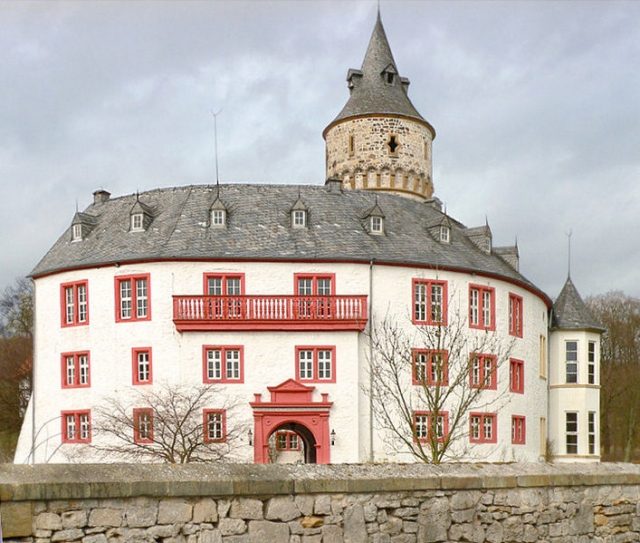
Oelber Castle is a castle located in Oelber am weißen Wege, a district of the municipality of Baddeckenstedt in the district of Wolfenbüttel in Lower Saxony. The castle building lies on the western foothills of the Lichtenberge, which form the northwestern part of the Salzgitter mountain range.
The circular complex is a comprehensive renovation from around 1580 on the foundations of a 12th-century moated castle. It was almost from the beginning in the possession of the noble family von Cramm, who, however, shared the property with another noble family until their extinction in 1686. Due to its picturesque appearance, the castle complex was used in 1960 for outdoor shots of the feature film "Das Spukschloß im Spessart" (The Haunted Castle in Spessart).
The former moated castle Oelber played only a minor role in the Middle Ages. Located in a valley of the Lichtenberge mountain range, away from the major military and trade routes, it was not contested. However, since its affiliation with the Principality of Braunschweig-Wolfenbüttel from 1523, the location had a sensitive position in the outermost southwestern tip of the heartland. Surrounded by foreign territories, the Dukes of Braunschweig kept it in their possession through all the turmoil. During the Thirty Years' War, the imperial general Count Tilly quartered himself and his troops in the complex, which had by then become a castle, for three months in 1626. Even today, a room bears the name "Tilly Hall". After his departure, the Danish army under Count Philipp Reinhard von Solms occupied the castle and devastated it as well as the village. Tilly's troops confronted the Danes under King Christian IV about 15 km south of Oelber am weißen Wege and defeated them on August 27, 1626, in the Battle of Lutter am Barenberge.
Feudal History
In the sense of feudalism, the bishops of the Diocese of Hildesheim initially held sovereignty over the castle and village. After the Hildesheim Diocesan Feud, the Principality of Braunschweig-Wolfenbüttel became the new feudal lord for the castle owners in 1543.
Construction History
The current castle complex stands on the foundations of a medieval moated castle and appears in a historical description as follows:
The noble castle Oelber is... a quite respectable, but almost old building, built by the distinguished noble family von Cramm. This castle... is built in a circular shape, surrounded by a moat.
Around 1580, extensive renovations took place, which amounted to a new construction. The then lord of the castle and Landgrave of Hesse's governor of the lands on the Lahn in Marburg, Burchard VI. von Cramm, transformed the mighty, almost closed building with an inner courtyard into a Renaissance castle. The Marburg Castle served as a model. The surrounding moat was drained and filled. A tradition states:
Anno 1583, Burchard von Kram... together with his brother Frantz von Kram, rebuilt and extensively adorned Oelber Castle as if anew.
Further renovations were carried out in the 19th century when the east wing was redesigned. The round stair tower in the inner courtyard was also raised to create the impression of a keep. A larger park was created to the east.
The castle has a small inner courtyard, surrounded by mostly three-story buildings, some half-timbered. In a small area, there is a gap in the building, filled with a wall. Access is provided by a gate passage on the south side, which features a barrel vault with Renaissance beams. In addition to the actual castle, the upper castle, there is also a spatially separate outer bailey, dated to 1594. It is a simple, two-story rectangular building in Renaissance style.
Ownership
The ownership history of the former castle and the associated manor began in 1274 with the sale by the noble lords of Meinersen to the von Krebs family. Documents from 1296 and 1299 indicate that the knightly family von Cramm became the owner. Ludolf and Burghard von Cramm are mentioned as castellans. The von Cramm family had to share the castle and the manor for centuries with other noble families. In 1390, the von Steinberg family is mentioned as co-owners, and shortly thereafter, the von Bortfeld family took their place. Within the families, the rights were again divided, which led to difficult internal ownership conditions with a division into an upper and lower court (main castle and outer bailey). The castle therefore had four knightly seats until the 18th century. When the von Bortfeld family died out in 1686, the situation did not become simpler, as an ownership dispute broke out within the von Cramm family. Officially, the family was the sole owner only in 1766, and in 1771, the ownership conditions were finally settled. Since 1974, the financial manager Egbert von Cramm has been the lord of the castle.
Note: As the castle is privately owned, it is not accessible to the public, except on special occasions.
Noble Family von Cramm
The von Cramm family already appears in documents from the 12th century, their origin is presumed to be in the nearby village of Cramme in today's Wolfenbüttel district. They were a wealthy knightly family and a respected feudal tenant of the spiritual and secular lords of the region of today's Southeast Lower Saxony. In the Middle Ages, many descendants were knights or squires, but also ministeriales. In later centuries, family members served the Welf dukes as generals, chamberlains, and ministers. Worth mentioning are:
- Aschwin IV, a mercenary leader of the 16th century, who served both French kings and Lüneburg dukes on European battlefields.
- Gottfried von Cramm, the "Tennis Baron" (1909-1976), became world-famous as a tennis player, reaching the Wimbledon tennis tournament final three times. He is buried in Oelber am weißen Wege near the castle chapel after his fatal car accident in Egypt.
Castle and Village
The village of Oelber was historically closely linked to the castle and its lords. The economic basis of the noble owners was large land ownership in the form of a manor. The land and large livestock provided wages and bread for the villagers. Subsidiary businesses also emerged, such as a distillery, a brewery, a brickworks, and a lime works.
Current Use+
After Egbert von Cramm took over the castle complex in 1974, he had the traditional property extensively renovated. His wife Helena, née Countess von Metternich, made the castle a focal point for the entire region. Together with Anna von Veltheim, née Countess zu Rantzau, she founded an event company that organizes events such as exhibitions, concerts, auctions, art and antique fairs, festivals, and a Christmas market in the castle complex and in the restored manor buildings. A special attraction for many visitors are the knight games in summer.
Castle as a Film Set
In 1960, director Kurt Hoffmann filmed outdoor scenes for the movie "Das Spukschloß im Spessart" (The Haunted Castle in Spessart) with Liselotte Pulver against the picturesque backdrop of the castle. The plot takes place in the wooded Spessart of the present day, where ghosts haunt the castle, having been walled up centuries ago as robbers. The haunting suits the impoverished castle owner, as the edifice is to be bought and converted into a luxury hotel. The film attempted to build on the cinematic success of "Das Wirtshaus im Spessart" (The Inn in Spessart) from 1958.
Take Mobile History with you
You are reading this text for free. Premium adds what matters on the road: descriptions read aloud, sites found through your camera, whole regions taken offline.
- Every description, including the ~17,700 Premium sites
- Audio guide: have descriptions read to you on location
- AR finder: see sites through your camera, with distance and bearing
- Unlimited saved sites
14 days free, then from €2.99 a month. Cancel anytime.
Source: Wikipedia · Licence: CC BY-SA 4.0 · Image: https://de.wikipedia.org/wiki/Datei:Schloss_Oelber_S%C3%BCdseite.jpg
This description draws on the facts documented in the linked Wikipedia article; Wikipedia content is licensed under CC BY-SA 4.0. Wording and editing: Mobile History.
Location: 52.1017, 10.2378