To be privately owned
CastleEssen - Kettwig
Oefte Castle
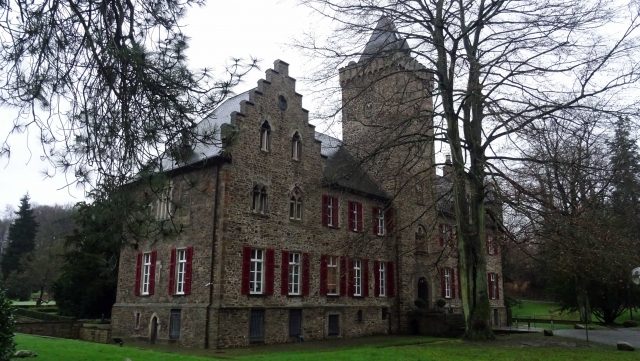
Schloss Oefte, also known as Haus Oefte, on the south bank of the Ruhr in Essen-Kettwig, was a fief of the Imperial Abbey of Werden in the Middle Ages and was first documented in the 9th century. The complex is thus one of the oldest manor houses in the region.
The meaning of the name is roughly "forest house by the river". From 1424 to 1938, the tower ruin of Luttelnau Castle, known as Kattenturm, also belonged to the Oefte estate.
Since 1985, the castle complex and its surrounding park have been listed as a historical monument. It is used by a golf club and is therefore not publicly accessible.
Schloss Oefte is a two-winged building clad with quarry stone, which received its current appearance through alterations in the 19th century and renovation work in 1961. Its wings are connected by a centrally located square tower. This projects from the facade like a risalit. It has a corbelled battlement from 1888 and three windows with double central columns in the Romanesque style. The two-story wings on the sides are divided into five axes by windows. The grand staircase in front of the tower dates from 1842 and was formerly accessible via a stone arch bridge.
A map from 1771 still shows the castle as a two-part complex, consisting of an outer bailey and a manor house surrounded by moats. The outer bailey – as well as a former chapel – was demolished, so that no above-ground traces are visible today. However, the former moat is still clearly recognizable as a depression in the terrain.
As Uvithi, the surrounding Honnschaft was already mentioned in 796 at the time of Saint Liudger, when he acquired numerous estates in the vicinity of Werden for a monastery foundation. Like many fortified houses in the Ruhr valley, it was a superior court with several associated subordinate courts at the end of the 12th century. The court was transferred to the von Oefte family, who held the office of Droste of Werden Abbey.
Since 1377 an open house of the Archbishop of Cologne Friedrich III von Saarwerden, the Lords of Oefte engaged in robber knighthood from there during the 14th century. In the 15th and 16th centuries, the Lords of Eller and the Lords of Uhlenbrock were alternately enfeoffed with Haus Oefte.
Through the marriage of Gertrud von Eller, Oefte came to Dietrich Ottmar von Erwitte, a military leader in the Thirty Years' War, in the 17th century. His daughter Maria Elisabeth Ursula married Ferdinand Wilhelm von Dornick and thus brought Haus Oefte to his family.
Numerous other owners followed in quick succession, namely the families von Winter zu Bromskirchen, von Dalwigk zu Lichtenfels and the Barons von Vinke auf Ostenwalde, before the castle came to Imperial Count Werner von der Schulenburg-Wolfsburg in 1818 (other sources mention the years 1822 or 1834) through the marriage of Baroness Charlotte Louise Ernestine von Vincke. She and her descendants had the complex fundamentally redesigned in the Neo-Gothic style in the 19th century (1842 and 1888) by the Hanoverian architect Ferdinand Schorbach, so that only remnants of the Romanesque complex from the 12th/13th century have been preserved in the lower part of the northwest wing. At the same time, the current landscape garden was also created.
Take Mobile History with you
You are reading this text for free. Premium adds what matters on the road: descriptions read aloud, sites found through your camera, whole regions taken offline.
- Every description, including the ~17,700 Premium sites
- Audio guide: have descriptions read to you on location
- AR finder: see sites through your camera, with distance and bearing
- Unlimited saved sites
14 days free, then from €2.99 a month. Cancel anytime.
Source: Wikipedia · Licence: CC BY-SA 4.0 · Image: Jörg Heldt
This description draws on the facts documented in the linked Wikipedia article; Wikipedia content is licensed under CC BY-SA 4.0. Wording and editing: Mobile History.
Location: 51.3652, 6.9626