To be privately owned
CastleLüdenscheid
Oedenthal Castle (Lüdenscheid)
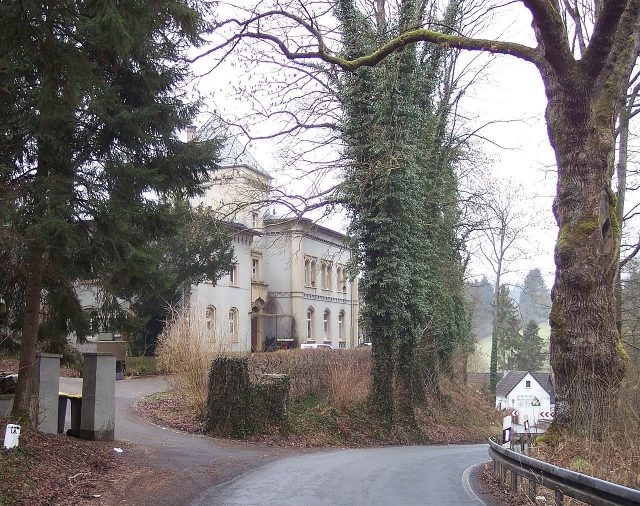
Oedenthal Castle is a manor house in the northwestern area of the city of Lüdenscheid. It is located on a mountain spur above the confluence of the Grebbecke and Linnepe, a tributary of the Volme. Starting from the B 54, a driveway leads past the property towards Heerwiese / Brockhauser Ebene.
The first documented mention was in 1160 as Odincdala. At that time, it was a property subject to tribute to the Werden main court of Schöpplenberg. The Lords of Odendal, as they were called at the time, also owned estates in neighboring Othlinghausen since the 13th/14th century. Their coat of arms, in the form of three linked rings, matched that of the Neuhoff family at Neuenhof Castle, suggesting that they were of the same lineage. From the mid-16th century, Oedenthal was owned by various changing noble families. In 1725, it was auctioned. Georg Hermann von Holtzbrinck acquired the estate, as well as Haus Rhade in the Volme valley in the same year. Von Holtzbrinck was General Crown Postmaster with ministerial rank in Wettin Poland and had been elevated to hereditary nobility by the Saxon Elector and Polish King. As he remained childless, he appointed his nephew, the Prussian War Commissioner Georg Wilhelm von Lent, as his main heir, should his second wife, a Baroness von Büna, remarry. After this happened, but she still claimed inheritance rights, a settlement was reached: Frau von Büna received Holtzbrinck's Saxon and Polish estates, while von Lent received the Sauerland-Märkisch ones. At his uncle's request, he himself adopted the name von Holtzbrinck. For about two hundred years, his descendants resided at Oedenthal as a country and partly also main residence. Two of them received a renewal and recognition diploma of their "old nobility" from Frederick the Great in 1767. Heinrich Wilhelm von Holtzbrinck, Prussian President of the Government and temporarily Prussian Minister of Commerce, spent his retirement at Oedenthal. Since 1931, it, along with the associated farms and lands, has been in bourgeois ownership. The predecessor building of the current manor house is said to have been a moated castle with a drawbridge, "not as surprising as one might assume, given the abundance of water even for a spur location like this." After a fire around 1865, the existing buildings were erected.
Description+
The irregular composition of the individual building parts suggests a reuse of the foundations of the burnt-down predecessor building. The substance of the cellar vaults and other structural remains confirm this. Two building wings of different heights with differing facade designs now flank a massive tower. After the removal of the original corner battlements, it now only has a simple pyramid roof, but still forms the architecturally dominant element. On the street front, it also houses the main portal with a Tudor arch under the coat of arms of the von Holtzbrinck family. The entrance is surmounted and enhanced by an ornamental balcony on the first floor. Ornamental elements in the Neo-Gothic Tudor style can also be found on the other parts of the building. The main building, despite its more modest dimensions, shows a clear stylistic kinship with Herdringen Castle near Arnsberg. Immediately adjacent as a kind of outbuilding is the so-called "Jägerhaus" (Hunter's House), a regionally typical long-hall house from around 1700 with a striking side portal in the Neo-Renaissance style.
Oedenthal Water Mill+
For about 800 years, a water mill has belonged to the Oedenthal estate and castle. The historic building, a typical Märkisch rubble stone plastered building with a boarded gable, is located directly below the castle. Originally, it had two water wheels. The existing one was operational until the 1980s, but is currently in great need of repair. As late as the 1940s, a threshing machine, a grain mill, a bone mill, a dough machine and other kitchen appliances in the attached bakehouse, as well as a power generator, were operated by hydropower. After an interruption, the mill once again houses an excursion restaurant with a beer garden. Towards the street, the appearance, distorted by advertising signs, needs improvement.
Surroundings+
The castle and mill are located in a largely authentically preserved area of the Märkisch cultural landscape around the valleys of the Linnepe and Grebbecke. They are easily accessible via hiking trails from the Hohe Steinert or the former village of Lüdenscheid-Othlinghausen (also with a traditional excursion restaurant). The Rhein-Ruhr long-distance hiking trail of the Sauerländischer Gebirgsverein (SGV) touches the castle.
Take Mobile History with you
You are reading this text for free. Premium adds what matters on the road: descriptions read aloud, sites found through your camera, whole regions taken offline.
- Every description, including the ~17,700 Premium sites
- Audio guide: have descriptions read to you on location
- AR finder: see sites through your camera, with distance and bearing
- Unlimited saved sites
14 days free, then from €2.99 a month. Cancel anytime.
Source: Wikipedia · Licence: CC BY-SA 4.0
This description draws on the facts documented in the linked Wikipedia article; Wikipedia content is licensed under CC BY-SA 4.0. Wording and editing: Mobile History.
Location: 51.2328, 7.5842