To be privately owned
CastleOberköllnbach
Oberköllnbach Castle
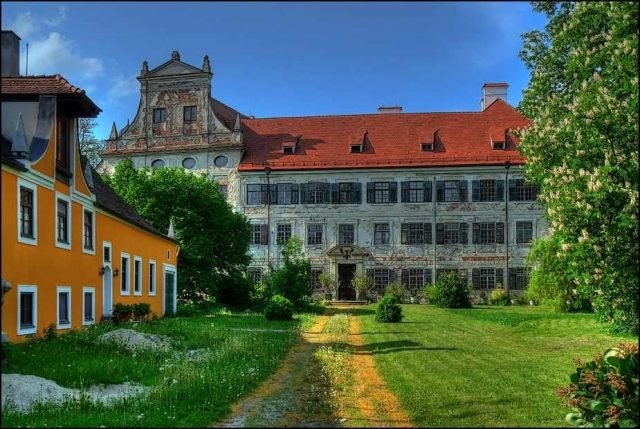
Old records about a Köllnbach are often attributed to the place Großköllnbach in today's district of Dingolfing-Landau. An entry from the 13th century definitely refers to Oberköllnbach, when a family of citizens named after Köllnbach became traceable in Landshut. An ecclesiastical institution is considered the oldest landowner in Köllnbach, over whose estates the duke exercised the Vogt rights at the end of the 13th century. Around 1500, the Hofmark comprised the villages of Ober- and Unterköllnbach, Au, Veitsbuch, and three other estates. It is considered certain that until the 15th century, Unterköllnbach consisted of only two farms, while the present Oberköllnbach was the center of Köllnbach.
The further history of the village is closely intertwined with the history of Oberköllnbach Castle. Within the framework of the castle estate, all professions necessary for its maintenance were practiced, but these were not independent craft businesses in the modern sense. The remaining inhabitants belonged to the unfree peasantry and had to pay tributes to the landlord, first in kind, later in money, and perform corvée labor on the estate. They were entitled to the usufruct of forest, water, and pasture, with the exception of hunting and fishing. They were also subject, as far as minor offenses were concerned, to the landlord's court, which he could primarily exploit financially through fines. Capital crimes, however, had to be referred to the ducal regional court.
During the Thirty Years' War (1618 to 1648), the population fled with livestock and other possessions into the castle, and the then lord of the castle, Ladislaus von Törring, tried to defend his manor, but without success. The Swedes stormed the castle and ravaged it terribly. The lord of the castle himself had just managed to escape. The underground escape routes, one of which is partially preserved in Oberköllnbach, are also likely to date from the time of the Thirty Years' War. The castle was rebuilt in 1670 as a four-wing complex.
In the year of the inventory in 1752, the Counts Arco auf Valley were the owners of the Hofmark Oberköllnbach with the parts Hofberg and Armannsberg. At that time, the village housed numerous farmers and cottagers, as well as some craftsmen, in 31 properties. In 1840, Oberköllnbach counted 35 houses with 195 inhabitants.
In the revolutionary year 1848, the noble and manorial jurisdiction passed to the state. Political communities were formed. Even around the middle of the 19th century, the rural village of Oberköllnbach and the typical manorial settlement of Hofberg were structurally and functionally clearly separated. Thereafter, the valley floor along the connecting road was developed, thus abolishing the separation. In 1970, Oberköllnbach had 226 and Hofberg 181 inhabitants.
Take Mobile History with you
You are reading this text for free. Premium adds what matters on the road: descriptions read aloud, sites found through your camera, whole regions taken offline.
- Every description, including the ~17,700 Premium sites
- Audio guide: have descriptions read to you on location
- AR finder: see sites through your camera, with distance and bearing
- Unlimited saved sites
14 days free, then from €2.99 a month. Cancel anytime.
Source: Wikipedia · Licence: CC BY-SA 4.0
This description draws on the facts documented in the linked Wikipedia article; Wikipedia content is licensed under CC BY-SA 4.0. Wording and editing: Mobile History.
Location: 48.6748, 12.3179