School
CastleLutherstadt Wittenberg - Nudersdorf
Nudersdorf Castle
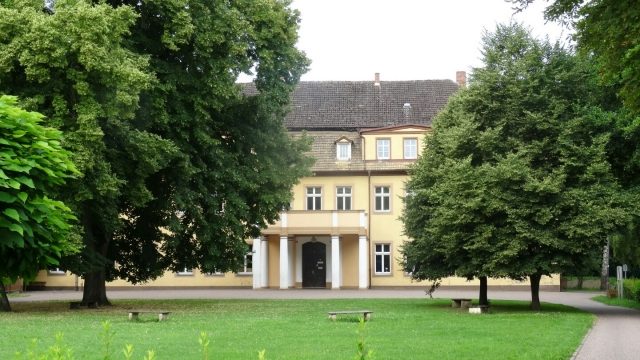
Nudersdorf Castle is an 18th-century building located in the Nudersdorf district, which belongs to Lutherstadt Wittenberg in Saxony-Anhalt.
On January 20, 1548, Chancellor Dr. Gregorius Brück received from Elector Moritz of Saxony, among other things, the village of Nudersdorff with all rights and with the hare hunt on the same village market as a fief. Moritz had become the new sovereign of the Electorate of Saxony with the acquisition of the electoral dignity and renewed the enfeoffment, which had previously been carried out by Duke Friedrich of Saxony when Brück acquired the estates from Bernhard Brambach, a citizen of Wittenberg.
The aforementioned enfeoffment letter did not yet mention a manor in the true sense of the word. An estate consisting of two wings meeting at right angles must have been built by Gregor Brück. The estate also included a paper mill, which Gregor Brück's son of the same name sold in 1578 to Dr. Veit Winsheim from Wittenberg.
By 1592, Nudersdorf was already in the possession of representatives of the von Leipzig family. In 1622, Wilhelm Löser acquired the Nudersdorf estate from the heirs of the deceased Friedrich von Leipzig. During the Thirty Years' War, the Nudersdorf estate is said to have been "demolished". In 1654, Ludomilla Löser undertook to clear the Nudersdorff estate again and transfer it to Georg Heinrich Löser in Kropstädt. From this point on, the ownership of the Nudersdorf and Kropstädt estates was linked, and representatives of the Löser family regularly renewed the enfeoffments at the Dresden fief court until the beginning of the 18th century. After the death of Georg Heinrich Löser, his three brothers Wilhelm Heinrich, Eustachius, and Wolf Adam Löser, who lived abroad, did so. Their cousin Magnus Löser († 1693) also had a share in the Nudersdorf estate.
In 1704, Wilhelm Heinrich Löser took over the estate as sole owner, having already ensured its structural renewal in its present external form (coat of arms stone from 1703). Wilhelm Heinrich Löser died in 1709 without leaving any children of his own. His two brothers Eustachius and Wolf Adam therefore inherited the estate. As the latter continued to live abroad, Eustachius became the new hereditary and judicial lord of Nudersdorf. He died on January 23, 1732, and his two sons Jost Heinrich and Eustachius Friedrich Löser inherited the estate, and since they were in military service, they sold it in 1738 to the court councilor and ordinary professor in Wittenberg, Dr. jur. Augustin Leyser. The ennobled Leyser died on May 4, 1752, in Wittenberg without leaving any living sons. As desired, he was buried in Nudersdorf on the 9th of the month. The estate then fell to the Braunschweig-Lüneburg Chief Appellate Councilor Friedrich Wilhelm von Leyser in Celle. After Leyser died on July 15, 1766, his two sons Friedrich Wilhelm and Georg Ludwig von Leyser took over the Nudersdorf estate. The latter ceded his share of the estate to his older brother in 1767. Friedrich Wilhelm von Leyser died unmarried on April 3, 1784, in Celle and had bequeathed the estate by will to his nephew August Wilhelm Friedrich von Leyser, born in 1771. He became a Rittmeister in the Garde du Corps and in 1803 achieved the conversion of the male fief into an inherited estate. Leyser, who had meanwhile been promoted to Saxon Major General and Brigadier of Cavalry, sold the Nudersdorf manor, which had been in the Kingdom of Prussia since 1815, in the same year to the Prussian Chief Forester Alexander Ferdinand von Erdmannsdorf.
On November 18, 1840, the allodial manor of Nudersdorf was auctioned to the highest bidder, the economy inspector Christian Meyer from Wiesenburg, who acquired the estate on behalf of the Saxon chamberlain and manor owner Curt Friedrich Gottlob von Watzdorf from Wiesenburg. Watzdorf died on April 14, 1848, and his widow and children inherited the estate. They sold it on April 4, 1849, to the bailiff Johann Friedrich Pfau from Lobstädt near Borna, later residing in Anger near Leipzig. In 1850, Pfau transferred it to the brothers Gustav and Karl Wilhelm Luther. They built a bathhouse here. A discovered sulfurous spring was enclosed, and the water was piped to the bathhouse. The bath became well-known and had an increasing number of visitors year by year. The industrial boom (mining of coal and clay, crafts, trade) in Nudersdorf caused the cessation of bathing operations. In 1945, the owners were expropriated and expelled by the communists.
Since 1945, Nudersdorf Castle has been used as a school, initially as the Nudersdorf village school, later as a 10-grade, sometimes multi-stream polytechnic secondary school in Nudersdorf.
In 1992, the castle became the seat of the Südfläming administrative community. The Nudersdorf primary school (grades 1-4) was integrated. The building and the castle forecourt were renovated. A historical castle festival takes place annually in summer.
In 2005, Nudersdorf was incorporated into Lutherstadt Wittenberg, meaning the castle is no longer the seat of the Südfläming administrative community. However, it remains the seat of the citizens' office.
In 2006, the castle was repurposed by the relocation of the primary school to the 2nd floor and by the Nudersdorf youth club moving into the south wing of the castle.
Take Mobile History with you
You are reading this text for free. Premium adds what matters on the road: descriptions read aloud, sites found through your camera, whole regions taken offline.
- Every description, including the ~17,700 Premium sites
- Audio guide: have descriptions read to you on location
- AR finder: see sites through your camera, with distance and bearing
- Unlimited saved sites
14 days free, then from €2.99 a month. Cancel anytime.
Source: Wikipedia · Licence: CC BY-SA 4.0 · Image: Jörg Heldt
This description draws on the facts documented in the linked Wikipedia article; Wikipedia content is licensed under CC BY-SA 4.0. Wording and editing: Mobile History.
Location: 51.9269, 12.5923