School
CastleDornum
Norderburg Castle
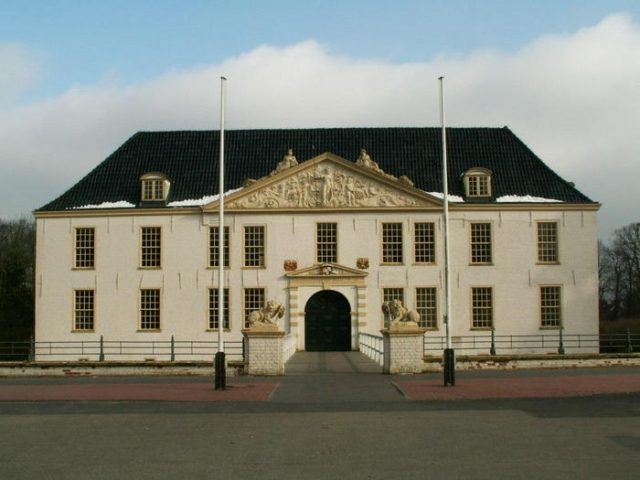
Norderburg is a moated castle in the East Frisian municipality of Dornum in northwest Lower Saxony. The main building and outbuildings have been used as a school since 1951.
As early as 1400, there were three chieftain's castles in Dornum: Norderburg, Westerburg, and Osterburg – the later Beningaburg. Norderburg, like Beningaburg, was probably built in the 14th century. The builder was presumably Olde Hero von Dornum, whose son and heir Lütet was married to Ocka tom Brok.
In 1397, Norderburg was the scene of arguably the most famous – and also literarily processed – family drama in East Frisian history: The son of Norderburg's builder, Lütet, allegedly at the advice of his mother-in-law, slew his wife Ocka for alleged infidelity and insubordination. Thereupon, his mother-in-law Foelke Kampana, wife of Chieftain Ocko II. tom Brok and popularly known as the "Quade Foelke" (Evil Foelke), showed her strong side and promptly took over the castle. Both Lütet and his father were beheaded on the mother-in-law's orders.
Around 1420, Norderburg came into the possession of the East Frisian chieftain family Kankena through the marriage of Lütet's daughter Etta to Mauritz Kankena.
All Dornum castles were destroyed in 1514 during the Saxon Feud. The Saxons had conquered the castles but sold them for 4000 guilders to Hero Omken from Esens. Hero Omken was a bitter enemy of the East Frisian Count Edzard I. Cirksena (1461–1528), with whom the original castle owners Hero Mauritz Kankena († 1518) and Hicko Mauritz Kankena († 1515) were allied. The Cirksena were able to briefly recapture the castle, but Hero Omken drove them out, plundered, and destroyed it. In 1534, Hicko Kankena had the destroyed Norderburg rebuilt as a precursor to the current castle, using bricks in monastery format and shell limestone mortar.
In 1556, Norderburg passed into the possession of the von Closter family, who originated from the Dutch province of Drenthe, and remained their property until the 18th century. The last hereditary lord, Haro Joachim von Closter (†1728), converted the castle between 1698 and 1707 into a magnificent Dutch Baroque palace with a park, within whose walls remnants of the old Renaissance complex can still be found. In 1707, the gatehouse from 1678 received its 30-meter-high tower, crowned with a Welsche Haube (Rhenish helmet). Bells hang in the two lantern-like intermediate sections of the tower. A passage with a wide round arch leads through the gatehouse to the actual main building. It was also Haro Joachim von Closter who had the saying "Envy is dearer to me than pity" placed above the archway in the inner castle courtyard. In a fire in 1721, the north wing burned down and was completely rebuilt.
Later, Norderburg changed owners several times. From 1920, the building was used as a private secondary school. One of the headmistresses was Christine Bourbeck, who later became known in Berlin as one of Germany's most important Protestant theologians. From 1930 to 1933, the East Frisian Farmers' College was housed in the building. From 1933, the building served as a Führer School for the SA and a living and training facility for the Reich Labor Service. In 1942, the castle passed from private ownership to state ownership.
After World War II, the building came into the possession of the State of Lower Saxony. From Easter 1951, a private secondary school was again housed in the Norderburg building. In 1956, it was converted into a public school, with the district of Norden taking over the school sponsorship.
Extensive restoration work was carried out by the State of Lower Saxony from 1994 and especially in the years 1998 to 2001.
Description+
Schlossstraße leads through the gatehouse from 1678 with its spire from 1707 and ends on the wide square of the outer bailey, into which the baroque castle avenue lined with old trees also flows. The square is surrounded by low buildings that were once farm buildings and the stables. From the outer bailey square, a wooden bridge leads over the moat surrounding the castle to the castle portal. Above the portal is a monumental gable, which in its center depicts Pallas Athena, the Greek goddess of wisdom and the art of war.
Significant is the Knights' Hall of Norderburg, a two-story room with a surrounding gallery and a baroque ceiling painting depicting Demeter, the goddess of fertility and the earth. Two baroque paintings by an unknown artist in the Knights' Hall show Hero Mauritz von Closter (1594–1673) with his four sons, the other his wife Almuth von Fridag (1604–1650) with her three daughters. The paintings exemplify how a noble Baroque family wished to be portrayed.
Take Mobile History with you
You are reading this text for free. Premium adds what matters on the road: descriptions read aloud, sites found through your camera, whole regions taken offline.
- Every description, including the ~17,700 Premium sites
- Audio guide: have descriptions read to you on location
- AR finder: see sites through your camera, with distance and bearing
- Unlimited saved sites
14 days free, then from €2.99 a month. Cancel anytime.
Source: Wikipedia · Licence: CC BY-SA 4.0 · Image: http://www.wehrbauten.de/thread.php?threadid=554
This description draws on the facts documented in the linked Wikipedia article; Wikipedia content is licensed under CC BY-SA 4.0. Wording and editing: Mobile History.
Location: 53.6489, 7.4299