To be privately owned
Golfclub
CastleSchwieberdingen - Nippenburg
Nippenburg Castle
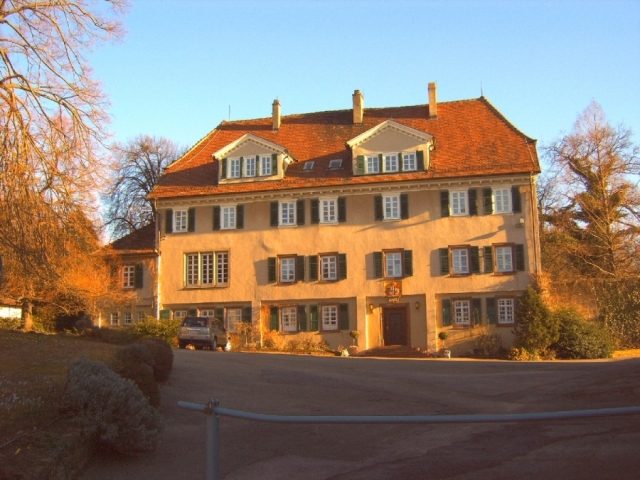
The Nippenburg is the ruin of a spur castle and a manor southwest of Schwieberdingen at 295 m above sea level. It was first mentioned in a document in 1160 and is considered the oldest in the Stuttgart region. In the 17th century, the castle, strategically located on a mountain spur above the Glems valley, was abandoned and the manor house Schloss Nippenburg was built in its immediate vicinity. In the following centuries, the castle complex was used as a quarry and left to decay. The remains of the castle ruin with high shield wall and outer bailey parts as well as a massive barn from 1483 were consolidated in the early 1980s.
The Nippenburg was probably built for military purposes in the 11th century by a local noble family. It is considered the oldest castle ruin in the Stuttgart area. The castle was first mentioned in a document in the Codex Hirsaugiensis, which attests to a mill built by a Berwart "below the Nippenburg" in 1160.
The original castle complex was expanded several times over time. For example, the Zwinger (outer bailey) in front of the ring wall dates from the first half of the 14th century. The outer bailey with the still preserved massive barn was built towards the end of the 15th century.
Due to the newly developed explosive projectiles and the accompanying replacement of catapults by mortars and cannons, the castle complexes could no longer offer sufficient protection to their inhabitants. Since living in castles was also cold, wet, and uncomfortable, they were increasingly abandoned. Around 1600, construction of the manor house Schloss Nippenburg began above the castle complex, which was expanded and altered in the 18th and 19th centuries.
When Wilhelm, the last knight of Nippenburg, built the manor house, he had stones broken out of the castle and used them as building material for his new residence. After the castle complex itself was inhabited until about 1700, it was left to decay in the following centuries. The exact time when the castle was completely abandoned as a dwelling and refuge cannot be precisely determined. An oven plate from 1770 found during restoration work suggests that the castle was still partially inhabited at a later date. However, correspondence between the bailiffs of Markgröningen and Leonberg, who argued over well-preserved boards and beams from the Nippenburg in 1647 and 1648, shows that parts of the buildings within the castle were already abandoned at that time and that the remaining parts of the castle were used until it was finally just a ruin. Over time, ivy and shrubs covered the remaining walls. Only the castle's storage rooms were used by the residents of the manor house for a long time.
In the 1960s and 1970s, the plan matured to renovate the dilapidated walls. To preserve the castle ruin, extensive restoration measures were carried out on the endangered walls from 1979 to 1984. The costs were borne by the State Monuments Office of Baden-Württemberg, the municipality of Schwieberdingen, the current owner Count Leutrum, and the district of Ludwigsburg. Today, the Nippenburg castle ruin is a popular excursion destination.
Nippenburg Castle Ruin+
The castle ruin is located southwest of Schwieberdingen on a hill at the edge of today's Nippenburg estate. The hilltop castle, situated on a mountain spur surrounded by the Glems river, was protected on three sides by swamps and the steep slope. This area immediately around the castle was once bare, as no tree or bush was to offer cover and protection to attackers. The castle was almost exclusively threatened from the east side, where the mountain spur continues into open terrain. To protect against this, the castle lords erected the mighty shield wall, parts of which are still visible today. In front of the sixteen-meter-high and three-meter-thick wall, a neck ditch ran southeast of the castle complex to ward off enemies. A stone arch bridge led over this wide and once approximately six to eight-meter-deep moat, ending three meters in front of the castle gate. The drawbridge located between the bridge and the castle gate – presumably replaced by another stone bridge arch in the 15th century – could be raised in case of danger. Due to this defense system, the Nippenburg provided its inhabitants with security and refuge for many centuries. It is not recorded that the Nippenburg was ever captured, destroyed, or burned down.
The complex has two outer baileys. The first, southern outer bailey with a large castle barn and the wide former courtyard area, shows the remains of two castle gates in the west and east. The remains of the eastern gate tower to the left and right of the path still indicate today that there was a well-fortified defensive system on this side with a covered battlement that extended to the castle barn. The castle guard was also stationed here.
Next to the large open meadow in the southern outer bailey is an economic building, the Gothic castle barn built in 1483, largely preserved in its original form. Beneath it is an unusually large vaulted cellar, which was vital for storing provisions, especially during longer sieges. Under the barn roof are three grain lofts built one above the other. The southern forecourt of the castle was probably filled with the excavated material from the construction of the neck ditch. This created a high retaining wall, which is enclosed in the south by two projecting walls, forming a Zwinger-like area.
The western castle gate leads down to the Glems valley. Here, too, the former chain slots of the drawbridge can be seen. Following the path through the second castle gate towards the valley, on the right-hand side is a stretch of wall belonging to a former farmyard. On the inner walls of the farmyard, under a lean-to roof, were the stables and the forge on one side, and the servants' quarters with a wheelwright's and saddler's workshop on the other. A little further on, one encounters the recognizable remains of an earlier rampart and ditch system, which served as a first defensive area of the castle to the west. A steeply sloping footpath or bridle path leads here to the Glems, which is about 50 meters lower.
In the western outer bailey, opposite the large castle barn, only the remains of a cistern and a once tall keep with the five-meter-deep dungeon cellar below it, which cannot be viewed, are found.
Through the opening of the inner castle gate, which no longer exists today, one enters the courtyard of the main castle. Here, in the eastern part, rises the back of the mighty shield wall, to which a ring wall connects on both sides, which in earlier times surrounded the entire castle courtyard. The wall is mostly still preserved hip-high today, well secured, and only interrupted to the north. It is presumed that parts of the wall on the steep slope have eroded. An information board with a floor plan and history of the Nippenburg is attached to the inside of the old ring wall.
A gate in the ring wall, towering high in the southern part, opens the way to the southeastern Zwinger. This represented another important defensive area due to the multitude of loopholes. In the southeastern corner of the Zwinger stood the watchtower, wantonly destroyed in 1945 and popularly known as "Käppele". The lookout, still completely preserved today, testifies that the gatekeeper operated the drawbridge from here.
In the castle courtyard itself, between the keep and the still preserved castle cellar, was the spacious kitchen. The vaulted ceiling of the castle cellar once formed the foundation for the palas, which is only fragmentarily preserved and, apart from some windows and restored walls, shows few details. Under the protection of the shield wall stood the women's quarters, called the Kemenate, to which a small chapel was attached.
Schloss Nippenburg Manor House+
As the castle increasingly lost its original function from the late 16th century onwards, a representative castle was built in its immediate vicinity, constructed in 1600 by Heinrich Schickhardt, and rebuilt in 1728 and again in the 19th century. The current three-story plastered building in classical design, which can be considered a typical rural noble residence, includes a farmyard with various buildings and a park. Since 1951, the castle has again been inhabited by the comital family Leutrum von Ertingen, the direct descendants of the Knights of Nippenburg.
In the rear area of the manor house, enclosed by old walls, lies the approximately two-hectare castle park. The more than 200-year-old park has been redesigned several times over the centuries. The oldest map from 1767 shows straight rows of fruit trees in the area of today's park. Only at the end of the 18th and in the 19th century was it transformed into its current form in the style of an English landscape garden. An English garden, in contrast to a French Baroque garden, is intended to imitate nature as closely as possible; there are no straight axes or strict geometric shapes. Along the paths covered with fine gravel, the castle park features more than 30 different species amidst the closely mown lawn, including rare oaks and beeches, sequoias, trumpet, tulip, and ginkgo trees, as well as some seemingly interspersed rose beds and flower borders. A botanical specialty is a dawn redwood (Metasequoia). This deciduous conifer species was only discovered in China in 1941 and was previously only known from fossil finds.
The castle park, like the manor house itself, is privately owned by the family von Ertingen and is not accessible to the public. On the Day of Open Monuments on September 10, 2006, which was themed "Lawns, Roses and Borders – Historic Gardens and Parks," the Local History and Culture Association Schwieberdingen offered guided tours through the otherwise closed garden.
Inhabitants of Nippenburg+
The Nippenburg was built as the ancestral seat of the noble family of the same name residing here. The origin of the family name is not clear. However, it is presumed that the name can be traced back to an Alemannic tribal leader named Nippo.
The family of the Lords of Nippenburg is first mentioned in a document in 1273, when a Fridericus de Nippenburc appeared as a witness in a document of Count Palatine Ulrich von Tübingen. However, their name also appears in a source from 1662 for a much earlier period, as it speaks of a knight Wilhelmus de Nippenburg who is said to have attended the equestrian games in Konstanz on Lake Constance in 948.
The Nippenburgers were initially vassals of the former Count of Asperg, a branch of the Counts Palatine of Tübingen, and from 1308 onwards, they were associated with the Württemberg territorial and feudal lords. However, individual members of the widely branched family tree also appeared as Baden and Hohenlohe vassals throughout history. In the 14th century, the Lords of Nippenburg already held rights and possessions in many places, which expanded in the course of the 15th century. Their lands were located in the extensive area stretching from the Korngäu and Schönbuch in the south to the Zabergäu in the north, and from the Pforzheim area in the west to the Remstal in the east. At times, they also owned Kleiningersheim Castle, Ditzingen Castle, and Bromberg Fortress in the Kirbach valley. In 1488, the Knights of Nippenburg joined the Swabian League, which emerged from the merger of the knightly society Sankt Georgenschild and some imperial cities, at the imperial request. Since the League was directly subordinate to the Empire, they gained greater independence from their sovereign by joining. In addition to expanding and consolidating their secular power, the Lords of Nippenburg also sought to gain ecclesiastical power. Thus, Fritz von Nippenburg was the first known church lord of St. George's Church in nearby Schwieberdingen in 1306 and thereby had a say in the allocation of ecclesiastical offices. As local lords of Schwieberdingen, the Nippenburgers also acted as builders. In 1489, work began on the nave of St. George's Church, and in 1495, the construction of the choir. Furthermore, the construction of the moated castle in 1508 and the castle barn in 1565 can also be attributed to the Lords of Nippenburg.
As the only one of his lineage, Philipp von Nippenburg, born in 1458, also rose to the highest state offices. In 1498, he was appointed to the Württemberg government. By 1501, he was already ducal Württemberg court master. During the time of the "Poor Konrad" uprising, he was one of the most important advisors alongside Duke Ulrich of Württemberg, who then enfeoffed him with the hereditary cupbearer office in the Duchy of Württemberg in 1515. The coat of arms of the Nippenburgers, previously an open eagle's flight on a blue background, was from then on extended by the cupbearer's goblet. The year 1518 brought further advancement for Phillip von Nippenburg. He was appointed Württemberg Landhofmeister (chief court official) and, together with the legal chancellor, took over the government affairs. During this time, the Nippenburgers were at the peak of their economic and political power.
With the beginning of the 17th century, a decline in Nippenburg's possessions, which had reached their greatest territorial extent towards the end of the 15th century, can be observed. This is mainly due to the fact that after the decline and extinction of Nippenburg side lines, the lands were inherited by other knightly families. From then on, the possessions of the Lords of Nippenburg concentrated predominantly around Hemmingen, Schöckingen, Schwieberdingen, and Unterriexingen.
After the lineage of the Knights of Nippenburg in Schwieberdingen died out in 1609 with the death of the last hereditary cupbearer Wilhelm von Nippenburg, the castle and estate passed to the House of Stockheim in 1611 through the marriage of Anna Benedikta von Nippenburg and Baron Johann Heinrich von Stockheim. The male line of the Nippenburgers outside Schwieberdingen died out with the death of Ludwig von Nippenburg in 1646. The name and coat of arms of the Nippenburgers lived on as a byname in the comital family Bissingen-Nippenburg, as Johann Friedrich von Bissingen married Kunigunde von Nippenburg in 1646 and took over the Nippenburg ancestral property. The former seat of the Counts of Bissingen and Nippenburg, Hohenschramberg Castle, is therefore sometimes also called Nippenburg today. The female line of the family von Nippenburg survived until the end of the 17th century. As "the last of her lineage and name," as it says on her tombstone in Böblingen, Ursula Margaretha Truchsess von Höfingen, née von Nippenburg, died in 1696.
Through Friederieke Julianne von Stockheim, the granddaughter of Anna Benedikta von Nippenburg, who brought the castle and estate as a dowry into her marriage with Count Ernst Ludwig Leutrum von Ertingen in 1685, the property came into the family possession of the Counts Leutrum, to whom the castle, manor, and estate still belong today.
Sagas and Legends+
Like many medieval castles, the Nippenburg is also surrounded by several sagas and legends.
It is said that once, in the swampy terrain of the lowlands of the Glems valley below the Nippenburg, all warriors perished in the moor during a battle.
Long after that, a knight lived at Nippenburg who had a single daughter. Knight Christoph von Hemmingen courted her. One time, the bride returned home late at night. In the darkness, she strayed from the path and fell into the moor. No one heard her cries for help, and she sank into the moor. When they searched for her the next day, they found only a small cloth of hers. To forget his great sorrow and not be constantly reminded of the terrible misfortune, the groom went to war with the emperor. But even in the midst of war, he could not forget his young bride and her painful end. Nothing more was heard of him in his homeland. After his military service, he is said to have entered a monastery where he lived for many years and dedicated himself to natural medicine. Having grown old, he was drawn back to the place of his former great love, and when a monk built a hut and settled below the Nippenburg, no one recognized the former youth, for many decades had passed, and there were only a few people left at Nippenburg and in Hemmingen who could remember the misfortune of that time. Soon it was rumored in the area that an old monk lived below the Nippenburg, praying day and night. He collected grasses, herbs, and roots and distributed them to the sick who sought healing for all kinds of ailments. They brought him food and drink and revered him as a saint. They also helped him build a small church. So the years passed, and one morning, when seekers of help knocked on his door again, it remained silent: The old man lay dead in his hut. When the summoned men laid him on a stretcher, a golden cross emerged from under his cowl. On one side it read: "Knight Christoph von Hemmingen" and on the other: "Love never ends." The place below the Nippenburg is still called the Moorkirchle (Moor Chapel) today.
The Nippenburg is also associated with all sorts of ghost stories. It is said that a count named Hans buried his fortune there and continues to guard it after his death. In earlier times, it was also reported that a headless rider was often seen at the Schwieberdingen quarry, whose horses had braids woven into their tails and manes by ghosts. Furthermore, stories are told about the Käppele, the so-called old watchtower of the Nippenburg. It is said that the path to Schwieberdingen should be avoided at night, as the Käppelesgeist (Käppele ghost) goes down from the Nippenburg to Schwieberdingen at night.
Schloss Nippenburg Golf Course+
In direct proximity to the Nippenburg manor house lies the 18-hole Schloss Nippenburg Golf Course. The 90-hectare area, once used for agriculture, was transformed into a modern golf course in 1995. The planning of the 6,154-meter-long, par 71 course was the responsibility of top German golfer Bernhard Langer. In addition to the 18-hole main course, there is a practice facility with a driving range, putting and chipping greens, and three practice bunkers.
The Schloss Nippenburg Golf Course became world-renowned through the German Open, which were held here from 1995 to 1997. The winners of the tournaments, each endowed with almost two million Deutschmarks, were Colin Montgomerie from Scotland in 1995, Ian Woosnam from Wales in 1996, and Ignacio Garrido from Spain in 1997.
Take Mobile History with you
You are reading this text for free. Premium adds what matters on the road: descriptions read aloud, sites found through your camera, whole regions taken offline.
- Every description, including the ~17,700 Premium sites
- Audio guide: have descriptions read to you on location
- AR finder: see sites through your camera, with distance and bearing
- Unlimited saved sites
14 days free, then from €2.99 a month. Cancel anytime.
Source: Wikipedia · Licence: CC BY-SA 4.0 · Image: http://schloesserrundschau.de/bawue/schloesser/nippenburg.html
This description draws on the facts documented in the linked Wikipedia article; Wikipedia content is licensed under CC BY-SA 4.0. Wording and editing: Mobile History.
Location: 48.8609, 9.0588