Uninhabited
CastleMittweida - Zschöppichen
Neusorge Castle
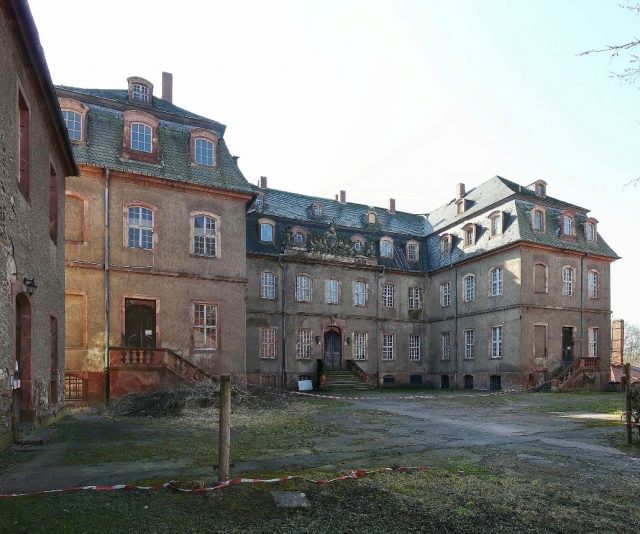
Neusorge Castle is a baroque castle complex in the Zschöppichen district of the city of Mittweida.
Zschöppichen was first documented in 1350 as property of the Knights of Wolkenburg and named a knight's seat in 1445. In the mid-15th century, Zschöppichen came into the possession of the von Stockhausen family and from them, through inheritance, to the von Schönberg family. The von Schönberg family coined the name Neusorge, building a Renaissance castle in 1579 after a fire, replacing the former castle complex. In 1610, Neusorge was sold to Elector Christian II of Saxony and in 1689 came into the hands of the von Arnim family.
General von Arnim erected the castle complex in baroque form in 1720, but it was destroyed again in 1745 by a fire after a lightning strike. Reconstruction, presumably based on plans by the Saxon Rococo architect Johann Christoph Knöffel, began in 1751 but was only completed in the late 1760s due to the Seven Years' War and a brief change of ownership to Gotthelf Adolph von Hoym (1756/67) by Carl Sigismund von Arnim (1700–1773). Completed means: The manor, the court building, as well as the orangery and the park were finished. Also the guesthouse, dovecote, and sheep farm. The castle itself remained an unfinished shell and was temporarily used as a barn and distillery. Carl Sigismund von Arnim sold the almost rebuilt Neusorge Castle to Heinrich von Bünau. Through several interim purchasers, Neusorge came into the possession of the von Carlowitz family, who sold the castle before World War I to the Leipzig Welfare Association, which used the orangery and castle as a children's home.
In 1923/24, Elsa Brändström took over Neusorge Castle to house a children's home for children of former German prisoners of war who had died in Russian captivity. In addition to 60 permanent children, half or full orphans who grew up in family groups, the castle also hosted groups of 150 recuperating children for several weeks at a time. By the time Elsa Brändström gave up the house in 1931, 2931 children had come here for recuperation. The Leipzig Welfare Association received the house back, but its use was ended by the National Socialists in 1934, and the castle was then used as a motor sports school by the NSKK. The manor was divided into 10 agricultural enterprises as the so-called 1st Saxon Peasant Settlement. After World War II, the castle served as a refugee home, briefly as a sports school, and came under the legal responsibility of public education for the Karl-Marx-Stadt district, where it was again used as a children's home and school for difficult-to-educate children and young people, named after the socialist Spanish fighter Fritz Pawlowski, until 1993. Since then, the castle has stood empty and is decaying. In 2014, a monument in honor of Brändström was inaugurated by the Swedish ambassador.
Complex+
The Baroque castle is an eleven-axis, three-wing complex (park side: 13 axes) with a courtyard of honor. The plastered building has two full stories and a mansard story on a large vaulted cellar; on the park side, there are three full stories. In front of it is a gatehouse with the mirrored courtyard of honor as the farmyard of the former estate, to whose side wings the large orangery adjoins at a right angle to the west, while the building called the Erbgericht adjoins the eastern side wing of the gatehouse. The farmyard, built of quarry stone, is single-story with dormer windows in the pitched roof. The formerly baroque park in front of the baroque terraces is heavily overgrown. The pond is silted up. The statues of the Four Seasons by the sculptor Johann Gottfried Knöffler were not sold with the castle by the Carlowitz family but were lost during the air raid on Dresden in 1945. In 1984, a new children's home was built in the park using prefabricated construction.
Take Mobile History with you
You are reading this text for free. Premium adds what matters on the road: descriptions read aloud, sites found through your camera, whole regions taken offline.
- Every description, including the ~17,700 Premium sites
- Audio guide: have descriptions read to you on location
- AR finder: see sites through your camera, with distance and bearing
- Unlimited saved sites
14 days free, then from €2.99 a month. Cancel anytime.
Source: Wikipedia · Licence: CC BY-SA 4.0 · Image: Thomas Eichler
This description draws on the facts documented in the linked Wikipedia article; Wikipedia content is licensed under CC BY-SA 4.0. Wording and editing: Mobile History.
Location: 50.9524, 12.9912