To be privately owned
CastleNeuhaus an der Donau
Neuhaus Castle
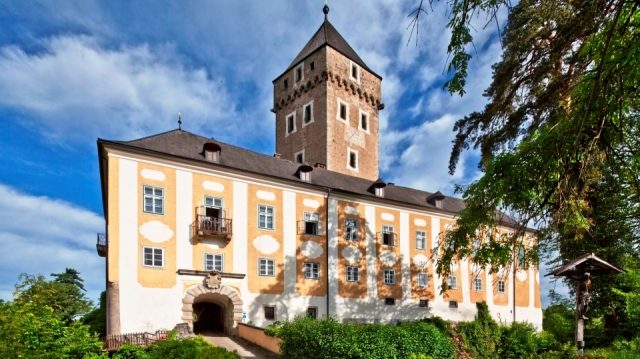
Schloss Neuhaus on the Danube, also known as Schloss Neuhaus in the Mühlviertel, is perched above the village of Untermühl (municipality of Sankt Martin im Mühlkreis) at the confluence of the Große Mühl and the Danube, between the Schlögener Schlinge and the market town of Aschach an der Donau.
The complex is privately owned and continuously inhabited. It was renovated in 2007.
Historians' opinions differ regarding the origin of the former Neuhaus Castle. It is dated to the 12th or (more likely) 13th century. In the 12th century, only a fortified house probably existed, serving the Bishops of Passau as a base for falconry.
The oldest part of the building is located in the rear, northeastern section of the complex and extended to the spot where the transverse wing with the clock tower stands today. In a second construction phase in the 14th century, the pentagonal tower with a curtain wall in front of it was built. In the third construction phase during the 16th century, the complex was supplemented by an outer bailey, and the old castle from the first construction phase was also rebuilt. A residential wing was incorporated into the curtain wall and the ring wall on the Danube side, thus creating the present castle. By 1729, the fortifications in the south and east were dismantled, thereby enhancing the castle-like character.
From the chain barrier tower, which stands below the castle, the Danube could be blocked with a chain. From the castle, the Danube could be overlooked from Aschach almost to the Danube loop near Exlau (approx. 8 km).
The Lords of Schaunberg were particularly prominent as castle lords, entrusted with the protection of Danube shipping. In the Schaunberg Feud, a power struggle between the Schaunbergers and the Austrian Duke Albrecht III, Neuhaus Castle was successfully defended against ducal troops in 1381, 1386, and 1389. Despite military successes, the Schaunbergers ultimately lost this conflict and had to recognize Albrecht III as their liege lord.
In 1481, Duke Georg the Rich of Bavaria-Landshut conquered the castle. He died in 1503 without a male heir. After the end of the ensuing War of the Landshut Succession, Emperor Maximilian I claimed Neuhaus Castle, among others, as war reparations. Subsequently, the castle was pledged several times, from 1537 to the Sprinzensteiners. In 1565, the Sprinzensteiners received the castle as a fief, and in 1591 as free property. In 1729, the now castle came to the Counts of Thurn und Taxis through marriage. In 1868, Eduard Planck von Planckenburg bought the castle. In 1920, it came to the current owner family Plappart (von Leenheer) through marriage.
Take Mobile History with you
You are reading this text for free. Premium adds what matters on the road: descriptions read aloud, sites found through your camera, whole regions taken offline.
- Every description, including the ~17,700 Premium sites
- Audio guide: have descriptions read to you on location
- AR finder: see sites through your camera, with distance and bearing
- Unlimited saved sites
14 days free, then from €2.99 a month. Cancel anytime.
Source: Wikipedia · Licence: CC BY-SA 4.0 · Image: http://www.wehrbauten.at/ooe/oberoesterreich.html
This description draws on the facts documented in the linked Wikipedia article; Wikipedia content is licensed under CC BY-SA 4.0. Wording and editing: Mobile History.
Location: 48.4230, 13.9911