Children's Home
CastleGeinberg -Neuhaus
Neuhaus Castle
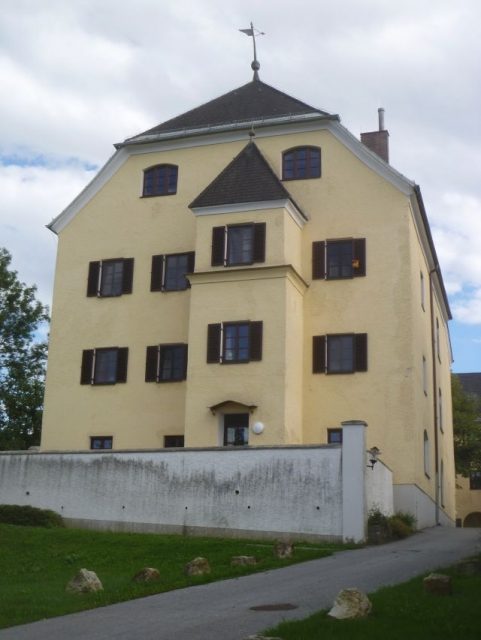
Neuhaus Castle is located in the eponymous district of the municipality of Geinberg in the Ried im Innkreis district in Upper Austria.
The Passau ministerial family of the Geginperger (Geinberger) was based in Geinberg. Their castle was located on the site of the current parish church of Geinberg. The following members of this family are known by name: Pernhart (1130), Meginhart I and Alram, Eticho (1150), Rudolf (1189), and Chunrad I (1200-1230). The last of this family was Chunrad II.
In 1290, the Ahamer (Aheimer, Ahaimer) appeared, also ministerials of the Diocese of Passau, who had their seat in the fortress "Newes Haws". This castle must have been built between 1262 and 1290. The Ahamer are first mentioned in a document from Ranshofen Abbey in 1290, but did not remain continuously at Neuhaus. For some time, the owners changed. Administrators were appointed, such as Alram von Rotten (1330). An important representative of the Ahamer family was Georg I († 1380), who founded the parish of Geinberg in 1359. He was administrator in Ried im Innkreis in 1358 and administrator in Burghausen from 1366-1371. In 1388, Neuhaus came to Count Erasmus von Aichberg, who was replaced by Christian Ramstorfer in 1392. A Veit von Aham was administrator of the Passau fortress Obernberg in 1405. In 1405, Friedrich der Scherenreiter followed, in 1419 Gottfried Raty, and in 1428 Kaspar von Ahaim († 1450), district judge in Landsberg. He was followed by Achaz Raumung (1434-1438) and Diepold von Ahaim († 1480), also administrator in Landsberg. In 1449, Duke Ludwig of Bavaria handed Neuhaus over to Hanns and Heinrich den Eggern. In the middle of the 15th century, the Ahamer were in ducal-Bavarian service. Neuhaus came to the Ahaimer von Wildenau line in 1566. Hans Adam von Ahaim died in Vienna in 1579.
Duke Albrecht V of Bavaria gave Neuhaus to his chamberlain Hansen von Grebmern in 1585. During this time, the castle was also converted into a palace. Neuhaus came to the Stangel family in 1588. In 1644, a division took place, in which Neuhaus with the Hofmark Geinberg came to Johann Ignaz von Ahaim. In 1652, the Ahaimer were elevated to the status of Imperial Barons. In 1694, Neuhaus came to Baron Gemel von Fischbach by purchase. Neuhaus Castle was conquered in the Peasants' Revolt in 1705.
Neuhaus remained in the possession of the Ahamer (together with Herbstheim and the Elreching estate) until the 19th century. The last Ahamer was Josef Matthias Franz Xaver Benedikt Count von Aham († January 12, 1881), chamberlain to the King of Bavaria.
Count Rambaldi became the new owner by inheritance, but he died before the will was opened. Thus, the property came to Aloisia von Gumpenberg, married to the railway doctor Dr. Grossmann in Ergoldsbach. Neuhaus was managed by two of her daughters. After that, Neuhaus Castle came by purchase to the Redemptorist nuns in Ried; Neuhaus was to become a women's monastery. However, this decision was reversed. In 1884, the Neuhaus estate was acquired by the farmer Radlinger from Aspach. In 1889, the property went to the Amesreither family from Ried, then to the married couple Josef and Rosa Schrefl from Obernberg. The widow Rosa Schrefl opened a bathing establishment here according to Pastor Kneipp's cold water healing method. In 1892, Protestant children from Vienna came to Neuhaus for recreation for the first time. Rosa Schrefl's son used the seclusion of the castle for a counterfeiting workshop. In 1906, the estate was sold by Rosa Schrefl's daughter to Countess Vitzthum von Eckstaedt from Neuhofen an der Krems. In 1919, the castle came to the "Curatorium of the Jubilee Foundation for Railway Children" and thus became a children's convalescent home. In 1925, the railway health insurance fund became the new owner, and in 1930, it went to the "Freie Schule-Kinderfreunde" association of the Social Democratic Party. In 1936, the castle was taken over by the State Youth Office, and through the children's holiday program of the Fatherland Front, recreational stays for children were offered in Neuhaus. In 1938, Neuhaus Castle came into the possession of the Gauleitung of the NSV (National Socialist People's Welfare).
In 1945, Neuhaus Castle came under the administration of the Upper Austrian provincial government as a children's home. The "Kinderfreunde" of the Socialist Party of Austria had a right to restitution for 20 years and organized recreational stays here between 1945-1956 during the summer months. The Neuhaus Castle institution was also not spared from accusations of child abuse; the cases had occurred between 1948 and 1993.
Between 2000 and 2005, a general renovation of the castle took place. Today, socio-pedagogical residential groups are housed here. Eight children live in these groups for longer periods (several months to several years), placed by child welfare for various reasons (overwhelm, illness or death of parents, neglect, abuse, mistreatment).
Neuhaus Castle today+
The former castle or current palace is located on a moderately high mountain ridge above a pond. The outer bailey with a tower, visible in Wening's engraving, has disappeared, but the main building remained after its renovation in the 16th century. The front building is the former palas and is recognizable as such by a hipped roof. In the rear part, a semicircular tower projects from the wall front. The ring wall has been removed except for sparse remains. The enclosure, which formerly extended to the pond below, is also no longer present. The castle is now structurally adapted (living, play, and leisure facilities) as a children's home.
Take Mobile History with you
You are reading this text for free. Premium adds what matters on the road: descriptions read aloud, sites found through your camera, whole regions taken offline.
- Every description, including the ~17,700 Premium sites
- Audio guide: have descriptions read to you on location
- AR finder: see sites through your camera, with distance and bearing
- Unlimited saved sites
14 days free, then from €2.99 a month. Cancel anytime.
Source: Wikipedia · Licence: CC BY-SA 4.0 · Image: http://commons.wikimedia.org/wiki/File:Schloss_Neuhaus_Eingangsgeb%C3%A4ude.jpg
This description draws on the facts documented in the linked Wikipedia article; Wikipedia content is licensed under CC BY-SA 4.0. Wording and editing: Mobile History.
Location: 48.2548, 13.3132