To be privately owned
CastleWeißenbach-Neuhaus
Neuhaus Castle
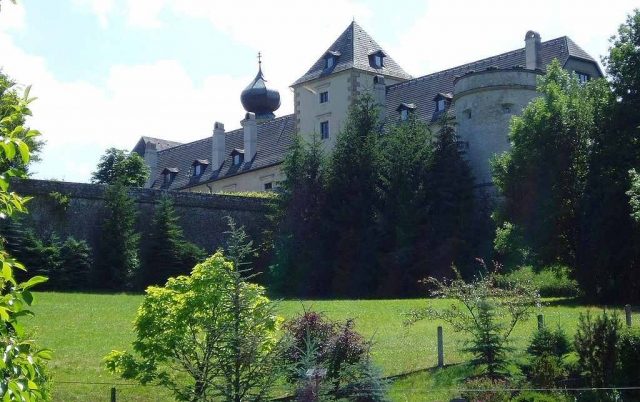
Neuhaus Castle is located in Neuhaus in the Baden district of Lower Austria. Its history is closely linked to that of the village of Neuhaus.
The nucleus of the castle was a fortified house, presumably built in the second quarter of the 13th century. It is first mentioned in a document in 1246, when Ulrich von Neuhaus is named as the lord of the castle in a land register.
The princely castle was administered by stewards in the 14th century until it came into the possession of the Wolzogen family (knights since 1591, barons since 1607) in 1595. Hans Christoph von Wolzogen had the castle fundamentally redesigned at the beginning of the 17th century, and the church was also built during this period.
As Protestants, the members of the Wolzogen family lost their possessions during the Counter-Reformation; Paul I von Wolzogen had to emigrate to Saxony in 1628. In the following period, the castle changed hands several times. In 1683, it was plundered and set on fire by Ottomans.
In 1694, a glass and mirror factory was established in the still usable rooms. From 1724, back in the possession of the Imperial Court Chamber, the castle was restored under Emperor Charles VI. A new wing for the mirror factory was built on the west side of the courtyard, but it was moved to a building at the foot of the castle hill in 1742 and to Schlöglmühl in 1830.
In 1769, a public elementary school was established in the east wing, followed by a teacher training college in 1780. From 1833, the west wing was used as a rectory after Neuhaus was elevated to its own parish.
From 1830, the castle was owned by Baron Georg Simon von Sina, who gave it to his granddaughter Anastasia Countess Wimpffen 20 years later.
In 1938, the German Imperial Forest Service took over the castle. During the fighting in the last days of World War II, the castle and church burned down on April 21, 1945. After 1955, the west wing was rebuilt. The east wing was acquired and restored by a private individual in 1977, while the west wing initially fell into disrepair again.
Current Use+
Half of the castle is privately owned by the Huemer family, the other half belongs to the Archdiocese of Vienna.
The private part was renovated from a ruin with great effort in the 1980s. The other half is the rectory and has also been undergoing renovation since 2003/04.
Layout+
The complex is surrounded by a wall, reinforced at the two eastern corners with round towers and on the west side with two square defensive towers. Through the entrance on the east side and the wide gate hall, which passes under the east wing, one enters the castle courtyard, which is enclosed on the west by the building of the former mirror factory. To the south, the courtyard is bordered by the church, to the north by the enclosing wall. A gate embedded there was originally equipped with a drawbridge.
The elongated eastern wing, now well preserved, comprises two stories and served as a residential castle. Above the gate rises a four-story gate tower.
The opposite, also two-story west wing with its originally baroque facade is flanked by two three-story, slightly projecting towers crowned with pyramid roofs. Two symmetrically arranged doors with triangular gables lead to the interior. On the southern end, a modern access to the rectory was created during the renovation.
Behind the west wing lies an almost square second courtyard. Here was originally the fortified house from the 13th century, which gave the castle and the place its name (novum castrum). Inhabited until the beginning of the 17th century, the building was then abandoned and fell into disrepair. In the middle of the courtyard, remnants of cellar walls still point to the old building.
Church
Part of the castle complex is the single-nave church with a cross-ribbed vault, dedicated to Saint John of Nepomuk. It is an independent parish church.
Hans Christoph von Wolzogen had the church built between 1610 and 1612 in the late Gothic (sic!) style in place of the Romanesque castle chapel as a Protestant house of prayer. Under the chancel, he had a crypt built for his family, in which four family members and a priest are buried.
Due to the suppression of the Protestant confession during the Counter-Reformation, the church stood empty from 1628 and, like the castle, was destroyed by the Ottomans in 1683.
When Emperor Charles VI had the castle restored and a mirror factory was established in the buildings, the church initially served as a magazine. Only when Neuhaus was elevated to its own parish in 1733 did the church again serve its intended purpose and receive baroque furnishings.
After its destruction in the last days of World War II and its restoration, the church was consecrated again by Archbishop Theodor Innitzer on November 24, 1946.
The replacement of the long-serving pastor Mag. Berger in 2002 was the impetus to revitalize the church and the rectory. In 2005, the church was repainted, the high altar restored, the organ built in 1891 completely overhauled, and all electrical installations renewed. The parish council organized and assisted with the work. In August 2005, the castle courtyard was redesigned. The renovation was completed with the altar consecration by Archbishop Christoph Schönborn on September 10, 2006.
For some time now, there has been the possibility to financially support the helpers with "castle building blocks."
Take Mobile History with you
You are reading this text for free. Premium adds what matters on the road: descriptions read aloud, sites found through your camera, whole regions taken offline.
- Every description, including the ~17,700 Premium sites
- Audio guide: have descriptions read to you on location
- AR finder: see sites through your camera, with distance and bearing
- Unlimited saved sites
14 days free, then from €2.99 a month. Cancel anytime.
Source: Wikipedia · Licence: CC BY-SA 4.0 · Image: http://commons.wikimedia.org/wiki/File:Burg_Neuhaus.jpg
This description draws on the facts documented in the linked Wikipedia article; Wikipedia content is licensed under CC BY-SA 4.0. Wording and editing: Mobile History.
Location: 47.9960, 16.0484