Cultural Events
School
CastlePaderborn-Schloß Neuhaus
Neuhaus Castle
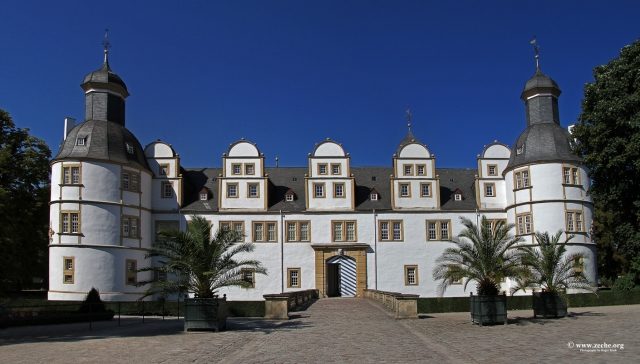
Schloss Neuhaus, located in the Paderborn district of Schloß Neuhaus, named after it, is a significant building of the Weser Renaissance. It is situated on an island-like location at the confluence of the Lippe, Alme, and Pader rivers in the southeastern corner of the Westphalian Bay.
The first documented mention of the place Neuhaus dates back to 1036. In 1257, the Paderborn bishops erected a fortified house there in a protected location about four kilometers northwest of the city of Paderborn. Due to disputes with the city's citizenry, Bishop Heinrich von Spiegel definitively moved the episcopal residence to Neuhaus in 1370, from where the Prince-Bishopric of Paderborn was governed until its annexation by the Kingdom of Prussia in 1802. The oldest preserved part of the now four-winged complex, the Haus Spiegel, is named after him. Each subsequent part of the castle also takes its name from the respective builder.
From 1524 to 1526, during the reign of Erich von Braunschweig-Grubenhagen, master builder Jörg Unkair erected the Haus Braunschweig, which forms the current front.
In 1534, Hermann von Wied connected the two previously separate buildings with the construction of the Haus Köln.
Between 1548 and 1560, the Haus Kerssenbrock was built under Rembert von Kerssenbrock.
In 1590, Dietrich von Fürstenberg had the building expanded into the four-winged complex that still exists today. The size of the castle was almost doubled, and the four round towers were also erected during this construction phase.
In 1736, under the Wittelsbach Clemens August, the Baroque garden was completed. Grenadiers of the Paderborn Infantry Regiment served as guards at the castle.
During the Seven Years' War from 1756 to 1763, the castle was damaged.
After the Peace of Lunéville, Prussia annexed the Prince-Bishopric in 1802 as compensation for territorial losses on the left bank of the Rhine, although the constitutional basis for this, the Reichsdeputationshauptschluss, only followed a year later, in 1803. From then on, the castle was no longer a residence.
After this annexation and a brief interlude during the "French period," in which the castle belonged to the Kingdom of Westphalia from 1807 to 1813, it was used militarily. Thereafter, the castle became the garrison for the following cavalry units: Cuirassier Regiment "von Driesen" (Westphalian) No. 4 First Squadron (October 6, 1820 to 1833), Hussar Regiment "Kaiser Nikolaus II. von Russland" (1st Westphalian) No. 8 (1851 to 1919), 15th Cavalry Regiment (1921 to 1945) (cf. also Officer Riding School in Paderborn). As a result of the Second World War, the castle grounds were now within the British occupation zone and were taken over by the British Army of the Rhine.
Only on July 19, 1964, after the municipality of "Neuhaus" was renamed "Schloß Neuhaus" in 1957 on the occasion of the castle's seven-hundredth anniversary, did the British hand over the castle to the municipality for the symbolic price of one Mark.
The Legend of the Murdered Roofer
On the ridge of the west gable of the Haus Fürstenberg, a reclining stone figure stands out. Its origin is based on a legend, which is briefly retold here:
Prince-Bishop Ferdinand von Fürstenberg (1626–1683) had invited guests to a hunt, including a close young relative, a Herr von Spiegel, who was known as a good shot but had no hunting luck that day and was very annoyed about it.
As the hunting party returned to the castle, a roofer engaged in repairs interrupted his work to watch the hunting party's arrival.
The annoyed hunter aimed at the roofer – just to show what a good shot he was – and fatally hit him.
He escaped the bishop's order to apprehend the perpetrator on horseback. Years later, he visited Neuhaus again, believing the bishop had forgotten the murder. However, he was arrested, sentenced to death, and executed at Wewelsburg.
A monument was erected at the scene of the crime for the shot craftsman. Annette von Droste-Hülshoff's ballad Kurt von Spiegel is based on this story.
Current Use+
In 1967, the newly founded Realschule moved into the castle building with initially 32 students; today, almost 800 students are taught by 43 teachers. In 1972, the Gymnasium Schloß Neuhaus was also founded there, although it was housed in the castle for only one school year and then temporarily outside the castle grounds. In 1974, it was finally able to move into the newly built school center in the rear part of the castle park, which it shared with the neighboring Heinrich Hauptschule. Since the municipality of Schloß Neuhaus was incorporated into the city of Paderborn on January 1, 1975, ownership of the castle grounds and the sponsorship of the three schools passed into the hands of the city of Paderborn on that date.
In 1994, the city of Paderborn hosted the North Rhine-Westphalia State Garden Show at Neuhaus Castle, which led to the creation of the Castle and Riverside Park around the castle, used since 1995 for annual event series, the Schloßsommer.
The princely dining room of the castle (erroneously also called "Spiegelsaal" in Paderborn jargon) is today the "good parlor" of the city of Paderborn and is used for representative events.
Take Mobile History with you
You are reading this text for free. Premium adds what matters on the road: descriptions read aloud, sites found through your camera, whole regions taken offline.
- Every description, including the ~17,700 Premium sites
- Audio guide: have descriptions read to you on location
- AR finder: see sites through your camera, with distance and bearing
- Unlimited saved sites
14 days free, then from €2.99 a month. Cancel anytime.
Source: Wikipedia · Licence: CC BY-SA 4.0 · Image: http://www.zeche.org/
This description draws on the facts documented in the linked Wikipedia article; Wikipedia content is licensed under CC BY-SA 4.0. Wording and editing: Mobile History.
Location: 51.7452, 8.7124