To be privately owned
CastleGuttenburg
Neuguttenberg Castle
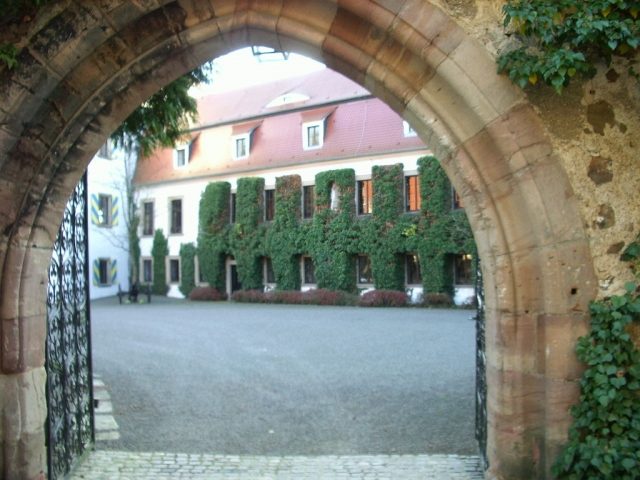
Guttenberg Castle and its predecessor buildings, Alt- and Neuguttenberg Castles, are complexes in the municipality of Guttenberg (Upper Franconia).
Alt- and Neuguttenberg Castles and the Lords of Guttenberg+
The name is said to derive from the personal name Cotto, an administrative official of the Counts of Andechs (noble family), Dukes of Merania. A Gundeloh von Plassenberg, documented in 1148, also a ministerialis of the Counts of Andechs-Merania, residing at Plassenburg near Kulmbach, is considered the first in the lineage of the Imperial Knights, since 1700 Barons of Guttenberg, who reside at Guttenberg Castle.
The Guttenbergs, an Imperial Knight family of the lower nobility in the Upper Franconian region, attempted to expand their feudal possessions to Untersteinach in the early 14th century, a place that was then an important traffic hub with customs rights and corresponding revenues. In 1315, with the taking possession of Guttenberg Castle, the name "von der Plassenburg" changed to "von Guttenberg", to which a small village of the same name with serf and corvée-obligated farmers belonged. At this time, the expansion of the Altguttenberg castle complex is also dated, for which an opening right existed until 1342 for the feudal lords, the Bishops of the Diocese of Bamberg, and subsequently for the Margraves of Kulmbach. Heinrich von Plassenberg, called von Guttenberg, who united the family's disjointed possessions, is considered the builder of Altguttenberg Castle. With him begins the lineage of the Guttenbergs. In the Guttenberg Feud, Altguttenberg Castle was besieged by Margrave Frederick V of Brandenburg and had to be handed over to him as the next feudal lord at the end of the conflicts.
Events in 1523
In the mid-16th century, the robber knight Hans Thomas von Absberg abducted merchants from imperial cities in Franconia, Swabia, and the Egerland in the former Nordgau (Bavaria) on their trade journeys, demanded a high ransom for their release, and stole the trade goods. He had allies who supported him in his raids and hid him in their castles when there was a risk of capture. The Lords of Guttenberg, feudal holders of Alt- and Neuguttenberg Castles, also participated, hoping to replenish their dwindling incomes. In 1523, a Swabian League of trading cities sent its troops to raze 23 "robber nests" to the ground, including the Guttenberg castles. On July 8, they reached the complex and blew it up to prevent the return of the Guttenbergs and other robber knights residing there and to put an end to the banditry. A woodcut from 1523 depicts a view of the destroyed castle complex in Guttenberg.
In most records regarding the origin of the Guttenberg castle complex, the location of the two is described such that during the construction of Neuguttenberg Castle, a part of the complex was built into the courtyard of Altguttenberg Castle. This action led to disputes in 1482 between the Guttenbergs and at least twelve co-owners and feudal holders of Altguttenberg Castle, whose names are not known in more detail.
In 1490, Altguttenberg was occupied by Margrave Siegmund of Brandenburg-Kulmbach because the construction of Neuguttenberg Castle seemed threatening to him. However, since Philipp von Guttenberg had already had his property occupied by one of the other ministeriales, the knight Georg von Bayern, the Margrave dispossessed the Guttenbergs, who only regained their property around 1503. In contrast to Neuguttenberg, the older complex was not rebuilt after 1523 and fell into disrepair.
The woodcut by Hans Wandereisen with the Guttenberg castle complex in Franconia
Compared to Neuguttenberg, the relatively small Altguttenberg complex dominates the larger Neuguttenberg Castle in Hans Wandereisen's woodcut. Situated on a flat hill, the castle is framed by rock formations. The complex itself consists of a palas, a gatehouse, a defensive oriel on the left side, and an already destroyed keep. The house on the right edge apparently did not belong to the actual complex, as it would otherwise have been destroyed by the troops. (See Sparneck Castle for comparison). In the center of the image, remnants of walls and beams are visible, which could originate from Neuguttenberg Castle. The League's troops in this cut consist of a captain and three higher officers on the right edge of the image, two horsemen in the center of the image, and a detachment of foot soldiers in the left half of the image.
In Hans Wandereisen's woodcut of Neuguttenberg, no other buildings are visible besides the castle. The relatively large complex is located on a mountain spur, at the top of which the keep stands. Five of the castle's total of nine main buildings are already in flames as the troops of the Swabian League of Cities, depicted here with four men, approach the castle. A tower in the center of the castle is already being blown up, which is recognizable by the pointed flames.
The castle complex after its destruction in 1523
Guttenberg Castle was rebuilt after its destruction by the Swabian League of Cities; further sieges in the following centuries did not pass it by without leaving their mark. After a fire in 1908, it was completely renovated. Only a few traces of the medieval construction remain.
Family Foundation from 2008+
Today, Guttenberg Castle with its inventory and forestry operations is owned by the "Freiherrlich von und zu Guttenberg'sche Privatstiftung" in Radmer in Styria, Austria, founded by Philipp Franz zu Guttenberg. The castle is now the residence of the head of the house, Enoch zu Guttenberg, and his family from his second marriage.
Take Mobile History with you
You are reading this text for free. Premium adds what matters on the road: descriptions read aloud, sites found through your camera, whole regions taken offline.
- Every description, including the ~17,700 Premium sites
- Audio guide: have descriptions read to you on location
- AR finder: see sites through your camera, with distance and bearing
- Unlimited saved sites
14 days free, then from €2.99 a month. Cancel anytime.
Source: Wikipedia · Licence: CC BY-SA 4.0
This description draws on the facts documented in the linked Wikipedia article; Wikipedia content is licensed under CC BY-SA 4.0. Wording and editing: Mobile History.
Location: 50.1519, 11.5658