To be privately owned
CastleNeugattersleben
Neugattersleben Castle
Neugattersleben Castle emerged from a significant medieval castle complex in Neugattersleben on the banks of the Bode River between Halle and Magdeburg in what is now Saxony-Anhalt. It was owned by the von Alvensleben family from 1573 to 1945.
Strategic Location and Early History+
At the crossing of the military road from Magdeburg to Halle (Saale) and Leipzig over the Bode River flowing down from the Harz mountains stands the ancient Neugattersleben Castle, surrounded by watchtowers, against a backdrop of vast parklands. Over the weathered arched bridges spanning the river arms, all the armies of Europe that fought on the battlefields of Central Germany have flowed back and forth since the Middle Ages. Here on the Bode, shortly before its confluence with the Saale, the Archbishopric of Magdeburg and the Principality of Anhalt-Bernburg once clashed. From 1815, Neugattersleben belonged to the Prussian Province of Saxony. Since 1243, a family named after it held the castle as an archiepiscopal fief. Towards the middle of the 14th century, the Magdeburg magistrate acquired the basic rights. In 1549, Emperor Charles V – because of its conduct in the Schmalkaldic War – imposed the Imperial Ban on Magdeburg and in 1550 enfeoffed the Counts of Mansfeld with Neugattersleben, which, however, fell back to the city in 1563. Heavily indebted, the magistrate was forced to sell.
The Alvensleben Era+
In 1573, the Alvensleben family from Hundisburg Castle acquired the castle and lordship. Until 1809, a new enfeoffment was always to take place in the town hall there, after the death of the respective senior member of the family and the mayor of the old town of Magdeburg. From 1573 until the 19th century, Magdeburg, the urbs Parthenopaea, as it is called in documents, as feudal lord, bore the Alvensleben coat of arms rose in the divided escutcheon.
The new owner, Ludolf X von Alvensleben, built the northwest wing of the castle, the castle chapel, and a water mill with six grinding gears. His successor continued the castle construction from 1597–1609. Divided in 1619, the castle and lordship were distinguished until 1796 into an "Old" and a "New Side". From the ruins left by the Thirty Years' War, the residential buildings were rebuilt under Gebhard XXV von Alvensleben from 1657–1665, enriched by a baroque chapel on the upper floor, a multilingual library, and the once famous collection of 250 portraits of outstanding personalities, distributed among three halls. In the 18th century, the construction of a separate gallery building was planned. A Gothic vault and a stucco ceiling with religious depictions in the castle still recall the two former castle chapels.
Minister Johann Friedrich II von Alvensleben, creator of the Baroque castle and park at Hundisburg, also expanded the Neugattersleben garden complexes. Their Renaissance-style layout suggests that their beginnings date back to the 16th century. Each generation tends to change something in gardens. The two generations of English-Hanoverian ministers following Johann Friedrich, Rudolf Anton von Alvensleben (1688–1737) and Johann Friedrich Karl von Alvensleben (1714–1795), also enriched Neugattersleben with collections; they maintained and beautified the park with its arbors, sculptures, and canals. However, following British models, it began to be transformed a l'angloise as early as 1758. The iconological program of the once numerous statues on the garden parterres is well-known.
In 1796, the large properties of the house were divided among six brothers. They founded new lines that acquired possessions as far as Silesia, East Prussia, and after 1900, in other parts of the world. From 1798–1805, the extensive castle underwent a complete renovation. The royal couple Frederick William III and Louise were the first guests in the renovated castle, shortly before the Napoleonic Wars would have almost brought this house to ruin.
The mid-century under Ludwig von Alvensleben (1805–1869) was marked by economic ascent: the mining of lignite, potash, limestone, and industrial facilities corresponded to agricultural technological progress. Neugattersleben, in particular, had been richly endowed with foundations for public welfare since 1573. His son Werner-Alvo von Alvensleben (1840–1929) – entrepreneurially gifted – successfully continued the economic activities. He was also castle captain in Quedlinburg and one of the most famous four-in-hand drivers before 1914. He romantically rebuilt the castle buildings (1870 and 1883–1884) and, being creatively gifted, expanded the parklands.
His successor Count Bodo von Alvensleben, lord of the castle until 1945, exerted far-reaching influence in times of ferment and decay – among other things, as president of the German Herrenklub. His brother Werner (1875–1947) came into conflict with the regime and was sentenced by the People's Court under the chairmanship of Freisler shortly before the end of the war in 1945. A memorable event: in 1936, the Bishop of Münster and later Cardinal Clemens August Count von Galen, the head of the church's overall resistance against the National Socialist government, married a daughter of this house, which was represented by strongly pronounced personalities throughout the centuries, at the castle.
Old View and Reconstruction Image+
Until the Thirty Years' War, the upper castle had pointed towers and half-timbered superstructures. After 1657, it transformed into an early Baroque building with richly decorated gables, dormer windows, and two stair towers that bore high, multi-broken onion domes, as we see in our picture. From 1798, towers and decorative forms were removed. The three floors received regular rows of windows in the taste of late Baroque Classicism, which remained when the castle regained towers, gables, and bay windows, albeit in an altered form, in 1883. The age of the buildings is not easy to guess due to the somewhat confusing construction development.
For the present view, the perspective from the north was chosen to bring the castle and the Bode river arms into the foreground, especially since a contemporary engraving also shows the interesting south front. Both pictures depict the state of the 18th century, which can be easily compared to today's, although individual parts of the building are missing and the Baroque garden has been altered. Between the castle and the mill, the medieval bridge complex crosses the branched courses of the river today as it once did. The small island next to the castle, called Schiffchen (little boat), formerly served as a bulwark. In the "Vogelherd" (top right) there was a round hedge labyrinth.
Inside the house (1945), around the entrance hall, were the older castle chapel with a Gothic vault and, among other living rooms, the library and the Black Eagle Chamber, so named after the portraits of family members awarded the Order of the Black Eagle. On the main floor were ballrooms and the Imperial Rooms, once intended for monarch visits, with 17th-century stucco ceilings.
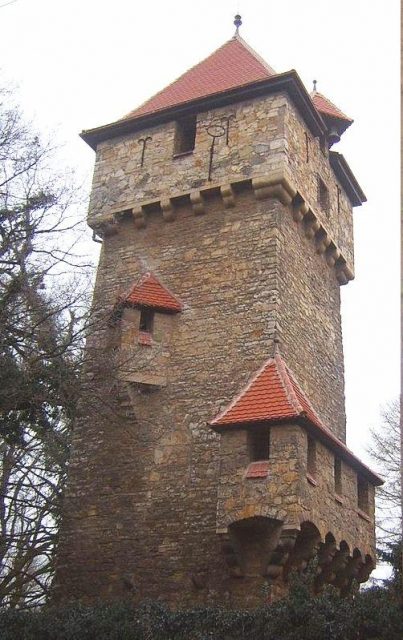
The church, rich in tombs, the mausoleum, and the Kaiser Wilhelm Tower look down from hills onto the Bode valley, castle, and park meadow. The tower keeps alive the memory of visits by Emperor Wilhelm II, who often announced himself for hunts and here alone brought down over five thousand pieces of game. In the church is the sarcophagus of the castle lady Anna von Veltheim (died 1897), designed, donated, and consecrated by the Emperor himself, on which she is depicted resting under a canopy.
The Period After 1945+
After expropriation by the land reform in 1945, the castle initially served as a Higher Agricultural School, then as a Technical College for Agriculture, then as an Institute for Agronomy, and from 1960 to 1992 as an Agricultural Engineering School for Seed Management. Only a small part of the estate was settled and managed as a VEG (People's Own Estate). In 1992, Theopra Bildungsgesellschaft mbH initially leased the castle and acquired it as property in 1997. Since 1999, a fundamental renovation and restoration has been carried out by the new owner.
Take Mobile History with you
You are reading this text for free. Premium adds what matters on the road: descriptions read aloud, sites found through your camera, whole regions taken offline.
- Every description, including the ~17,700 Premium sites
- Audio guide: have descriptions read to you on location
- AR finder: see sites through your camera, with distance and bearing
- Unlimited saved sites
14 days free, then from €2.99 a month. Cancel anytime.
Source: Wikipedia · Licence: CC BY-SA 4.0
This description draws on the facts documented in the linked Wikipedia article; Wikipedia content is licensed under CC BY-SA 4.0. Wording and editing: Mobile History.
Location: 51.8515, 11.7049