Museum
CastleNeuenstein
Neuenstein Castle
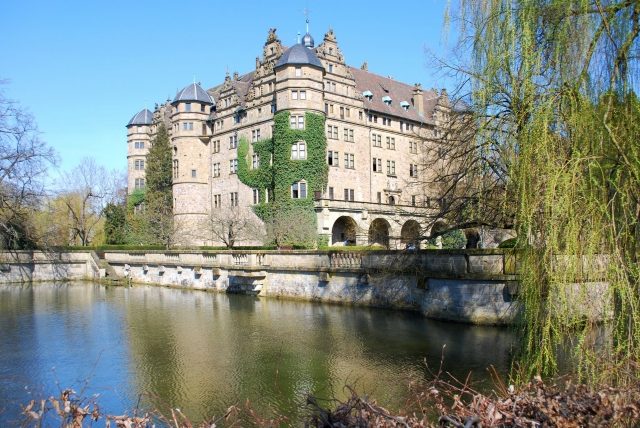
Neuenstein Castle is located in the center of the town of Neuenstein. Built as the seat of the noble line of Hohenlohe-Neuenstein, it now houses a castle museum and, with the Hohenlohe Central Archive Neuenstein, the joint house archive of the House of Hohenlohe, managed by the state of Baden-Württemberg. The 41-meter-long and over ten-meter-wide Knights' Hall also regularly hosts concerts as part of the Hohenlohe Cultural Summer.
Architecture
The castle, in the Renaissance style, is a mighty, enclosed four-wing building with six floors. At its northwestern corner stands the Romanesque keep of the former castle. Two other corners are occupied by tall round towers. A bridge leads to the entrance portal, which is adorned with the coats of arms of Ludwig Casimir von Hohenlohe and his wife Anna von Solms-Laubach.
The Castle Museum
During a visit to the castle museum, visitors can explore, among other things, the Imperial Hall, the King's Vault, and the late medieval and fully functional castle kitchen – all still largely in their original condition.
In addition to art-historically valuable objects, hunting weapons and trophies are on display. The centerpiece of the museum, however, is the Cabinet of Art and Curiosities. It showcases Renaissance artworks as well as curiosities and memorabilia; among them a hat of the Swedish King Gustav II Adolf, a shoe of Empress Catherine the Great, and a bladder stone almost the size of a fist from the Count of Nimburg.
The roots of the present castle can be traced back to a Staufer moated castle from the early 13th century. It stood on a sandbank in a marshy area near an old trade route that led from the Rhine via Wimpfen eastwards to the Danube.
Around 1230, the complex was owned by the Lords of Stein, whose descendants later called themselves "von Neuenstein," and around 1300 it came into the possession of the Counts of Hohenlohe, who used the castle as their residence.
After the complex had already been expanded in the 15th century, Count Ludwig Casimir von Hohenlohe had it transformed into a Renaissance-style castle by the Heilbronn master builder Balthasar Wolff in the 16th century. The expansion lasted until the beginning of the 17th century.
After Wolfgang Julius von Hohenlohe died in 1698, the family moved their residence to Öhringen. Neuenstein Castle subsequently stood empty and fell into disrepair. Later it served as a reformatory and workhouse, as an old people's home, and an orphanage.
From 1870, renovation work was carried out in the Imperial Hall to then lay the foundation for a family museum of the House of Hohenlohe with an antique collection from Kirchberg Castle. It was one of the first private museums in Germany and was accessible to the public from 1878.
At the beginning of the 20th century, Prince Christian Kraft zu Hohenlohe commissioned the architect and castle researcher Bodo Ebhardt with a comprehensive restoration of the castle. The work took place between 1906 and 1925. In the course of this, an additional floor was added to the complex.
For the construction and supply of the castle, the Eschelbacher Steige played an important role as a transport route.
Take Mobile History with you
You are reading this text for free. Premium adds what matters on the road: descriptions read aloud, sites found through your camera, whole regions taken offline.
- Every description, including the ~17,700 Premium sites
- Audio guide: have descriptions read to you on location
- AR finder: see sites through your camera, with distance and bearing
- Unlimited saved sites
14 days free, then from €2.99 a month. Cancel anytime.
Source: Wikipedia · Licence: CC BY-SA 4.0 · Image: Peter Schneider
This description draws on the facts documented in the linked Wikipedia article; Wikipedia content is licensed under CC BY-SA 4.0. Wording and editing: Mobile History.
Location: 49.2041, 9.5788