School
CastleNeubeuern
Neubeuern Castle
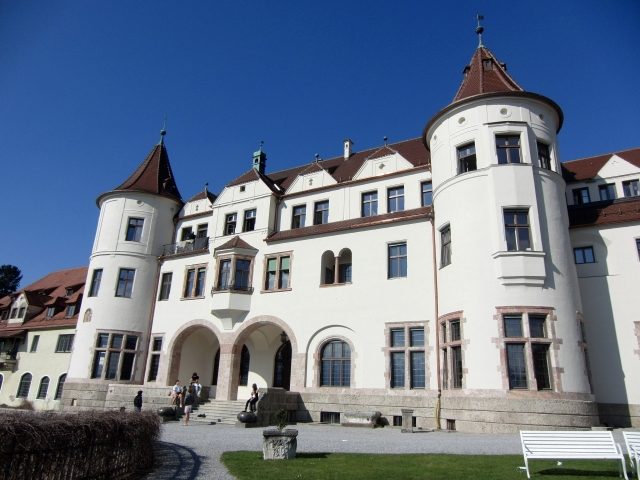
Neubeuern Castle is a multi-winged castle complex in the Inn Valley. It was originally built in the 12th century as a hilltop castle on a hill in the Inn Valley above the town of Neubeuern. The striking keep is visible far across the Inn Valley and from the A 8 and A 93 motorways.
12th–17th Century
Based on the oldest part of the castle, the keep, the first beginnings of Neubeuern Castle can be dated to the second half of the 12th century. The castle originally belonged to the dominion of the Bishops of Regensburg. During the conflicts between the prince-bishopric and the Bavarian Duke Ludwig in the 13th century, it was handed over to Count Konrad von Wasserburg for administration. He is said to have built a massive ring wall with nine towers and expanded the fortress into the strongest castle complex in the Inn Valley. In 1388, however, the Bishop of Regensburg sold the castle to the knight Hartprecht Harskircher of Zangberg, the chamberlain of Duke Friedrich of Bavaria-Landshut. Over three hundred years of Regensburg rule thus ended for Neubeuern.
12 years later, Knight Wolfhart von der Alben acquired the castle, but sold it again in 1403 to Knight Jakob von Thurn. The Thurn family had risen from minor archiepiscopal vassals to the Salzburg nobility. The castle remained in their possession for over two hundred years until the beginning of the 17th century, when the rule of the Thurns began to crumble.
18th–19th Century
From 1668, the Counts of Preysing-Hohenaschau became the "collectors" of the Thurn family's possessions in Neubeuern.
The castle and the market had survived the Thirty Years' War relatively unscathed, but in the War of the Austrian Succession, Hungarian troops destroyed Neubeuern. What remained of the castle was blown up.
Count Max IV. Emanuel von Preysing-Hohenaschau (1739–1764) then commissioned the Munich city architect Ignaz Anton Gunetzrhainer, together with his brother Johann Baptist Gunetzrhainer, to completely redesign the complex in the style of Bavarian-Tyrolean manor houses (1747–1752).
The castle chapel of St. Augustine was also rebuilt. Johann Baptist Zimmermann (high altar with column structure in the Wessobrunn stucco marble style) and Joseph Götsch, who created the two side altars in 1767/68 (Baptism of Christ and Martyrdom of St. Sebastian), contributed to the design. The castle chapel of St. Augustine is considered Bavarian Rococo and is a destination for visitors to Neubeuern interested in art history.
Count Johann-Christian Preysing died in 1833. The property remained in the hands of descendants for another thirty years and eventually could no longer be held by them.
In 1882, Jan Wendelstadt, son of the founder of the "Darmstädter Bankverein Ferdinand Wendelstadt" and a Dutch aristocrat, acquired the castle. In 1893, he married Julie Countess von Degenfeld-Schonburg, a lady-in-waiting to the Queen of Württemberg, who thereby became Baroness von Wendelstadt and mistress of Neubeuern Castle. This completed the connection to the Swabian-German ancient nobility.
20th Century
After the eastern part of the castle had already been renovated in 1893 after a fire, the Baron had the central building of the castle rebuilt between 1904 and 1908. He commissioned the architect Gabriel von Seidl, who had become known for building the Bavarian National Museum. The new central building, designed in the Neo-Renaissance style, is characterized by its spacious staircase and magnificent rooms.
The marriage of Jan Wendelstadt to Julie von Degenfeld remained childless. Thus, the Baroness spent the years after her husband's death primarily with her sister-in-law Ottonie von Degenfeld and other like-minded people. She formed a circle of artistically creative friends around her, which included writers and poets such as Hugo von Hofmannsthal, Annette Kolb, Rudolf Alexander Schröder, Rudolf Borchardt, Henry van de Velde, Harry Graf Kessler, Eugen Roth, Carl Burckhardt, Henry von Heiseler, the musician and composer Max von Schillings, and the art historian and Krupp director Eberhard von Bodenhausen. In addition, there were well-known South German painters such as Carl Arnold, Bruno Paul, Leo Putz, Paul Hoecker, Arnold Böcklin, Alfred Haushofer, Franz von Lenbach, Walter Püttner, Ludwig von Hofmann, Hans Rossmann, Josef Sattler, and Franz von Stuck. Some of these people met annually for a "Neubeuern Week" until the First World War. Afterwards, the castle was used as a military hospital.
School+
The general impoverishment after the First World War put an end to the previous life at the castle. To enable the continued maintenance of the complex, it was decided to found a boarding school based on the model of Salem Castle School. The school's founding was supported by Georg Kerschensteiner, school pedagogue and founder of the German vocational school system.
On May 5, 1923, Neubeuern Castle opened its doors as a school. The first director was the Latin teacher Josef Rieder, and among the first students was Michael Mann, a son of the writer Thomas Mann. Other students were transferred from Salem Castle School.
During the National Socialist era, Rieder tried to steer a ideologically neutral course, but the NSDAP considered the school "politically unreliable" and had it closed on February 13, 1941. To prevent expropriation, the Baroness sold the entire castle complex to the German Reich in the spring of 1942. Subsequently, a National Political Educational Institution, Napola, was established in the castle, the only one in the Reichsgau Munich-Upper Bavaria. Shortly thereafter (November 12, 1942), Baroness Julie von Wendelstadt died.
During the Second World War and the American occupation, the school again served as a military hospital. After the end of the war, the Baroness's sister-in-law, Countess Degenfeld, and her daughter, Marie-Therese Miller-Degenfeld, who was now living in America, campaigned for the sale of the castle to be declared invalid and reversed. Mrs. Miller intended to place the property in a foundation whose task it would be to revive the school.
In 1947, a founding consortium met, and in April 1948, school life could resume on a modest scale. The reopening of the boarding school as "Private Landerziehungsheim Neubeuern am Inn" by the foundation finally took place in June 1948. As a contribution to international understanding, the school was henceforth to be open to children and young people of all social classes and nations. In addition, Neubeuern Castle housed a youth leader school of the Bavarian Youth Council, founded in 1947, which was led by the reform pedagogue Karl Seidelmann in 1948.
Immediately after the Second World War, Neubeuern Castle primarily continued the pre-war literary tradition with the "Neubeuern Weeks." From July 26 to 28, 1947, a preparatory meeting of Group 47 took place in Hinterhör near Altenbeuern. The fourth official meeting took place at Countess Ottonie Degenfeld's property in Hinterhör in September 1948.
The Neubeuern Castle Boarding School
The current sponsor of the school is the "Stiftung Landerziehungsheim Neubeuern" (Neubeuern Rural Education Home Foundation). It is a state-recognized modern language and mathematical-scientific Gymnasium with a boarding school and day school. The school teaches according to the curriculum for Gymnasiums in Bavaria and aims to enable students to achieve their intermediate school leaving certificate and Abitur. Special emphasis is placed on the concept of holistic education. In addition to regular Gymnasium lessons, the development of athletic, artistic, and social skills is to be particularly promoted. For this purpose, there is a diverse range of so-called guilds, working groups, from which each student must choose a certain number depending on their age group.
The Castle in Film and Television+
The castle provided a backdrop for various films. The best known are Johannisnacht (1956) with Willy Birgel and Hertha Feiler, Ein Fall für TKKG: Drachenauge (1992) and Crazy (2000), which is based on the autobiographical novel of the same name by Benjamin Lebert, who was a student at Neubeuern Castle in 1998. His critical retrospective on his time at the boarding school became a bestseller. Large parts of the episode Tod im Internat of the television series Der Bulle von Tölz were also filmed at Neubeuern Castle. On September 23, 2006, a scene for the ZDF series Die Rosenheim-Cops was filmed on the south terrace of the castle. A one-hour report on the boarding school was broadcast on RTL on August 16, 2009. 4 boarding school students were accompanied by a camera team for a year.
Take Mobile History with you
You are reading this text for free. Premium adds what matters on the road: descriptions read aloud, sites found through your camera, whole regions taken offline.
- Every description, including the ~17,700 Premium sites
- Audio guide: have descriptions read to you on location
- AR finder: see sites through your camera, with distance and bearing
- Unlimited saved sites
14 days free, then from €2.99 a month. Cancel anytime.
Source: Wikipedia · Licence: CC BY-SA 4.0
This description draws on the facts documented in the linked Wikipedia article; Wikipedia content is licensed under CC BY-SA 4.0. Wording and editing: Mobile History.
Location: 47.7752, 12.1399