Museum
CastleWeißenfels
Neu-Augustusburg Castle
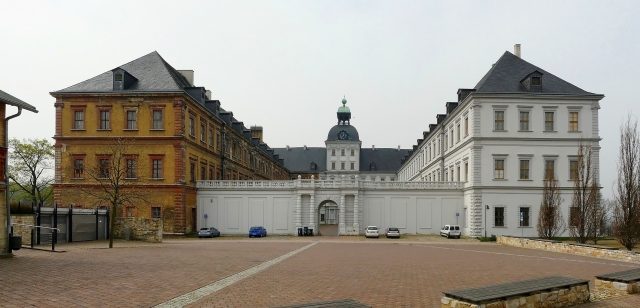
Weißenfels Castle Neu-Augustusburg in Saxony-Anhalt was the residence of the Saxon Duke of Saxe-Weissenfels from 1680 to 1746. It is partly very well preserved and today houses, among other things, an exhibition on the Duchy of Saxe-Weissenfels.
Construction and Significance+
The foundation stone was laid on July 25, 1660, by August, Archbishop of Magdeburg, who, thanks to the will of his father Johann Georg I of Saxony, had also been the first Duke of the Saxon secundogeniture Saxe-Weissenfels since 1657 and administered the duchy from his residence in Halle. The castle was built on the old fortress grounds, which had been razed by the Swedes in 1644 during the Thirty Years' War. However, with the end of the war and the associated Peace of Westphalia in 1648, the Electorate of Brandenburg acquired the claim to the secular possessions of the Archbishopric of Magdeburg (which also included the city of Halle). This was to be claimed as soon as the last administrator of the Archbishopric of Magdeburg died. It is therefore assumed that Duke August, knowing this, had Neu-Augustusburg built specifically for his successor, who, after his death, could no longer reside as Duke of Saxe-Weissenfels in the newly established Duchy of Magdeburg.
His son Johann Adolf I of Saxe-Weissenfels moved into the still unfinished castle in 1680 after his father's death as the new and first duke and brought it to completion over the next 14 years. The master builders were Johann Moritz Richter and his son of the same name. With this building, they created one of the largest early Baroque castle complexes in Central Germany.
The following resided at the castle until the dissolution of the duchy in 1746:
- 1680-1697 Johann Adolf I of Saxe-Weissenfels
- 1697–1712 Johann Georg of Saxe-Weissenfels
- 1712–1736 Christian of Saxe-Weissenfels
- 1736–1746 Johann Adolf II of Saxe-Weissenfels
The castle developed into a cultural center that attracted important artists such as Johann Beer, Johann Philipp Krieger, Georg Philipp Telemann, and Friederike Caroline Neuber.
Here, Duke Johann Adolf I of Saxe-Weissenfels also discovered the musical talent of young Georg Friedrich when he asked his personal physician Georg Händel to let his son play the organ in the castle church. Johann Sebastian Bach composed the cantata Was mir behagt, ist nur die muntre Jagd BWV 208 (Hunting Cantata) for Duke Christian of Saxe-Weissenfels, which premiered in Weißenfels in 1713 in honor of the Duke (today Hotel Jägerhof). His cantata Entfliehet, verschwindet, entweichet, ihr Sorgen BWV 249a (Shepherd Cantata) was performed here at Neu-Augustusburg Castle for the Duke's birthday in 1725. He composed his Toccata and Fugue in F BWV 540 for the organ of the castle church.
Castle Church St. Trinitatis
Particularly interesting and worth seeing is the largely original Castle Church St. Trinitatis, which is one of the most beautiful early Baroque churches in Central Europe.
As a castle chapel, the space is conceived from the opposite of the altar and the princely box in the gallery. Johann Oswald Harms was responsible for the painting; the surrounding gallery pictures show typologically corresponding scenes from the New (1st gallery) and Old Testaments (2nd gallery). A special decorative element are the numerous emblemata. The original pulpit altar by Johann Heinrich Böhme from Schneeberg and Johann Balthasar Stockhammer (1678/80) was dismantled after the castle passed to the Catholic House of Saxony in 1751; the altar received a relief of the Annunciation as an altarpiece.
Among the well-known castle preachers were Johannes Olearius (1611–1684) and Erdmann Neumeister (1671–1756).
The Weißenfels ducal family was buried in the crypt under the church's chancel. This crypt contains 38 partly magnificent tin sarcophagi and is usually accessible to visitors once a month.
Since 1946, the church has been used weekly by the Evangelical-Lutheran St. Trinitatis congregation of the Independent Evangelical-Lutheran Church, which, after concluding a usage agreement with the city in 2004, has also set up community rooms and the rectory in the adjacent northeast wing of the castle. At the same time, the superintendency of the Saxony-Thuringia church district is also located there.
Organ
The organ on the third gallery of the castle church was built between 1667 and 1673 by the organ builder Christian Förner. It comprised 22 stops on two manuals and pedal and was considered by contemporaries to be a technical and musical masterpiece of Central German organ building.
After decades of neglect during the period when the castle was used as a barracks, the organ was radically rebuilt in 1839 by Johann Friedrich Schulze, and in 1864 Friedrich Ladegast carried out repairs. After 1945, the pipework and casing were severely damaged; in 1985, a comprehensive new construction, described as a "partial reconstruction," was carried out by the organ building company A. Voigt. Despite the massive interventions, the Förner organ is considered a music-historical monument and a "key instrument for all organ building in Central Germany."
Castle Building
After the extinction of the Weißenfels ducal house in 1746, the castle initially returned to the Electorate of Saxony and was only rarely inhabited. From 1815, it belonged to Prussia and was converted into barracks for a battalion of the 1st Thuringian Infantry Regiment No. 31 in Erfurt. As such, it was used by the army as a non-commissioned officer school until 1920, then by the police. From March to August 1933, the castle served as a "collection camp for prisoners" for political detainees. After 1945, refugees found accommodation here, and subsequently, a technical college for local museums and the Shoe Museum of the GDR were established in the castle. In 1993, it was handed over to the city of Weißenfels for the first time. Since then, the building has been restored in sections.
Today, the Weißenfels City Museum is located in the castle building. In addition to an exhibition on shoemaking, which is essentially based on the concept of the Shoe Museum of the GDR, which was housed here since 1964, a newly designed exhibition on the Duchy of Saxe-Weissenfels has also been shown since 2007. From the castle terrace, there is a wide view over the city of Weißenfels. The castle cellar and the castle café are also venues for concerts, discos, comedy, and similar events.
Take Mobile History with you
You are reading this text for free. Premium adds what matters on the road: descriptions read aloud, sites found through your camera, whole regions taken offline.
- Every description, including the ~17,700 Premium sites
- Audio guide: have descriptions read to you on location
- AR finder: see sites through your camera, with distance and bearing
- Unlimited saved sites
14 days free, then from €2.99 a month. Cancel anytime.
Source: Wikipedia · Licence: CC BY-SA 4.0 · Image: Thomas Eichler
This description draws on the facts documented in the linked Wikipedia article; Wikipedia content is licensed under CC BY-SA 4.0. Wording and editing: Mobile History.
Location: 51.2000, 11.9752