Local government
CastleWillich-Neersen
Neersen Castle
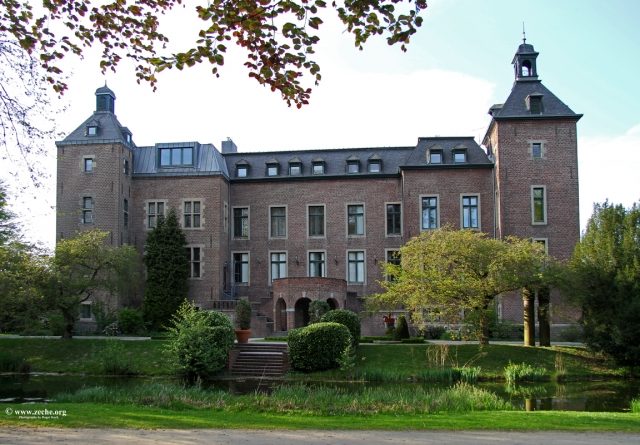
Schloss Neersen is a castle with a publicly accessible park in Neersen, a district of Willich on the Lower Rhine. It is located at an elevation of 44 meters above sea level.
Neersen Castle
When it was built, Schloss Neersen was still a moated castle on the Niers river. The castle was constructed as a stone lowland castle (motte) on a "Donk" amidst a landscape characterized by marshland. It lay directly on the Niers, which fed the moat and, until its canalization in 1930, flowed directly past the castle and later the palace. It is widely assumed that the name Neersen originates from this circumstance. Today, the Niers is about one kilometer away from the castle.
In the Middle Ages, Neersen was the center of a hereditary Vogtship, which was first mentioned in a document in 1263 as a fief of Electoral Cologne. At that time, the Knights of Neersen held the Vogtship. The Neersen area probably came under Electoral Cologne during the 12th century under Archbishop Philipp I of Heinsberg, but it is unclear when Neersen was elevated to an independent Vogtship. When in 1371, Archbishop Friedrich III of Saarwerden of Cologne enfeoffed Heinrich (IV) von der Neersen with the Vogtship, the then Neersen Castle was also explicitly mentioned in the document. The castle was located directly on the east bank of the Niers, which formed the border between the Electorate of Cologne and the Duchy of Jülich. The castle, administered by the Vogts, was garrisoned by Electoral Cologne troops in times of war and was intended to defend the Niers crossings. The exact course of the border between Electoral Cologne and Jülich was disputed; in any case, the Vogts of Neersen regularly had at least parts of their Neersen fief confirmed by the Jülich "Mannkammer" in Heinsberg.
In the 14th century, the Knights of Neersen unsuccessfully attempted to develop their Vogtship into an independent lordship. In 1487, with Heinrich VI von der Neersen, the male line of the family died out, and the inheritance fell through the marriage of his sister Agnes von der Neersen to Anton von Palant. The Hessian knight Ambrosius von Virmond zu Nordenbeck married their heiress Agnes von Palant, thereby establishing a new line of the "von Virmond" family in Neersen in 1502.
After the Thirty Years' War, the Virmond family's reputation had risen due to their involvement in the war. Johann von Virmond was elevated to Baron by Emperor Ferdinand II in 1621 for his services in the Battle of White Mountain. Furthermore, Neersen Castle was dilapidated, and a new, more fitting building was desired. The funds required for this came, since Johann's rule, from payments from the Elector of Cologne for providing armed forces, but also from the extortion of taxes and war contributions from the population.
Schloss Neersen
Under Adrian Wilhelm von Virmond, the medieval moated castle was converted into a three-winged, baroque palace with four corner towers between 1661 and 1669, at the then considerable cost of 18,139 Reichstaler and approximately two million bricks. Despite the dismantling of the medieval fortifications, the palace complex, with its forefield of moats and palisades, remained defensible; an inventory taken in 1765 still listed 15 metal cannons and a mortar.
In 1706, Damian Hugo von Virmond was elevated to Imperial Count by Emperor Joseph I. In 1720, Ambrosius Franz von Virmond had the palace further expanded; among other things, the central part of the palace was enlarged by several meters towards the inner courtyard, creating space for staircases. With the death of this very Ambrosius Franz von Virmond, the family died out in the male line in 1744. His childless widow, after a long legal dispute, finally ceded Neersen, along with Anrath and the palace, back to the Electorate of Cologne in 1763 for 110,000 Gulden, which then appointed an Amtmann in Neersen.
In 1794, Neersen was occupied by French revolutionary troops during the First Coalition War and was finally separated from Electoral Cologne in 1798 as part of the secularization. After the French period, the last Electoral Cologne Amtmann of Neersen, Josef Lenders, bought the palace. In 1852, the Gladbach manufacturer Felix Wilhelm Hüsgen leased the building from Josef Lenders' heirs and established a wadding factory and cotton weaving mill there. A fire on the night of March 28-29, 1859, destroyed the palace down to its outer walls.
Recent History
Josef Lenders' grandson, Hugo Lenders, had the damaged palace auctioned in 1894. The successful bidder was the Krefeld manufacturer Gustav Klemme, who had operated a velvet factory in Neersen since 1866. He had the palace, with the exception of the west wing, restored by 1896. In 1928, it was acquired by Emil Crous, a private individual from Viersen.
After World War II, the 5th Armored Division of the United States Army temporarily had its headquarters there. This was then abandoned, and the palace was handed over to the German Red Cross (DRK) via the district of Kempen-Krefeld, which used it as a recreation home for children.
In 1970, Schloss Neersen was purchased by the newly founded city of Willich, into which the municipality of Neersen was incorporated. To use the palace as a town hall, the renovation and reconstruction of the west wing were decided upon in 1973. The work was completed in 1982.
As part of the Euroga 2002, it was a component of the supra-regional state garden show of North Rhine-Westphalia. For this occasion, the outdoor facilities were restored based on 18th-century models. The park contains the "Park der Sinne" (Park of the Senses) with various stations such as labyrinths, etc.
The annual highlight is the Neersen Castle Festival, which has taken place in the castle courtyard under the open sky since 1984.
Take Mobile History with you
You are reading this text for free. Premium adds what matters on the road: descriptions read aloud, sites found through your camera, whole regions taken offline.
- Every description, including the ~17,700 Premium sites
- Audio guide: have descriptions read to you on location
- AR finder: see sites through your camera, with distance and bearing
- Unlimited saved sites
14 days free, then from €2.99 a month. Cancel anytime.
Source: Wikipedia · Licence: CC BY-SA 4.0 · Image: http://www.zeche.org/
This description draws on the facts documented in the linked Wikipedia article; Wikipedia content is licensed under CC BY-SA 4.0. Wording and editing: Mobile History.
Location: 51.2498, 6.4778