Restaurant
CastlePfarrkirchen bei Bad Hall-Mühlgrub
Mühlgrub Castle
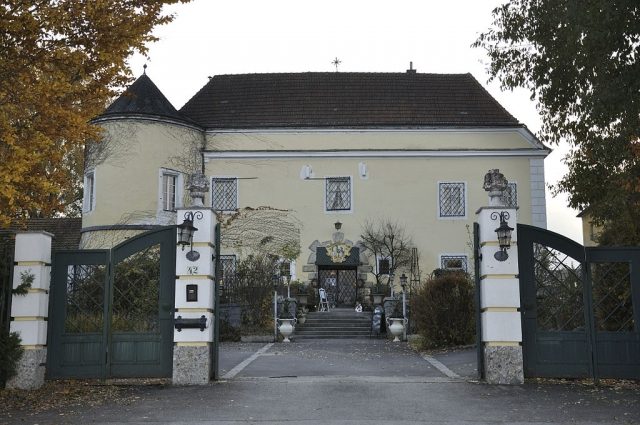
Mühlgrub Castle (also known as Grueb in the Traunviertel) is located in the eponymous district of the municipality of Pfarrkirchen bei Bad Hall in the Steyr-Land district of Upper Austria (Mühlgruber Straße 42).
Mühlgrub Castle emerged from the free manor of Grub (until 1415 it was simply called Grub). This was the seat of the Asperger von Aspertgerhof, who had received it as a fief from Kremsmünster Abbey. The manor is already mentioned in a Kremsmünster urbarium in 1299. The last of the Asperger was a Wolfgang, who, however, only owned half of the property, the other half belonged to a relative named Hans Pucher. Wolfgang's daughter Barbara was married to Hans Mühlwanger and inherited her father's share. In 1415, Hans Mühlwanger also bought the other part. Since that time, the seat has been called Mühlgrub. Under the Mühlwangers, it was converted into a Renaissance castle. In 1529, a Hans Mühwanger sold the castle to Hanns Greimatschmied. His heirs sold the property in 1544 to Hieronymus Prändl von Weissenbach, from whom it passed to the Wuecherer family six years later. The iron master and regional scribe of ob der Enns, Christoph Strutz, took over the property from Georg Wuecherer in 1601. In 1615, Hans Fenzl von Steyr succeeded him. In 1633, his daughter Elisabeth received Mühlgrub and brought the castle into her marriage with Wolfgang Jakob von Katzianer. In 1658, Siegmund Ferdinand von Katzianer sold the dominion to Veit von Gera, who, however, died in the same year. From his heirs, the dominion passed in 1659 to Schlierbach Abbey, which owned it until 1876. Then Gottlieb and Anna Pepöck bought the property. Their successor, Hans Hager, founded a brewery in 1891. The castle and brewery are now owned by the Fein family. The brewery ceased operations in 1986. In the 1970s, the world's largest bottle filling plant for "Schartner Bombe" was built here. Today, the castle is owned by the company "Country Home Style".
Mühlgrub Castle then and now+
The spacious complex of Mühlburg Castle stands on a hill above the Sulzbach stream.
As can be seen in Georg Matthäus Vischer's engraving from 1674, the castle had seven towers, two of which are still preserved. The castle was surrounded by several outbuildings, which were connected to form an outer wall. All the towers of the outer wall have disappeared. The castle itself is a four-winged complex around a rectangular inner courtyard. A tall, square tower with a pyramid roof is integrated into one wing of the castle. The second tower stands at the left corner in front of the castle entrance. This is a projecting round tower with a conical roof (formerly paired with a second one). The castle was severely damaged in the Second World War. The second flank tower was not rebuilt. Access to the castle is through a round-arched portal made of large stone blocks. Behind it is a gate hall that leads into the inner courtyard. The paved courtyard leads slightly uphill to the side with the rear tower. The windows have wrought-iron grilles.
The two remaining outbuildings of the original ensemble served brewery purposes until 1986.
Take Mobile History with you
You are reading this text for free. Premium adds what matters on the road: descriptions read aloud, sites found through your camera, whole regions taken offline.
- Every description, including the ~17,700 Premium sites
- Audio guide: have descriptions read to you on location
- AR finder: see sites through your camera, with distance and bearing
- Unlimited saved sites
14 days free, then from €2.99 a month. Cancel anytime.
Source: Wikipedia · Licence: CC BY-SA 4.0 · Image: http://commons.wikimedia.org/wiki/File:Pfarrkirchen_Schlo%C3%9F_M%C3%BChlgrub.JPG
This description draws on the facts documented in the linked Wikipedia article; Wikipedia content is licensed under CC BY-SA 4.0. Wording and editing: Mobile History.
Location: 48.0253, 14.2037