To be privately owned
CastleSalzburg
Montfort Castle
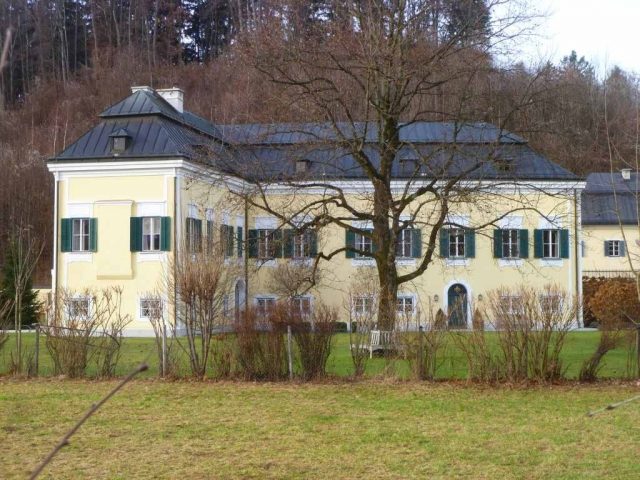
Montfort Castle (Salzburg) is located in the Hellbrunn district of Salzburg (Montforterweg 10). Other names for the building are Golserhof or Monforterhof.
As early as 1334, a country estate near Gols (Gols dua Praedia) is mentioned in the Nonnberg Urbar. In 1382, the property was called "hueb ze gols". In 1412, this farm was owned by the noble family of the "Golser", who had received it from Nonnberg Abbey as a life annuity; it remained in their possession until 1528. Then the property passed to Lienhart Hörmann, the son-in-law of Erentraud Golser. From his descendants, the Golser Hof passed to Baltasar Egger in 1606. In 1650, Mathias Mayr von Pürglau and his wife Susanne Fabrizin acquired the farm from Magdalena Eggerin, wife of Johann Helbmreicher.
In 1509, in addition to the Golser Hof, the small castle of Lüftenegg was mentioned, which was to become a main component of the later Montforter Hof. The sister of Archbishop Johann Ernst Graf Thun, Maria Anna, Countess of Montfort, née Thun and Hohenstein, acquired the Golserhof in 1699 and ten years later also Lüftenegg Castle and other surrounding grounds. The property thus created was named Schloss Thunegg or Tumeggerhof after the owner. Anton III, Count of Montfort (* 1670) had - not least because of a major counterfeiting scandal - transferred parts of the government business to his son Ernst in 1727 and moved in 1728 with his wife Maria Anna Countess of Montfort from the Montfort dominions in the Lake Constance region to Salzburg to the Montforter Hof, where both died in 1733. In 1733, the Countess of Montfort bequeathed the property as a fideicommiss to the family of her grandson Josef Graf Lodron. Should he have no male descendants, it was to pass to the next related Lodron or Montfort descendants. In 1746, Anton Graf von Montfort († 1787 as the last of his name), who had succeeded Count Josef von Lodron, followed in possession. In 1791, Hieronymus Graf von Lodron bought the farm.
In 1791, he sold the castle to Prince-Archbishop Colloredo, who had the manorial rights of Nonnberg Abbey extinguished and used the farm for hunting stays. The princely hunting ground included the Morzger hill, Hellbrunn, and the adjoining Eichetwald. To guarantee successful hunting for the hunting guests, numerous hunting facilities (small game fields and salt marshes scattered in the forest) were located on the Morzger hill and in its surroundings. Colloredo also had a gloriette built on the Hinterer Goiserberg, from which the Prince-Archbishop could enjoy a wonderful view of Hohensalzburg Fortress and the old town. The building stood on an approximately two-meter-high plinth with a square base measuring 2 m on each side. The tip of the lantern was 12 m high. The small castle, solidly built on the ground floor, had a floor area of 9 x 9 m. The wooden observation tower was 5 m above the base of the building.
After Salzburg's annexation to the Habsburg Monarchy in 1816, the estate became state property of the Imperial and Royal Monarchy and was left to the respective district governor (roughly equivalent to today's provincial governor) for use. Thus, the district governors Count Welsperg, Count Montecuccoli, Count Stolberg, and Count Chorinsky successively lived in or leased the castle. In 1875, Montfort Castle came into the possession of Karl Überreiter.
Finally, in 1884, Alois Graf von Arco-Stepperg bought the Montforterhof and its surroundings. In 1893, his only daughter Sophie Countess Moy de Sons inherited the property. Like Anif Water Castle and Villa Swoboda in Keltenallee (currently the residence of Karl Habsburg-Lothringen), the Montforter Hof was inherited by the Countess's nephew, the art historian Johannes Graf von Moy, who was succeeded as owner by his adopted son Johannes Graf von Moy. His descendants are still the owners, but the castle has been rented out to the Flick family, among others.
Building History+
The castle is a hook-shaped building. The two wings, built at right angles to each other, have uniform window plaster frames on the upper floor. The eastern part of the castle dates from the 15th century, the west wing from the 18th century. Around 1790, it received its current facades as a hunting lodge.
Montfort Castle has long included an economic wing with a stable building. Friedrich Graf Spaur praises the progressiveness of the agricultural farm building (water supply for cattle, feeding system, light) during the time of Prince-Archbishop Colloredo. The old stable has columns arranged in rows in six consecutive fields, above which a flat vault with transverse arches is built. Before 1995, a carpentry workshop was located in the old stable building. A private vehicle museum was then to be set up here, but this has not yet materialized. The eastern wooden part from the period after 1800, once separated from the stable by a path, was later joined with the stable to form a closed building with a uniform roof.
Montfort Castle was formerly surrounded by a large Baroque garden (150 by 50 m). In the decades before 1900, this complex, including the surrounding landscape garden, was gradually dissolved.
The building was fundamentally renovated in 2006 and is owned by Johannes Graf von Moy and partly by Ms. Corinne Flick.
Take Mobile History with you
You are reading this text for free. Premium adds what matters on the road: descriptions read aloud, sites found through your camera, whole regions taken offline.
- Every description, including the ~17,700 Premium sites
- Audio guide: have descriptions read to you on location
- AR finder: see sites through your camera, with distance and bearing
- Unlimited saved sites
14 days free, then from €2.99 a month. Cancel anytime.
Source: Wikipedia · Licence: CC BY-SA 4.0 · Image: http://de.wikipedia.org/w/index.php?title=Datei:Schloss_Montfort_%28Salzburg%29.jpg&filetimestamp=20121225203449&
This description draws on the facts documented in the linked Wikipedia article; Wikipedia content is licensed under CC BY-SA 4.0. Wording and editing: Mobile History.
Location: 47.7657, 13.0546