Hotel
CastleMontabaur
Montabaur Castle
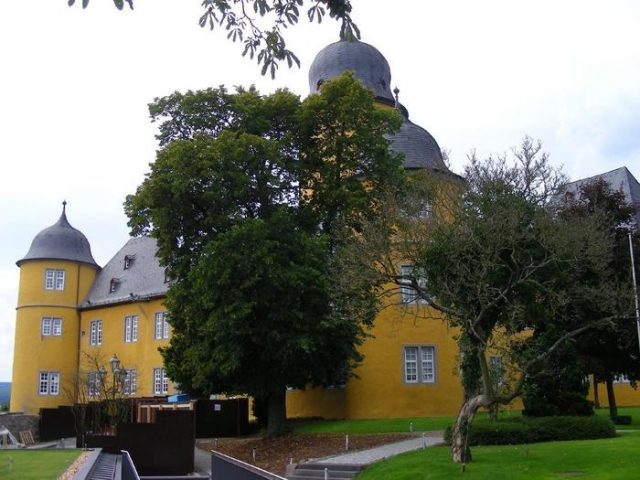
The baroque Montabaur Castle is the landmark of the city of Montabaur in the Westerwald. It stands prominently in its center on the Schlossberg (Castle Hill).
The castle consists of an outer bailey and a two-story main building, which, with its four wings, encloses an almost square inner courtyard. At the corners, it has three-story round towers with flat, curved domes as roofs. Its medieval keep is 33 meters high. On the courtyard side, three stair towers protrude from the yellow-painted facade.
The castle complex also includes several individual buildings, including the Zwinger (outer bailey) redesigned in the Baroque style, the Marstall (stables) from 1720, and the outer gatehouse with the year 1588.
The history of the castle dates back to the 10th century. In 959, a "Castellum Humbacense" was first mentioned in a document as the residence of Duke Hermann of Swabia. Emperor Henry II transferred the then castle, along with its associated manorial rights, to the Archbishop Poppo of Babenberg of Trier in 1018, and thus to the Archdiocese of Trier. Archbishop Theoderich von Wied had it fortified to secure the areas of his diocese on the right bank of the Rhine, but could not prevent the castle from being attacked and destroyed by the Count of Nassau in 1212. Inspired by Mount Tabor in Israel, Theoderich had the complex rebuilt in 1217 and named the castle hill "Mons Tabor," from which the later "Montabaur" developed. Under this name, the complex was first mentioned in a document in 1227.
The castle was subsequently administered by a castle captain. It also served as the official and residential seat of episcopal bailiffs and was guarded by castle men. Around 1400, their number was 53. Around 1280, the keep of the complex was built, but around 1520, the medieval defensive structure was converted into a four-winged Renaissance castle, whose core substance has survived to the present day. Previously, Emperor Maximilian had stayed overnight in the castle in 1505 with 500 people in his entourage.
The castle received its current appearance between 1687 and 1709, when Elector Johann Hugo von Orsbeck had it redesigned in the Baroque style by his court architect Johann Christoph Sebastiani. The ceiling painting is by Lazaro Maria Sanguinetti. It depicts allegories of light and personifications of the four elements: air, earth, fire, and water. The complex served as the residence of the Archbishops of Trier until the end of the 18th century, before the last Elector Clemens Wenzeslaus of Saxony fled from French revolutionary armies in 1794 and the Electorate was dissolved in 1801. The former Trier possessions – and thus also Montabaur Castle – fell to the Duchy of Nassau-Weilburg. The Dukes of Nassau subsequently used the complex as a hunting lodge.
From 1851 to 1880, the buildings housed the ducal-Nassau simultaneous teacher training college. From 1868, they also served as the seat of the district administration office and until 1945 as the residence of the district administrator of the Unterwesterwaldkreis. After the Second World War, from 1946, the castle was used as the administrative seat of the Montabaur administrative district.
In 1969, the Deutsche Genossenschaftskasse (German Cooperative Bank) acquired the complex, which was subsequently used by the Schulze-Delitzsch Institute and the Bundesgenossenschaftsschule Raiffeisen e.V. (Federal Cooperative School Raiffeisen). After the merger of both institutes in 1978 to form the Akademie Deutscher Genossenschaften (ADG), the latter bought the castle and converted it into a seminar and conference center.
Current Use+
Since 1970, Montabaur Castle has served as a nationwide center for management qualification for aspiring and current executives of cooperative banks as well as cooperative goods, trade, and service cooperatives. In addition, the Akademie Deutscher Genossenschaften operates a four-star hotel there with around 300 rooms. With over 70,000 overnight stays, Montabaur Castle is one of the largest hotel establishments in Rhineland-Palatinate.
Take Mobile History with you
You are reading this text for free. Premium adds what matters on the road: descriptions read aloud, sites found through your camera, whole regions taken offline.
- Every description, including the ~17,700 Premium sites
- Audio guide: have descriptions read to you on location
- AR finder: see sites through your camera, with distance and bearing
- Unlimited saved sites
14 days free, then from €2.99 a month. Cancel anytime.
Source: Wikipedia · Licence: CC BY-SA 4.0 · Image: http://www.wehrbauten.de/thread.php?threadid=980
This description draws on the facts documented in the linked Wikipedia article; Wikipedia content is licensed under CC BY-SA 4.0. Wording and editing: Mobile History.
Location: 50.4386, 7.8264