Offices
CastleHerzebrock-Clarholz-Möhler
Möhler Castle
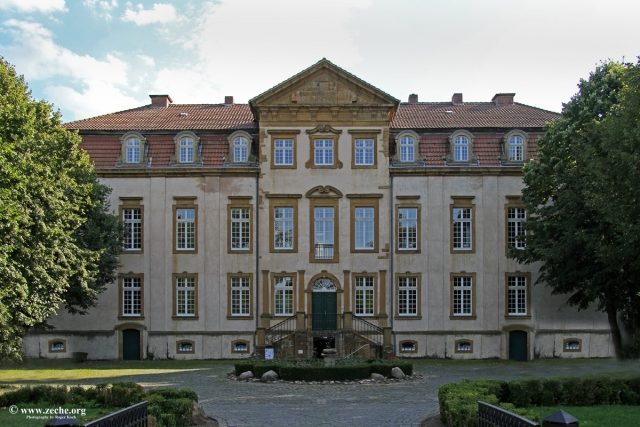
Möhler Castle is a baroque moated castle in Möhler, a district of Herzebrock-Clarholz in the Gütersloh district.
Möhler was first mentioned in a levy register of Freckenhorst Abbey in the 11th century as the knight's estate "Mudelare". From the 13th century, it is known that a Meinhard de Mudelare exchanged lands with Marienfeld Abbey. In a document from between 1237 and 1240, Count Konrad von Rietberg calls the knight Albert de Mudelere his "ministerialis noster", meaning his vassal. Presumably, a castle-like complex was built at the site of the present castle at that time.
In the "Verzeichnis der wuesten Erben und Guether" (Register of desolate heirs and goods) of the Prince-Bishopric of Münster from the first half of the 16th century, it states: "Ampt Stromberg, Kerspell Olde - Moeler, Wendt zustendig". It refers to the "de Wendt" family, who had leased lands here. Lubbert de Wendt built a house in Möhler between 1549 and 1564. However, the Renaissance building was already dilapidated by the end of the 17th century.
Through the will of Franz Egon von Wendt from 1709, the dilapidated house and the associated estates came into the possession of the Baltic branch of the Barons von Kettler.
The Prussian chamberlain Karl Aemilius Freiherr von Kettler had Möhler Castle built on the site of the old house. The two-winged noble residence showed a striking resemblance to baroque castles in the Mark Brandenburg; however, the architect remains unknown to this day. The interior of the Kettler's summer residence was probably never fully completed, and the baroque building was only inhabited by the noble family for a few decades. Today, only the main wing of the castle remains. The two side wings no longer exist.
With the construction of the castle between 1710 and 1715, craftsmen settled alongside the farmers, so that the former knight's estate developed into a village.
Möhler Castle, whose possessions included 896 Morgen in the parish of Oelde and 102 Morgen in the farming community of Herzebrock, changed hands several more times. From 1830, it was owned by the Dukes of Croy from Dülmen. From the end of the 19th century, the complex was severely neglected.
In the mid-19th century, the two side wings were demolished. Among other things, the Ludgerus Chapel was built on the edge of the village in 1853 from the material of the demolished side wings of the castle. The building plot and the inventory of the chapel were provided by the Duke of Croy.
In the 1980s, the castle was acquired by investors. The new owners had it extensively restored in the early 1990s, and part of the former baroque garden with strictly symmetrically arranged boxwood beds and sculptures was restored according to original plans.
The castle is not freely accessible today. The interior rooms are used commercially, housing several companies and businesses, including a catering establishment, an architectural and an engineering office, as well as photographers and designers. In total, the castle offers space for 40 workplaces.
Take Mobile History with you
You are reading this text for free. Premium adds what matters on the road: descriptions read aloud, sites found through your camera, whole regions taken offline.
- Every description, including the ~17,700 Premium sites
- Audio guide: have descriptions read to you on location
- AR finder: see sites through your camera, with distance and bearing
- Unlimited saved sites
14 days free, then from €2.99 a month. Cancel anytime.
Source: Wikipedia · Licence: CC BY-SA 4.0 · Image: http://www.zeche.org/
This description draws on the facts documented in the linked Wikipedia article; Wikipedia content is licensed under CC BY-SA 4.0. Wording and editing: Mobile History.
Location: 51.8594, 8.2103