To be privately owned
The Castle grounds can be visited
CastleRadibor-Milkel
Milkel Castle
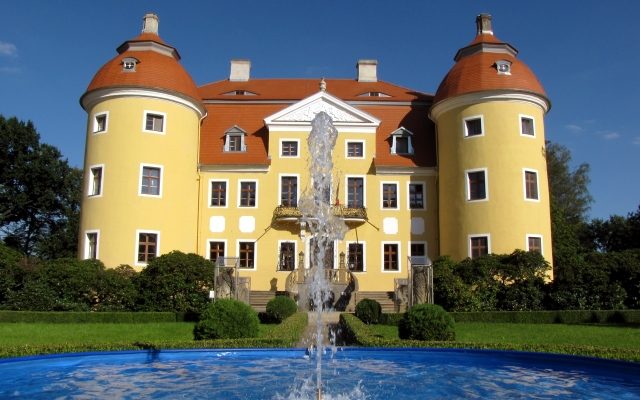
Milkel Castle is located in the eponymous village of Milkel in the Bautzen district and is a Baroque country castle in Upper Lusatia.
The Milkel Baroque castle complex is situated on the northern edge of the village of Milkel in the municipality of Radibor. This is located about 13 kilometers north of Bautzen in the Upper Lusatian Heath and Pond Landscape.
The castle, now again surrounded by water on four sides, is founded on oak piles and was presumably supplemented with stone buildings from 1302 onwards. A wooden defensive and residential tower is said to have stood here as early as the 9th century. The findings of the oak foundation in 2005, with a felling date of 1302, which are also exhibited in the castle courtyard, are the first proof of the existence of old German moated castles on oak pile foundations in Upper Lusatia. From the 14th to the 18th century, the castle was expanded by its respective owners. In 1719/20, the north tower was added by the von Ponickau family, and the current basic form was created. Since Moritzburg Castle was brought into its current form in 1724/25, it is likely that Milkel was the pilot project for Moritzburg.
Friedrich von Metzradt, already mentioned among the Budissin men in 1272, founded the Milkel manor around 1300. With him and his family, Milkel Church was built in 1322. The Metzradt family resided in Milkel until 1595, followed by the von Löben family from 1595 to 1617; the von Krahe family from 1617 to 1640, the von Ponickau family from 1640 to 1759, and the Counts of Gersdorf from 1759 to 1769. From 1769 to 1908, Milkel was owned by the von Einsiedel family. In 1908, the Landbank zu Berlin took over the property and sold it to the von Holnstein family, who extensively renovated the castle and lived there until their expropriation and expulsion by the communists in 1945.
From 1945 to 1948, it was used as a refugee camp; from 1948 to 1953, the Free German Trade Union Federation trained its functionaries here in the basic principles of Marxism and Leninism. From 1953 to 1993, the Sorbian language school used the area. From 1993 to 1998, the castle stood empty, was viewed by 51 interested parties, but not sold and, due to the high backlog of repairs, was left to decay until a buyer was found in 1998. After 14 years of renovation work, the castle, the cavalier houses, the park, and the burial sites of the previous owners are now in a historically worthy condition.
The Complex+
Above the portal door, the front windows, and in the gable part of the central risalit were the coats of arms of the former owners, the von Zehmen, von Ponickau, von Haugwitz, and von Einsiedel families. The time division of the sundial and all coats of arms were destroyed during GDR times because they were incompatible with the political ideology. The sundial was restored in 2008, and the stucco decoration in the ornamental gable in 2010.
Particularly noteworthy interior features include the cell vaults in the south tower from the period after 1400 and the stucco design (around 1750) on the ceiling of the Rococo hall.
In the visual axis to the west, on the ground floor, the symmetrical, French-style park section, equipped with sandstone sculptures and other decorative elements, can be seen. A sandstone bridge and the wrought-iron bridge, built on old foundations in 2005, lead to the larger, English landscape park. The 16 Baroque and Rococo figure groups that adorned both park areas before 1945 were smashed and buried by commissioned persons in the 1950s. Parts of these were excavated during leveling work near the oil house in 2004, cleaned, and exhibited in the castle. The English landscape park, traversed by many paths, shows clear structures of Prince Pückler's park design. From the African tulip tree to ash maples to native pedunculate oaks and common beeches, many different tree species can be found.
Usage+
The castle is now in private hands, the cavalier houses are rented. The park is open to visitors.
Take Mobile History with you
You are reading this text for free. Premium adds what matters on the road: descriptions read aloud, sites found through your camera, whole regions taken offline.
- Every description, including the ~17,700 Premium sites
- Audio guide: have descriptions read to you on location
- AR finder: see sites through your camera, with distance and bearing
- Unlimited saved sites
14 days free, then from €2.99 a month. Cancel anytime.
Source: Wikipedia · Licence: CC BY-SA 4.0 · Image: https://commons.wikimedia.org/wiki/File:Barockschloss_Milkel_Front_01.jpg
This description draws on the facts documented in the linked Wikipedia article; Wikipedia content is licensed under CC BY-SA 4.0. Wording and editing: Mobile History.
Location: 51.2998, 14.4608