Cultural center
Museum
CastleMeßkirch
Meßkirch Castle
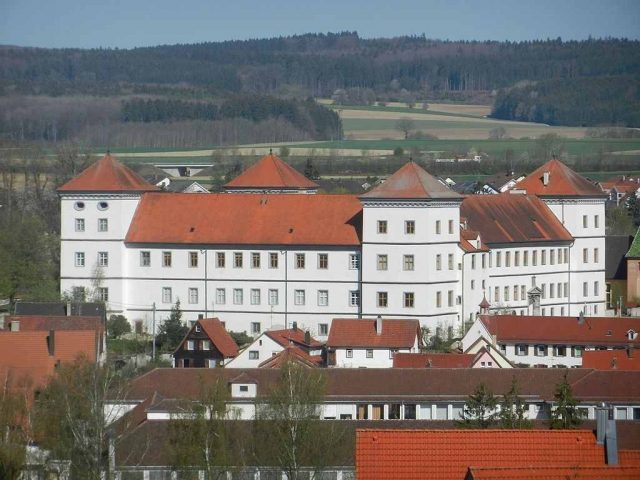
Meßkirch Castle, also known as the Castle of the Counts of Zimmern or simply Zimmern Castle, is located in the center of the town of Meßkirch in the Sigmaringen district of Baden-Württemberg. The castle serves as both a cultural and museum center.
The castle's origins date back to around 1400. Froben Christoph von Zimmern reports in the Zimmern Chronicle about the renovations his uncle Gottfried Werner had carried out on the old castle after 1520. His criticism of these measures is very drastic. The defects in the construction led to the castle becoming dilapidated in a short time. This also gave Froben Christoph the justification to completely demolish the old castle in favor of a new castle construction.
On May 9, 1557, three years after his accession to power, the new lord of the castle himself laid the foundation stone for the new building. A keystone with the year 1557 in the town wing of the castle bears witness to this. It is presumed that Froben Christoph might have drawn inspiration for the castle construction during his studies in France (Bourges, Angers, and Tours) between 1534 and 1540, but the supposed model for Meßkirch Castle, Ancy-le-Franc Castle, completed by Sebastiano Serlio in 1545, had not even been started at that time. The master builder of Meßkirch Castle, Jörg Schwarzenberger, is documented in Meßkirch in 1561 and again in 1566. Meßkirch Castle is the first regular four-winged castle complex north of the Alps in the Renaissance style.
Schwarzenberger later implemented this new castle type, called the Meßkirch Castle type, also for the Zimmern relatives, the Zollern in Hechingen and the Fürstenbergers in Heiligenberg, as well as for the Counts of Waldburg with the castles of Wolfegg and Zeil.
Similar, contemporary new castle constructions, such as Göppingen, 1555, and Hohenems, 1567, were not as stylistically pure as Meßkirch Castle. The castle planned for Freudenstadt in 1599 was never built.
In 1566, all four corner towers and three of the wings were completed, with an old building, the so-called "Schlössle," remaining as the fourth wing. The castle contains the oldest Renaissance banquet hall in Germany (1561), the Knights' Hall, measuring 30 x 9.60 meters, with its original wooden coffered ceiling, consisting of exactly 85 individual elements. A special feature is the technical innovation of the self-supporting ceiling, which means the room does not require columns. In December 1985, a valuable Renaissance coffered ceiling, similar to the one in the east wing, was discovered in the west wing of the castle. A second hall, measuring 20 x 9.60 meters, had already been divided into two rooms under Count Wilhelm von Zimmern, who continued the interior work after Froben Christoph's death. The interior work was completed by his death in 1594.
Froben Christoph's reference to the many snails (stone spiral staircases) and still existing exterior doors reflects the changed security needs of the castle lords of that time and the client's fear of a fire disaster. He not only provided many escape routes but also stone stairs that could have withstood a fire. Various escape options in case of fire were more important to him than protection from external enemies. The current baroque wooden staircase dates from the time of Froben Ferdinand zu Fürstenberg. A round stone chamber can still be found in the castle cellar.
The castle also features a vaulted cellar and a dungeon.
In 1594, after the extinction of the Counts of Zimmern, the castle initially served as a residence for the Counts of Helfenstein-Gundelfingen. The latter had a canting coat of arms placed above the main portal. From 1716, it was the residence of the Princes of Fürstenberg-Meßkirch.
The stable and carriage building (coach house) was built in 1737 by the Teutonic Order master builder Johann Caspar Bagnato and today houses the Classic Car Museum, which displays a collection of old automobiles and and motorcycles.
What strongly shaped both the building and urban history was the extinction of the male line of the Zimmern family as well as the Meßkirch line of the Fürstenberg family in Meßkirch in 1744. This meant that the Meßkirch upper class gradually migrated towards Donaueschingen, and those Meßkirch residents who worked in and for the castle lost their jobs.
The castle was no longer a residence and served as a dwelling for family members when needed; from 1726 to 1808, it was a widow's residence.
Architecturally, the castle construction was also influenced by Roman buildings of antiquity. This is evident in roof shapes, columns, and cornices: for example, the triangular gable above the archway, the stylized half-columns, or the building ornamentation along the facade.
Restoration+
Since the last additions around 1700, there have been no significant changes to the basic structure. The castle lacked the necessary structural maintenance, and over time, serious structural damage occurred. The city of Meßkirch, which acquired the castle and its court garden from the Fürstenberg princely house in 1961 for the symbolic purchase price of one German Mark, was for a long time unable to change anything.
When a monument preservation priority program of the Baden-Württemberg state government began towards the end of the 1970s, Meßkirch Castle was one of the most urgent objects. In 1984, it was recognized as a monument of particular national cultural importance, and in 1985, work began with the repair of the roofs and portals.
In January 1986, extensive coffered ceilings from the Renaissance period were discovered in three wings, and three barrel vaults with frescoes by Joseph Franz Wegscheider were uncovered in the former castle chapel. It features magnificent stucco ceilings.
From 1991 to 1995, the "Schlössle" and the coach house were renovated. With assistance from the monument utilization program and funds from the European Union, the exterior facade was simultaneously repaired in 1993. From 1998 to 2001, the interior renovation of the town wing, the renovation of the inner courtyard, and the cellar rooms took place. In 2005, the renovation of the valley wing finally began.
The west wing still needs to be renovated. However, since it is a protected monument, this requires enormous financial efforts that cannot be managed in the coming years.
The small castle hall features Renaissance arcades. In the former prince's apartment, the original stucco ceilings can be found. The impressive roof truss dates from the 16th century. The complex also houses 19th-century official rooms.
Usage+
The administrative center, even during the Fürstenberg era, was Meßkirch Castle, built by the Barons of Zimmern, the former residence of the Princes of Fürstenberg. Until the transition to Baden, the Fürstenberg Oberamt (district office) was also established there. After 1806, the Baden district office was housed there until it was dissolved in 1936 as part of an administrative reform decreed by the National Socialists, and the Meßkirch district was incorporated into the Stockach district. The last Fürstenberg authority, the Princely Fürstenberg Forestry Office, remained in the castle, and until the district reform in 1973, the district court was also located there. The notary's office still has its domicile in the castle today. The Allgemeine Ortskrankenkasse (AOK) of the Stockach district and various schools also found a home there for years, such as the Ursuline Women's School, later the Women's Vocational School and the Aufbaurealschule, a boarding school for the Benedictine Sisters of Saint Lioba (a branch school of the Kloster Wald boarding school, until its relocation to Wald in 1977). However, secondary school and middle school classes also temporarily used the rooms in the castle until the building complex was renovated. In 1983, the music educator couple Ludwig and Wilma Fischer-Schwaner operated a private music school in the castle.
Since its renovation, the building complex has been primarily used by the Martin Heidegger Archive. Its banquet hall is available for cultural events, conferences, and representative occasions of the city.
Museums+
District Gallery
Since 2006, the castle has housed the District Gallery Meßkirch Castle, a district-owned art collection of the Sigmaringen district, on two floors and a total area of approximately 450 square meters in the south wing of the castle complex, the so-called valley wing. In contrast to the open banquet hall, the south wing is divided into small room units for static reasons. The art objects are owned by the district or were acquired by the Oberschwäbische Elektrizitätswerke. In 2009, the number of visitors increased from 3,500 to 4,000.
Classic Car Museum
The Meßkirch Classic Car Museum displays a collection of old automobiles and motorcycles.
Martin Heidegger Museum
In 2002, a permanent exhibition on the life and work of the philosopher, the Martin Heidegger Museum, was opened on the ground floor of the east wing. In addition to a life chronicle and stages of Heidegger's philosophical development, the themes "Heidegger as a son of Meßkirch" and "Heidegger and art" are also presented. His working library is located in the Martin Heidegger Archive.
Court Garden+
The court garden, planned in 1735 as an architectural landscape garden with straight avenues, water basins, and plants shaped by garden shears, was never realized. Its builder, Froben Ferdinand zu Fürstenberg, died during the planning. Froben Christoph von Zimmern had already planned to create the garden as an orchard.
The smaller version of today's court garden was laid out in 1736 as a castle park in the French style according to plans by Johann Caspar Bagnato and planted with over 300 lime trees, of which 44 still stand today. In December 1985, 25 trees had to be felled. Of the total of 300 trees in the court garden, 57 are 200 years old or older. The special feature of the old tree population lies, on the one hand, in the high number of very old lime trees, which is unique regionally, and on the other hand, in the good health of the trees. Generally, all trees are hollow inside. However, most of them have enough residual wall thickness to ensure life-sustaining supply. In general, a large maintenance backlog and a very high incidence of deadwood can be observed throughout the area. For about 50 percent of the trees, growth training with pruning, crown securing, and shortening is overdue to maintain the vitality of the trees in the long term. In the past, trunk damage has repeatedly occurred due to lawn mowing in the court garden. In 2011, the city will begin with crown securing.
The fountain with a jet in a paved basin in the court garden was once donated by the Dual company. The park with its baroque structure was once a private garden with paths and sightlines, as well as parterre areas. The court garden changed over the decades with the demands of the public.
For the 750th anniversary of the city of Meßkirch in 2011, the court garden is to present itself anew as a collaborative design project by the city, citizens, and landscape planners. For this purpose, a citizen workshop was held in 2009 and 2010. The redesign will include enlarging the children's playground and changing the course of the Mettenbach stream.
In April 2010, surveys were carried out in the court garden for a park maintenance plan, with the aim of registering it in the monument register. So far, the court garden and castle together have ensemble protection. In the meantime, it has been declared a natural monument. The entry in the monument register and the creation of a maintenance plan are basic prerequisites for the recognition of the court garden as a "cultural monument of particular importance."
The richness of species and individuals in the court garden is significant: 44 bird species occur in the court garden, including 31 breeding bird species and three strictly protected species on the Red List of endangered species (Merlin, Green Woodpecker, and Kestrel), as well as 16 on the pre-warning list (such as Willow Warbler, Tree Sparrow, and Common Crossbill). Regional peculiarities include the Common Crossbill, a starling colony, and a colony of Fieldfares. Among beetles, a total of 40 species of wood beetles occur in the park and the orchard. Of particular importance is the Great Oak Jewel Beetle, which is among the critically endangered species. It has a unique refuge here between the Swabian Alb and the Alps and inhabits 27 lime trees, especially in the peripheral area of the court garden. For bats, the court garden is a very valuable area. The park, orchard, and adjacent open land are an ideal hunting habitat.
Events+
Meßkirch Castle Festival
The Meßkirch Castle Festival takes place annually around the castle, in the inner courtyard, and in the court garden. The festival is jointly organized and carried out by the city of Meßkirch, the Hofmann siblings, Meßkirch associations, and restaurateurs. In May 2008, the 4th Meßkirch Castle Festival was entirely dedicated to the 20th stage anniversary of the Hofmann siblings and attracted thousands of visitors to Meßkirch.
Meßkirch Castle Christmas
Since 2006, the Meßkirch Castle Christmas, a Christmas market in the castle courtyard that attracts hundreds of visitors, has taken place every first Advent weekend. The organizer is the Handels- und Gewerbevereinigung (HGV) from Meßkirch, which organizes the catering for the stalls together with local associations and businesses.
Classic Car Meeting
Since 2007, the largest classic car meeting in Upper Swabia has taken place every two years in the court garden, castle courtyard, and castle, attracting hundreds of classic vehicles and thousands of visitors. For the meeting on July 4-5, 2009, there was a special classic motorcycle meeting on Saturday for the first time. On Sunday, there was a general classic car meeting for all types of classic cars built up to 1975.
Take Mobile History with you
You are reading this text for free. Premium adds what matters on the road: descriptions read aloud, sites found through your camera, whole regions taken offline.
- Every description, including the ~17,700 Premium sites
- Audio guide: have descriptions read to you on location
- AR finder: see sites through your camera, with distance and bearing
- Unlimited saved sites
14 days free, then from €2.99 a month. Cancel anytime.
Source: Wikipedia · Licence: CC BY-SA 4.0
This description draws on the facts documented in the linked Wikipedia article; Wikipedia content is licensed under CC BY-SA 4.0. Wording and editing: Mobile History.
Location: 47.9930, 9.1101