Monastery operation
CastleLauda-Königshofen-Messelhausen
Messelhausen Castle
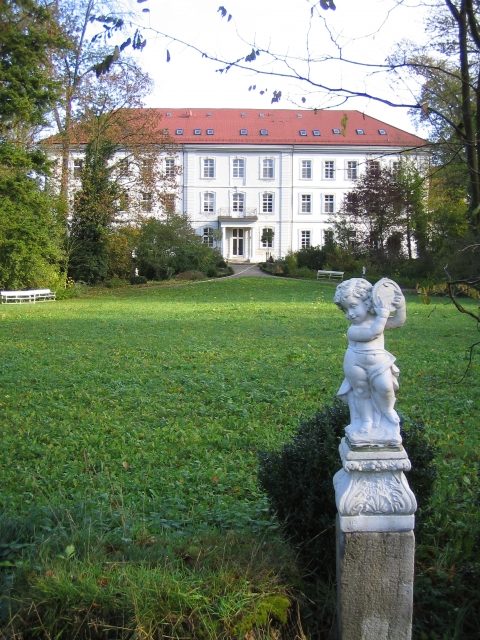
Messelhausen Castle and Monastery in Tauberfranken, Baden-Württemberg, was first mentioned in documents at the beginning of the 13th century; at that time, it was still referred to as "Messelhausen with a castle."
The castle initially belonged to the Counts of Hohenlohe; the feudal lords later changed frequently through purchase and sale or through conflict and negotiations. For example, the city of Rothenburg used the castle as a base to harm Bishop Johann I of Würzburg and his followers. However, he conquered the "robber castle" but had to return it in 1401 after peace negotiations. In 1530, Messelhausen Castle and village came to the Zobel family via the Lords of Tottenheim and Thüngen: The widow of Balthasar von Thüngen married Christoph Zobel von Giebelstadt zu Guttenberg in her second marriage, but he died soon after. In 1538, she sold "Messelhausen Castle and village, along with all appurtenances, for 9000 guilders (...) to her dear son-in-law Stephan Zobel von Giebelstadt zu Darstadt, who had become the husband of her youngest daughter Anastasia. In this way, Messelhausen Castle and village, along with Marstadt, came to the Zobel von Giebelstadt zu Darstadt family."
Originally, the castle, which until 1699 was only in the feudal possession of the village lords, was nothing more than a castle site of the Counts of Hohenlohe. It originally stood where the manor house still stands today. In accordance with its military purpose, the castle was surrounded by a rampart and moat, secured by a drawbridge, and equipped with strong towers, making it a moated castle.
During the Peasants' War in 1525, the castle was burned down by rebellious peasants. It was rebuilt after the war but was again devastated and destroyed in the Thirty Years' War; likewise in 1688, when it was burned down by the French.
In 1699, Johann Franz von Zobel built the castle for the third time (today, the tenant's apartment behind the park stands on this site), now in the Rococo style, and had a lake and a drawbridge installed. At this time, the castle already served as a lordly residence, but it was architecturally so poor that the lords felt compelled in 1740 to build a new residence, the current castle. The main building and the annex building to the south of it were built between 1740 and 1744.
The house chapel was already furnished as it can still be seen today. However, "this building was also not a fortunate one." The mansard roof of the main building was poorly constructed and unusually heavy, so the masonry soon developed alarming cracks. At the beginning of the 19th century, the lords therefore left the castle to decay and resided in Würzburg. The castle almost fell into ruin, and the garden became completely neglected. In 1829, the former canon Friedrich von Zobel decided to have the building restored to a habitable condition at his own expense. The walls were repaired, the heavy mansard roof was replaced by the current lighter one, and the second floor was extended. At that time, the current two gatehouses and the laundry building were erected. The castle garden was restored with numerous exotic trees and ornamental shrubs, and the lake was re-excavated. In addition, greenhouses and two basins with goldfish and fountains were created. Instead of the old dilapidated surrounding wall, the current wall was built in the 1840s and 1850s.
In 1932, the Augustinian Order acquired the complex and has since also provided pastoral care for the parish. In 1944, the research facility of the Physical Institute of the University of Heidelberg – kept strictly secret from the local population – worked in the Messelhausen castle building on an insulation layer for submarines, which would make them undetectable. The leading figure of the research project was Privy Councillor Prof. Philipp Lenard, Nobel Prize winner in Physics in 1905 and co-discoverer of X-rays. Due to the establishment of research work in the former castle, severe damage occurred to the buildings in Messelhausen when the Americans moved in during the last days of World War II; there were also heavy losses among the fighting troops and the civilian population.
Between 1947 and 1956, the monastery was a gathering point for Augustinian brothers expelled from Czechoslovakia and their relatives, who, however, returned the house to the German Augustinian province after establishing their own branches in Vienna, Stuttgart-Sillenbuch, and Zwiesel. In 1956, the house was modernized; in 1987, it was fundamentally renovated, and in 1998, the attic was converted.
In 2013, the monastery was abandoned and sold by the German Augustinian province.
Take Mobile History with you
You are reading this text for free. Premium adds what matters on the road: descriptions read aloud, sites found through your camera, whole regions taken offline.
- Every description, including the ~17,700 Premium sites
- Audio guide: have descriptions read to you on location
- AR finder: see sites through your camera, with distance and bearing
- Unlimited saved sites
14 days free, then from €2.99 a month. Cancel anytime.
Source: Wikipedia · Licence: CC BY-SA 4.0 · Image: http://de.wikipedia.org/wiki/Datei:Kloster_Messelhausen.jpg
This description draws on the facts documented in the linked Wikipedia article; Wikipedia content is licensed under CC BY-SA 4.0. Wording and editing: Mobile History.
Location: 49.5763, 9.7880