Cultural facilitie
CastleKissing - Mergenthau
Mergenthau Castle
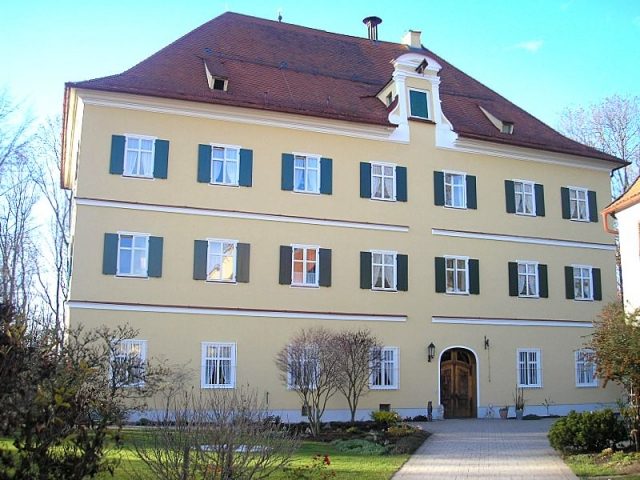
The baroque Mergenthau Castle is located about one kilometer north of Kissing in the district of Aichach-Friedberg (Swabia) on the Lechrain. The former "Tusculum" (country house) of the Augsburg Jesuits still serves as an agricultural estate. In 2006, the "Hiasl-Erlebniswelt" (Hiasl Experience World) was opened in the castle area, which focuses on the life of the poacher and robber captain Matthias Klostermayr.
The current castle estate is surrounded by the ramparts of a large High Medieval castle complex. The castle was probably built in the first half of the 11th century to protect the Welf possessions located near the city of Augsburg. The fortified complex gained particular importance due to its proximity to the Gunzenle, the legendary meeting place on the Lechfeld. The fortress was probably destroyed in 1078/79, but was subsequently repaired.
Welf VI died in 1191 as the last of his line. Part of the inheritance fell to his friend and presumed relative Udalskalk, who was then Bishop of Augsburg. The bishop handed Mergenthau over to the Prince-Bishopric of Augsburg shortly before his death.
In 1249, the episcopal castle appears as "castro nostro Mergatowe" in a document. In 1296, Mergenthau was captured and devastated during a feud between Duke Rudolf of Bavaria and the bishopric. After being relieved by Augsburg troops, the castle was rebuilt. In 1372, the Bavarians destroyed the complex again. The ruins were subsequently exploited as a welcome quarry. Farming families settled in the castle area and its surroundings, cultivating the associated land. In 1147, a Hans Meuting is mentioned. In 1561, Hans Holzkirchner received the collegiate farm in the castle site. In 1602, Wilhelm Weikmann was "Paur zu Mergenthaw" (Kissinger Urbar). "Because this farm was formerly a castle site...", the population of nearby Kissing was obliged to perform corvée labor on the farm ("Hewen, Mehen und schneiden" - mowing, scything and cutting).
In 1642/50, the property came into the possession of the Augsburg Jesuits through exchange, who leased the Mergenthau "Sedlhof". In 1695, an unspecified farm in Mergenthau was sold to a farmer from Aindling.
In 1703, the Jesuits complained that their estate in Kissing, "from which the Collegium entirely derives its livelihood... had been plundered twice by the Imperials and the Dutch/English." However, the inhabitants were able to get to safety. (War of the Spanish Succession).
The previous destructions were probably the reason for the baroque new building of the "Jesuit Castle". Construction began in 1713. Just two years later, the building was ready for occupancy. At the same time, the small castle in Kissing was built as the seat of the judge of the Hofmark.
The country house in Mergenthau cost a total of 17,455 guilders and 55 kreuzers. The design came from Hans Georg Mozart, a relative of the great composer. The original invoices are preserved through a transcript.
In 1722, a barn and a carriage house were added.
The original furnishings of the two "Bauhöfe", i.e. the country house and the small castle, are well documented by the preserved inventory. The rooms were decorated with paintings and engravings, the chapel on the ground floor (Mergenthau) had three altars and "chapel furnishings". The cellars were also richly stocked with wine, beer and other provisions. It is noteworthy that the servants' rooms were also equipped with paintings and copper engravings, and the staff also had their own kitchen. However, the beds were only provided with simple straw sacks. The most valuable piece of the former furnishings was a large painting of the Virgin Mary (2.07 x 1.43 meters) by the Augsburg master Hans Burgkmaier (around 1500). The work was still in the castle in 1865, but was sold to the art trade in 1906 and is now in a private collection in Schweinfurt. In Mergenthau, a good copy from the first half of the 19th century still commemorates the "Madonna on the Lawn Bench".
After the dissolution of the Jesuit order, the property passed to the "Pious Foundation" in Augsburg in 1773, which passed it on to the Catholic Study Fund in 1776. In 1808, the Study Fund had the furnishings auctioned off, and a year later also the buildings. Freiherr von Münch acquired the estate through exchange. In 1811, Sigmund Freiherr von Riedheim auf Harthausen is named as the owner. Subsequently, the owners changed twice more, until Andreas Samm acquired the former Jesuit castle in 1828. His descendants still manage the castle estate today. Events and markets are regularly held on the grounds. In 2006, the "Hiasl-Erlebniswelt" was set up in the economic part. The well-known poacher and robber captain Matthias Klostermayr, the "Bairische Hiasl", was born in Kissing in 1736 and served the Jesuits as a hunting assistant for two and a half years until he fell out of favor because of a carnival prank.
Architectural Description+
The castle estate is located about 20 m above the valley on a spur of the Lechleite. About 150 meters north, the ramparts of an early medieval ring fort can be traced in the terrain. The ring wall in the Ottmaringer Holz, in its last stage of expansion, was probably one of the smaller Hungarian protection castles on the right bank of the Lech, which Widukind of Corvey already mentioned in his chronicle.
The ramparts and moats of the Welf and episcopal predecessor castles of the present castle are also largely preserved. The two archaeological monuments are separated by a terrain incision and a small lake. The ramparts are up to five meters high, but are disturbed by some breaches. To the east, a neck ditch in front of the outer bailey protected the fortress; on the other sides, the terrain slopes moderately steeply. To the north and west, two presumed tower sites project in a tongue-like shape. The southern part of the former outer bailey is extended, following the terrain. Of the neck ditch between the main and outer bailey, only the southern outflow and a shallow depression are still visible.
The farm buildings almost completely enclose the area of the former core castle. An entrance gate is located in the southeast. The villa-like main building stands over the northeast corner, which can probably be explained by the reuse of the foundations of the medieval castle. Three stories are topped by a renovated hip roof. To the west, a risalit projects, which was formerly topped by a volute gable and crowned by an onion dome. The articulation is now mutilated, and the overall impression of the former show facade is rather sober. However, the view from the Lech valley is now obstructed by the forest.
The main entrance is opposite on the east side, but is not placed on the central axis, but shifted to the third northern window axis. The carved door dates from about 1770. Above it, a small, volute-decorated transverse gable breaks through the roof surface, which formerly served as a hoist. The floors are separated by cornice bands. Here on the east side, the original facade articulation is much better preserved than in the west.
Inside, remnants of the original furnishings have been preserved. The former chapel still has the original stucco decoration by Matthias Lotter from 1714. One can primarily recognize floral motifs, but also angels and putti. The ceiling fresco was created by Vitus Felix Rigl in 1769. It replaced the original painting by a "painter from Haunstetten", about whom nothing else is known. Rigl's painting shows St. Wendelin praying before the hearts of Jesus and Mary. Of particular local historical value are the depictions of the castle, the parish church, and the Burgstall chapel in the background. The preserved fresco in the main hall on the second floor also comes from the hand of the Dillingen master. Christ is depicted in the house of the rich man. The little-known Rigl proves himself to be a talented fresco painter through his two Mergenthau works, whose works also achieve a considerable decorative effect.
The grounds of the spacious outer bailey are also used for the estate. In the south there are some small animal enclosures.
The Bavarian State Office for Monument Preservation lists the earthworks of the castle's predecessor as a medieval castle site under monument number D 7-7631-0060.
The "Wichtelenloch" Earth-Stable+
Immediately next to the castle district, a branched tunnel system was discovered around 1800, dug into the solid sand of the Lechleite. The complex bears the characteristics of a typical earth-stable. Recent research sees a remotely cultic significance in the earth-stables in connection with early Christian ideas of the afterlife.
In the Kissing municipal area, three such complexes have been preserved. In addition to the "Wichtelenloch" in the "Katzensteig", the "Petersberg" and the "Kirchberg" are also undermined in this way.
The entrance to the "Wichtelenloch" had to be closed after the Second World War, as the narrow passages were a popular but life-threatening playground for the village youth. However, the earth-stable had already been scientifically examined and recorded several times in the 19th century.
The entrance tunnel is only about 0.60 to 1.10 meters high. An invading enemy could therefore only move forward by crawling or stooping. After about 15 meters, one can stand upright. The passage here is up to 1.76 meters high and one meter wide. Shortly before its end, a side passage, about 15 meters long, branches off to the north. Two other short side tunnels behind the entrance end in small chambers. Some light niches are incorporated into the side walls.
Take Mobile History with you
You are reading this text for free. Premium adds what matters on the road: descriptions read aloud, sites found through your camera, whole regions taken offline.
- Every description, including the ~17,700 Premium sites
- Audio guide: have descriptions read to you on location
- AR finder: see sites through your camera, with distance and bearing
- Unlimited saved sites
14 days free, then from €2.99 a month. Cancel anytime.
Source: Wikipedia · Licence: CC BY-SA 4.0 · Image: https://commons.wikimedia.org/wiki/File:Schloss_Mergenthau_3.jpg
This description draws on the facts documented in the linked Wikipedia article; Wikipedia content is licensed under CC BY-SA 4.0. Wording and editing: Mobile History.
Location: 48.3145, 10.9945