To be privately owned
CastleMaria Saal-Possau
Meiselberg Castle
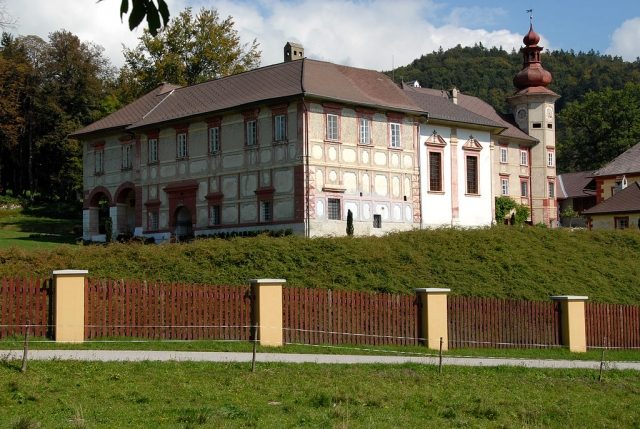
Meiselberg Castle is a castle near Maria Saal in Carinthia, presumably built in the 16th century. The building is currently privately owned and not publicly accessible.
The exact time of its construction and the builder of the castle are unknown. Under Hans Christoph von Metnitz, who bought the castle from the heirs of Hieronymus von Meiselberg in 1595, the castle was expanded in the 17th century. It changed hands several times and in 1694 came into the possession of Hans Adam Stampfer von Walchenberg, a member of a wealthy mining family from Öblarn. His descendants had the castle renovated and rebuilt in the Baroque style in the 18th century. The castle passed to Dismas Graf Christalnigg in 1793, whose descendant sold the estate to Marie Gräfin Wydenbruck in 1919. Since her niece Marie Therese Fürstin Hanau received the castle in 1941, it has been owned by the Hanau-Schaumburg family.
Architecture+
The multi-story castle has an irregular, horseshoe-shaped floor plan. Parts, such as the three-story corner tower with an onion dome or two facade turrets, date back to the 16th century, while the wing extensions were created in the 17th and 18th centuries. Special features of the exterior design include an arcaded walkway and the color scheme of the facades, which are partly marbled.
In the castle's great hall, there is a ceiling painting by Josef Ferdinand Fromiller depicting Abel's death.
Trinity Chapel+
A small Holy Trinity Chapel was added to the castle as early as 1700, featuring an altarpiece depicting the Resurrection of Christ. A ceiling painting by Anton Zoller and a Trinity group from 1710, as well as stucco work by Kilian Pittner, adorn the chapel. It also serves as a burial place for the castle owners and their family. Among others, Countess Minky von Wydenbruck, owner from 1919, the Counts Christalnigg, and Countess Paula Vojkffy, who took her own life at Meiselberg Castle in 1886, are buried in the chapel. The castle chapel also contains the remains of Princess Nora Fugger, née Princess von Hohenlohe-Bartenstein, who became particularly known for her impressions from the time of the Austro-Hungarian monarchy "In the Splendor of the Imperial Era" and was a well-known salonnière in late 19th-century Vienna alongside Princess Pauline Metternich.
Take Mobile History with you
You are reading this text for free. Premium adds what matters on the road: descriptions read aloud, sites found through your camera, whole regions taken offline.
- Every description, including the ~17,700 Premium sites
- Audio guide: have descriptions read to you on location
- AR finder: see sites through your camera, with distance and bearing
- Unlimited saved sites
14 days free, then from €2.99 a month. Cancel anytime.
Source: Wikipedia · Licence: CC BY-SA 4.0 · Image: http://commons.wikimedia.org/wiki/File:Maria_Saal_Moederndorf_Schloss_22092006_33.jpg
This description draws on the facts documented in the linked Wikipedia article; Wikipedia content is licensed under CC BY-SA 4.0. Wording and editing: Mobile History.
Location: 46.7037, 14.3806