Municipal offices
CastleMattighofen
Mattighofen Castle
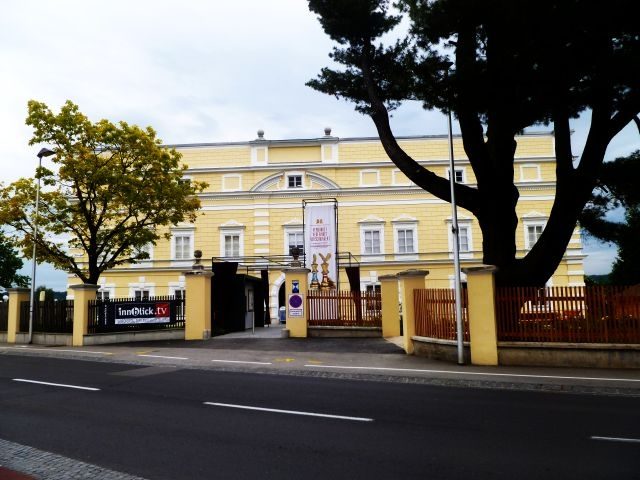
Mattighofen Castle is a former castle and current palace in the municipality of Mattighofen in the Upper Austrian district of Braunau am Inn. Construction dates back at least to the 8th century. Today, the building is used for public purposes.
The castle, located at the northern end of Mattighofen's town square, was first mentioned in a document in 788 as Matagao. On its site was an Agilolfingian ducal manor, which was taken over by the Carolingians after the Agilolfingians were deposed as Bavarian dukes. In 1007, King Henry II gifted the castle with the entire Mattiggau to the Diocese of Bamberg. The building served as accommodation for the administrators. In 1400, the area and with it the castle came under the rule of the Kuchler family. After their extinction in 1438, it again became the property of the Bavarian dukes. On October 10, 1459, Knight Jan Holub was enfeoffed with the castle and the associated jurisdiction. After the extinction of the Holub family, in 1517 Count Christoph von Ortenburg, who had already married the heiress Anna in 1514/15, acquired the castle, which had reverted to the Bavarian duke, for 4500 guilders. Their common son Joachim had it converted into a Renaissance castle in 1551. During this time, the castle building received four corner towers. In the same year, a brewery was also established in the castle. Due to several fires and later alterations, little today reminds of these former building activities. From this renovation, a brick door frame with the double coat of arms of Ortenburg-Fugger can still be found at the right entrance. Originally, this served as access to the inner attic. The inscription on the door frame reads:
“Joachim Grave zv Ortenburg etc. Vrsvla Gräfin zv Ortenburg geporene goggerin Freiin zv Khirchperg vnd Weissenhorn sein Gemachel MDLI”
Another door frame, which was once in the castle, is now the entrance portal of the Klampfer Chapel in Reitsham near Lochen. According to its inscription, this refers to Count Christoph and his two wives. Furthermore, a damaged architrave for Count Joachim is still immured in the castle entrance.
In a niche of the entrance, there is also a fragment of a Roman tombstone from the 2nd century. It shows a sacrificial servant with an incense box and a grieving genius.
Two years after Joachim's death, the Counts of Ortenburg sold the lordship of Mattighofen in 1602 for 102,000 guilders to the Bavarian dukes. From then until the Peace of Teschen, which brought the Innviertel to Austria, the castle and lordship were, with brief interruptions, in Wittelsbach hands. The Bavarian dukes had the castle and lordship administered by stewards, who resided in the castle.
After the flight of Elector Max Emanuel, Mattighofen Castle and lordship fell to the imperial council Gundacker von Starhemberg in 1710. In 1794, the castle and its associated grounds were sold to the brewer Jakob Haidenthaler, who converted it into a brewery. In 1796, the castle was repurchased. In 1799, the building was remodeled in the Italian style, losing its castle-like character and largely acquiring its present appearance. The corner towers visible in Michael Wening's engraving were removed, the moats were filled in, and the drawbridge, which had been preserved until then, was removed. With the purchase of the Kobernaußerwald in 1868, Mattighofen Castle also came into the possession of the Habsburg family fund, who had it converted into an imperial hunting lodge. The Imperial and Royal Tax Office, which had been housed in the castle until then, was relocated to a house on the town square (today Stadtplatz No. 13). In addition to the rooms for the owners, the forest administration was also housed in the castle.
In the 20th century, ownership changed frequently, which was related to the ownership of the Kobernaußerwald. From 1918 to 1938, the War Victims' Fund owned the castle, during the National Socialist era it belonged to the German Imperial Forests, and after the end of World War II, to the American occupation forces. From 1947, the Austrian Federal Forests were the owners of the castle.
In 2007, the city of Mattighofen bought the building. In 2012, it became one of the three venues for the Bavarian-Upper Austrian State Exhibition "Allied - Antagonistic - Related", which also had other venues in Burghausen Castle in Bavaria and Ranshofen Monastery in Braunau am Inn. Even before the state exhibition, it was considered to move the city administration into the castle and to build an event hall. Since June 17, 2013, Mattighofen's city administration has been located on the first floor of the castle.
Take Mobile History with you
You are reading this text for free. Premium adds what matters on the road: descriptions read aloud, sites found through your camera, whole regions taken offline.
- Every description, including the ~17,700 Premium sites
- Audio guide: have descriptions read to you on location
- AR finder: see sites through your camera, with distance and bearing
- Unlimited saved sites
14 days free, then from €2.99 a month. Cancel anytime.
Source: Wikipedia · Licence: CC BY-SA 4.0 · Image: http://commons.wikimedia.org/wiki/File:Schloss_Mattighofen-1.jpg
This description draws on the facts documented in the linked Wikipedia article; Wikipedia content is licensed under CC BY-SA 4.0. Wording and editing: Mobile History.
Location: 48.1056, 13.1500