To be privately owned
CastleMassenheim
Massenheim Castle
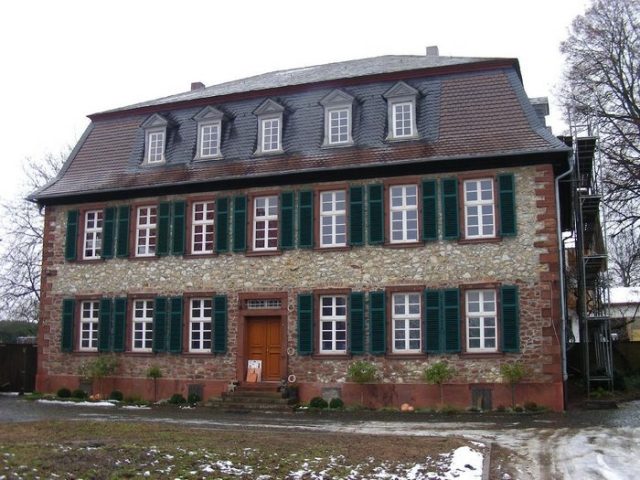
In 1412, the estate is first mentioned as the "Hofhaus des Königsteinschen Lehen" (Court House of the Königstein Fief) in the possession of the Wolf von Todenwart family. It was a single-story residential building with farm buildings surrounded by a wall, parts of which are still present today.
1575 Change of ownership to the Eisenberger von Ortenberg family. Their daughter Anna Elisabeth married the nobleman Konrad Nikolaus von Kellenbach, who sold the estate to the Penz von Penzen family.
1758 The estate came into the possession of Forester Walther. He expanded the estate with its lands and presumably also added a story to the residential building.
1774 After considerable enlargement, his widow sold the property for 11,500 Gulden to Prince Friedrich von Anhalt – Köthen after his death. He left it to his sister Maria-Magdalena as a permanent residence. Until her untimely death in 1783, she performed many good deeds in the community. The community gave her a dignified grave in the central aisle of the church.
1802 Philipp Franz Freiherr Knebel von Katzenellnbogen sells his estate, belonging to the Middle Rhenish Knighthood, to Freiherr Ludwig Christian von Fechenbach in Sommerau and his wife Sophie, née Freiin von Brabeck, for 39,000 Gulden.
1803 Excerpt from the Frankfurt Court Cadastre. Sophie von Fechenbach, née von Brabeck, acknowledges before Mayor Johann Nikolaus Olenschlager in Ffm to have received the sum of 3600 Gulden from him and 7400 Gulden from Dr. jur. Carl Friedrich Starck, totaling 11,000 Gulden, and to have mortgaged her noble estate in Massenheim for it.
1818 Baroness Sophie von Fechenbach sells the estate to Jacob Borkholder from Mosbach (Wiesbaden).
1830 Jacob Borkholder's daughter, Katharina Borkholder, married Carl Friedrich Wilhelm Müller from Niedernhausen in 1830 and took over the property in 1860. Müller = member of the Chamber of Deputies as a landowner. Müller was a tenant farmer on the Kreidelschen Hofgut near Massenheim; this is how the castle was sometimes called. Field names like Kreidelwiesen still indicate this today. The 9 financially strongest businesses were selected for the chamber.
1869 The estate passes to his son Ferdinand Müller. After his death, his 6 children inherited the property. Their mother married the administrator Weber in a second marriage. The same Weber bought the Massenheim Mill (Wickerbachmühle) in 1880.
1920 The heirs of Ferdinand Müller sell the estate to the Götz von Schwanenfließ family.
1926 The castle went to the banker Artur Levita from Wiesbaden. Among other things, he ran a nursery and trained Massenheim residents in this profession.
1932 The property was bought by the Desor family and taken over in 1934. They operated fruit growing and had a custom pressing facility. From 1940 - 45, the castle was used as a labor service camp for the BDM, from 1945 until the 1950s, the textile company Junkermann established a production facility there, manufacturing dolls, among other things.
2009 A Geis family took over the property and rebuilt the side wing. Activities in the field of elderly care will soon be developed there.
Source Text: http://www.massenheim.eu
Take Mobile History with you
You are reading this text for free. Premium adds what matters on the road: descriptions read aloud, sites found through your camera, whole regions taken offline.
- Every description, including the ~17,700 Premium sites
- Audio guide: have descriptions read to you on location
- AR finder: see sites through your camera, with distance and bearing
- Unlimited saved sites
14 days free, then from €2.99 a month. Cancel anytime.
Source: Wikipedia · Licence: CC BY-SA 4.0
This description draws on the facts documented in the linked Wikipedia article; Wikipedia content is licensed under CC BY-SA 4.0. Wording and editing: Mobile History.
Location: 50.0406, 8.3845