Museum
CastleLahnstein
Martinsburg Castle
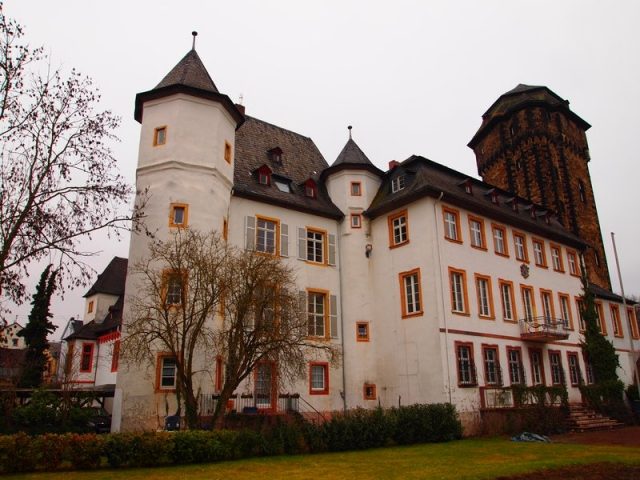
Martinsburg Castle, also simply called Martinsburg, is a castle complex in Lahnstein. It was built in 1298 as a toll castle by the Archbishops of Mainz and was originally named Burg Lahnstein. The Archbishop of Mainz built this complex simultaneously with the city wall in Lahnstein, and it is one of the few undestroyed castles on the Middle Rhine. Today it is privately owned and houses apartments and offices, a carnival museum, and a mint.
Martinsburg was built at the end of the 13th century as a base for exercising Mainz's customs rights. Since 1292, the Electorate and Archbishopric of Mainz had secured shares in the Boppard imperial toll with the permission of King Adolf of Nassau. Since the Electoral Mainz castle of Lahneck stood on a hill some distance from the Rhine, a solid building was erected directly on the Rhine to secure the collection of tolls. Probably a fortified building, mentioned in a document in 1244, already stood at this location in the middle of the 13th century to monitor shipping.
The oldest parts of the castle consist of a rectangular residential tower with two corner towers, as well as the foundations of the hexagonal main tower in the south of the complex. The 28-meter-high keep that stands here today was built around 1400 and has an adjoining stair and latrine tower.
In connection with the construction of the city wall of Oberlahnstein after 1324, Martinsburg was also expanded. It formed the southwestern corner point of the city's fortifications. Towards the city, the lowland castle was secured with a moat and a solid gate, where a machicolation is still visible today. From such structural elements protruding over the castle gate, attackers could be doused with hot pitch or oil. The fortification towards the city was necessary because the city could be conquered by enemies, and the castle would then remain the last refuge for the Mainz officials. However, an uprising of the city population against their episcopal-electoral lords was not necessarily ruled out. As a city castle of the economically thriving Oberlahnstein, it housed the customs clerk and customs staff, porters and tower guards, as well as other auxiliary personnel.
The moated castle was never destroyed, but it was altered by additions and conversions until the end of its affiliation with Electoral Mainz in 1803. For example, the northwest wing was added as early as the 14th century, followed by the current southeast wing in 1497. Between 1719 and 1721, the gap that still existed on the Rhine side between the medieval residential tower and the keep was closed by a three-story central building in the Baroque style.
As an occasional secondary residence of the Mainz Electors, Martinsburg Castle was able to far surpass Lahneck Castle in importance since the end of the Middle Ages.
Take Mobile History with you
You are reading this text for free. Premium adds what matters on the road: descriptions read aloud, sites found through your camera, whole regions taken offline.
- Every description, including the ~17,700 Premium sites
- Audio guide: have descriptions read to you on location
- AR finder: see sites through your camera, with distance and bearing
- Unlimited saved sites
14 days free, then from €2.99 a month. Cancel anytime.
Source: Wikipedia · Licence: CC BY-SA 4.0 · Image: http://www.wehrbauten.de/thread.php?threadid=932
This description draws on the facts documented in the linked Wikipedia article; Wikipedia content is licensed under CC BY-SA 4.0. Wording and editing: Mobile History.
Location: 50.2975, 7.6056