Uninhabited
CastlePotsdam-Marquardt
Marquardt Castle
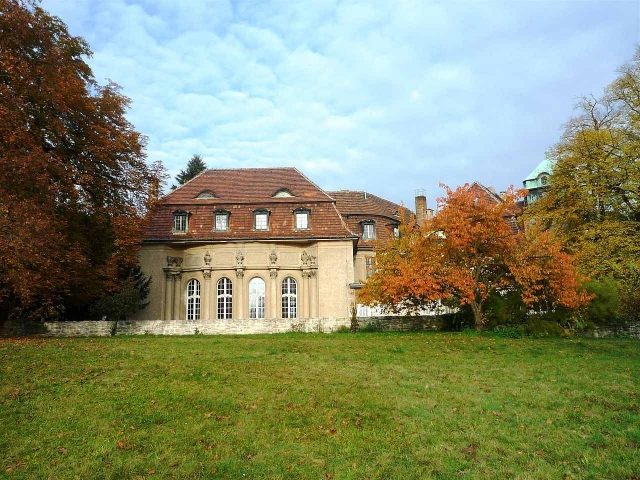
The town and Marquardt Castle are located about 15 km northwest of Potsdam city center on the Wublitz, a right tributary of the Havel. The castle park borders the Schlänitzsee. Since a municipal reform in 2003, Marquardt has been a district of Potsdam. The castle has a checkered history as a residence or summer retreat for noble or upper-class owners, as well as, among other things, a hotel, military hospital, and university institute. Currently (end of 2011), it stands empty and is only occasionally partially rented out.
Noble Residence+
Archaeological finds attest to an Old Slavic fishing settlement at this location as early as the 9th century. The original place name Skoryn (Old Slavic, later Germanized to Schorin) was first mentioned in a document in 1313. The ownership of the associated manor or stately home has been continuously known ever since. Since 1375, there were two manors in the village, with changing family ownership. In 1660, Moritz Andreas von Wartenberg bought both manors and formed a knight's estate from them. One of the manor houses was developed into the stately home, while the other served as the seat of the estate administration. The manor house at that time, later the castle, consisted of one floor of normal height and a half-story above it.
The last of the von Wartenberg family died in 1704 without descendants. The next owner and feudal lord was Marquard Ludwig von Printzen (1675-1725), who, as a busy statesman – he was, among other things, a Privy State and War Councillor and Director for Feudal Affairs – rarely stayed on his estate. At his request, King Frederick I allowed him to rename the property after his first name. As early as 1708, the Baron sold the now Marquard estate again, after which Carow (today's Karow near Genthin) with its castle, church, and hereditary burial became his family seat.
Between 1708 and 1781, Marquard was owned by the von Wyckersloot family, who had moved from the Lower Rhine. By royal decree of 1763, silkworm breeding was carried out on the then considerably enlarged property. A mulberry plantation was established for this purpose northeast of the manor house. In the third generation, the family was so heavily indebted that they had to sell Marquard at a loss. Regarding the subsequent development, Theodor Fontane (1819-98) noted in the Havelland volume of his Wanderungen durch die Mark Brandenburg (1862-89) that the previously inconsistent ownership had changed so frequently that ... we see Marquardt in the hands of four different families in the short period from 1781 to 1795. The proximity of Potsdam played a role in this. Those close to the court, or those out of service who found it difficult to withdraw completely from the sun, preferred the nearby localities. Among these was Marquardt. Courtiers acquired it, took their villeggiature (It.: recreational stay in a rural setting) here, and sold it again. A large fire in 1791 destroyed several farms in the village, but also large parts of the manor house and the associated farmyard.
In 1795, General Hans Rudolf von Bischoffwerder (1741-1803), a close confidant and advisor to King Frederick William II (1744-1797), became the new owner of Marquard. Marquard now briefly became the scene of a bizarre episode in Prussian history. Throughout his career as a soldier and in various state offices, Bischoffwerder had felt drawn to occult phenomena – a not uncommon inclination at the time. In 1779, he joined the Order of the Rosicrucians, a mystical-religious secret society that was directed against current Enlightenment endeavors. Together with Johann Christoph von Woellner, another high-ranking Rosicrucian, he was able to win over the Prussian Crown Prince Frederick William (II) as a member of the Order in 1781 and influence him in the spirit of the secret society, even after he was crowned king in 1786. At Marquard, Bischoffwerder had the so-called Blue Grotto set up in a tree-covered hill, a room with unusual light and color effects and with double walls. There – as well as in other places – the Rosicrucians held spiritualistic sessions in the presence of the frivolous and credulous king, with apparent ghost voices and other simulated supernatural phenomena. A later owner of the castle had the grotto demolished between 1860 and 1870 due to dilapidation. Its exact location can no longer be determined today.
Bischoffwerder enlarged his property through acquisitions. He is said to have had a good relationship with his farmers, reducing taxes and demanding fewer team services than was previously customary. After 1795, he had the area on the lakeshore designed as an English landscape park. In 1823, his son arranged for the park to be redesigned again according to a sketch by Peter Joseph Lenné. In 1843, the then pastor changed the spelling of the place name – Marquard became Marquardt. Theodor Fontane stayed here a total of three times and referred to the manor in his descriptions for the first time as "Schloss Marquardt" (Marquardt Castle).
Bourgeois Owners+
After a long period as a noble residence, Marquardt passed into the possession of a commoner in 1860. In 1862, the local clergyman noted that through Paul Tholuck, the new estate owner, who "...only introduces steam engines and other machines into the quiet and peaceful Marquardt, all poetry and idyll were destroyed. (...) Only the principle of utility now prevails, and everything depends on profit, on the purse. (...) Instead of the gentry, there were uneducated, arrogant, and immoral inspectors...".
The next owner in 1870 was Kommerzienrat Carl Meyer, a representative of the Essen-based company Krupp in Berlin, who had the castle rebuilt in 1879/80 as a two-story building with seven window axes. Meyer was followed in 1892 by Louis Auguste Ravené (1866-1944) as owner. He was a descendant of Huguenot refugees who had come from France to Berlin and had amassed great wealth through wholesale trade in steel and iron, especially during the expansion of German railway networks in the 19th century. He and his family mainly inhabited Marquardt during the summer months. Ravené initiated further extensive structural changes: First, the building from 1879/80 was extended upwards and expanded into an L-shaped structure; a tower was added, and terraces were created on the north and east sides. In a second phase of renovation in 1912/13, an entire wing with an oval ballroom and a large-windowed neo-baroque facade was added to the northwest. Various smaller additions and decorative elements such as putti and neo-rococo ornaments were also added. Ravené had the park extended and altered in places. At the 1897 World Exhibition in Brussels, he acquired the elaborately designed wrought-iron park gate. Around 1900, he endowed the new construction of the nearby Protestant village church, where he is buried. The architectural ensemble of that time has largely been preserved to this day.
In 1932, Ravené leased the castle to the hotel company Kempinski. The "Hotel Schloss Marquardt" with ten single and 14 double rooms, several paneled restaurants, tea and wine rooms, and terraces with views of the lake and park, developed into a popular excursion destination, especially for wealthy Berliners.
Second World War and Post-War Period+
The businesses of the Kempinski group were "Aryanized" by the National Socialists in 1937. Aschinger AG Berlin initially continued hotel operations in Marquardt until the complex was confiscated at the beginning of the war in 1939 and declared a reserve hospital. The restaurant remained in limited operation. In March 1942, Louis Ravené sold the property, i.e., the plots of land and all buildings located on them, in particular the castle, (...), greenhouse, garden house, distillery building, forge, garage with two apartments, ice cellar, bowling alley, and other buildings to Aschinger AG.
The Soviet Red Army occupied Marquardt on April 25, 1945. The military hospital was dissolved, and the Aschinger businesses were confiscated and soon thereafter expropriated. In the first post-war years, refugees from the formerly German territories east of the Oder temporarily found accommodation in the castle and its outbuildings. Potatoes and vegetables were grown on the larger park areas. Various users followed for the properties and buildings: a school for the deaf, the Oranienburg Horticultural School (until 1949), an experimental station for agrobiology (until 1951), various scientific institutions for fruit growing and fruit breeding. The last legal entity before the end of the GDR was the LPG Obstproduktion Marquardt since 1986.
After 1989+
In 1993, the "Esplanade" hotel group founded a "Schlosshotel Marquardt GmbH & Co. KG" and planned a new hotel building on the estate. After these plans failed, the federal government temporarily had an option on the castle. In 1998, a Munich real estate management company acquired the properties from TLG Immobilien GmbH, a subsidiary of the Treuhandanstalt. Meanwhile, the castle has been empty for a long time. The ballroom and some adjoining rooms can be rented for private events. After roof repairs and the removal of dry rot, users or buyers are currently (December 2011) being sought. The park, which, like the castle, is a listed building, must remain publicly accessible in the future.
An international summer exhibition of contemporary art titled "Rohkunstbau" (it first took place in 1994 in a shell construction hall in the Spreewald) has been located at Marquardt Castle since 2009. Since 1998, the castle and its surroundings have been the setting for filming for at least twenty film and television productions or music videos.
Take Mobile History with you
You are reading this text for free. Premium adds what matters on the road: descriptions read aloud, sites found through your camera, whole regions taken offline.
- Every description, including the ~17,700 Premium sites
- Audio guide: have descriptions read to you on location
- AR finder: see sites through your camera, with distance and bearing
- Unlimited saved sites
14 days free, then from €2.99 a month. Cancel anytime.
Source: Wikipedia · Licence: CC BY-SA 4.0 · Image: http://commons.wikimedia.org/wiki/File:Marquardt,_Schloss,_2.jpg?uselang=de
This description draws on the facts documented in the linked Wikipedia article; Wikipedia content is licensed under CC BY-SA 4.0. Wording and editing: Mobile History.
Location: 52.4579, 12.9631